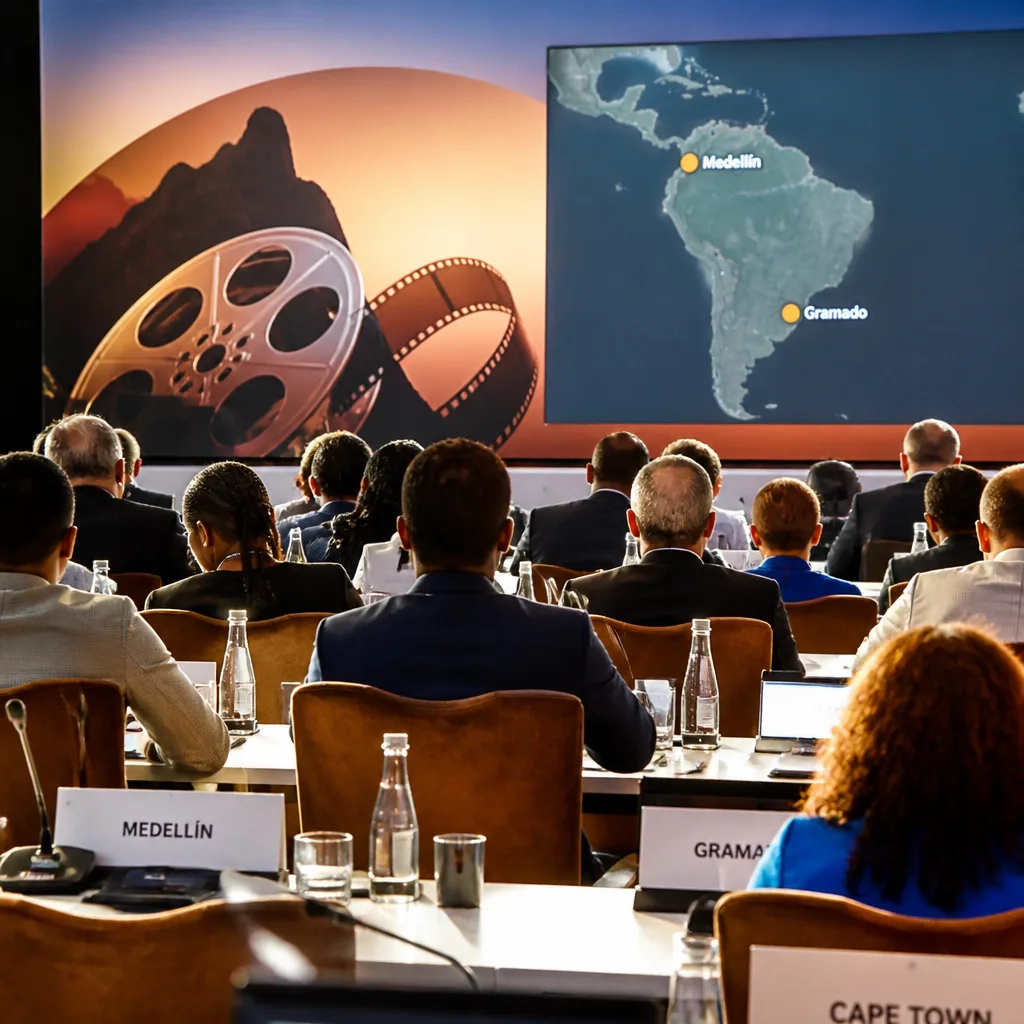
The Gramado Film Market will host the First International Meeting of Cities from 12–14 August, bringing municipal authorities from across Latin America together with executives from major film and streaming companies to examine how the creative economy — in particular the audiovisual sector — can support social and economic development.
From Medellín to Gramado: urban transformation through the audiovisual sector
Organisers said the meeting will feature presentations from Medellín, Colombia — a city of about 2.4 million residents — and Gramado, Brazil, a mountain tourist town of roughly 40,000 people. Medellín’s delegation will include Maria Fernanda Galeano Rojo, the city’s secretary of economic development, and Karla Valderrama, coordinator of Medellín’s film commission, who will outline the Colombian city’s experience in urban transformation, innovation and attracting audiovisual productions.
Ralfe Cardoso, general coordinator of the Gramado Film Market, said the festival’s long history has been central to Gramado’s emergence as a leading domestic tourism destination. According to Cardoso, the festival’s record — now at 54 consecutive annual editions — helped make Gramado Brazil’s second tourism destination after Rio de Janeiro.
“The growth of tourism in Gramado is connected to the film festival,” Cardoso said. “It all began 54 years ago. Gramado today ranks as the country’s second tourism destination, behind only Rio de Janeiro. The film festival created that. It’s interesting, because it’s something that began with art.”
The three-day forum forms part of the Gramado Film Market’s wider programme, which this year includes panels and pitching sessions. Organisers said executives from major companies will participate, signalling industry interest in city-led strategies for fostering production and local development.
- Participating companies named by organisers include: Amazon MGM Studios, Globo Filmes, Globoplay, Downtown Filmes, H2O Films, Vitrine Filmes and O2 Filmes.
- Focus areas include: municipal strategies to attract productions, links between cultural events and tourism, and how film-led activity can drive social and economic outcomes.
- Format will combine panels and pitching sessions at the Gramado Film Market forum.
Why South African readers should watch Gramado
Although the meeting is centred on Brazilian and Ibero‑American experiences, its themes resonate for cities and regions worldwide considering how to mobilise cultural assets for development. South Africa’s film industry, its cities and tourism economy are all engaged in debates about incentives, local skills and the extent to which festivals and production can catalyse wider urban benefits. The Gramado programme offers concrete cases — both a large metropolitan transformation in Medellín and a long‑running festival’s role in reshaping a small tourist town — that may inform policy makers, festival organisers and industry stakeholders elsewhere.
By convening municipal leaders alongside streamers and distributors, the Gramado meeting signals a recognition that attracting audiovisual investment requires coordinated public‑private engagement: destination planning, incentives and local capacity to host productions, as well as sustained cultural programming that can anchor tourism.
| City / Entity | Noted for |
|---|---|
| Medellín | Urban transformation, attracting audiovisual production (population ~2.4 million) |
| Gramado | Tourist destination shaped by a 54‑year film festival (population ~40,000) |
The Gramado Film Market’s inclusion of major industry players — from global studios to national broadcasters and independent distributors — highlights the commercial dimension of the discussions. For cities aiming to translate cultural activity into jobs and investment, access to commissioning and distribution partners is a key piece of the puzzle the meeting seeks to address.
Delegates and attendees can expect case studies, policy discussion and opportunities to pitch projects to companies active in Latin America’s dynamic audiovisual market. For international observers, the event will be an occasion to compare models for leveraging festivals, production incentives and city branding to broader development goals.
As national and municipal leaders weigh how best to support creative industries, forums such as Gramado’s offer tested examples of the links between culture, tourism and economic strategy — and a reminder that sustained cultural programming can have long‑term impacts on a place’s identity and economic prospects.