
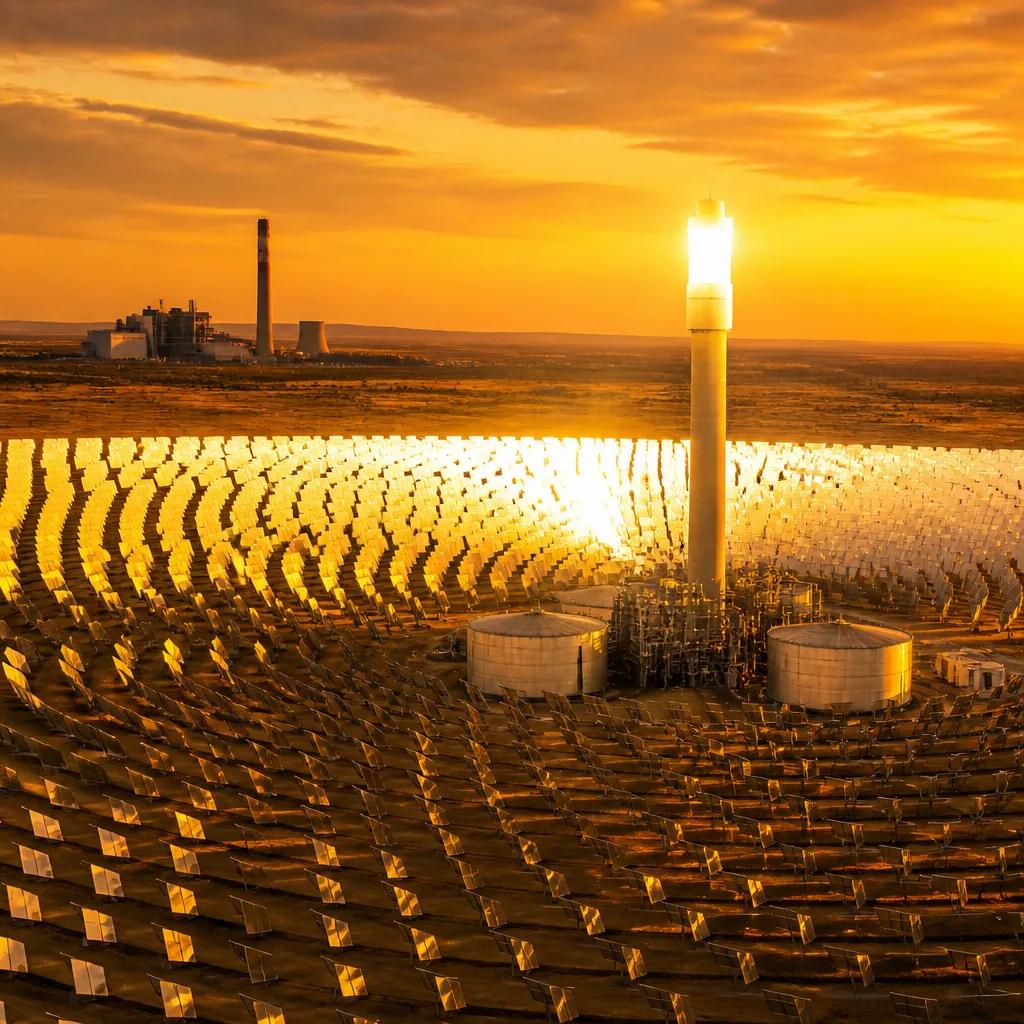
South Africa has among the world’s best conditions for a type of solar generation that can deliver power after sunset, but the technology has been sidelined in recent energy planning decisions. Concentrating solar power (CSP) uses mirrors to concentrate direct sunlight into heat, which produces steam to drive a turbine — and crucially, that heat can be stored for dispatch when the sun has set.
Why CSP matters for the grid
Coal currently supplies 74% of South Africa’s electricity. As the country plans to retire coal-fired power stations over the next two decades, it must replace a large, continuous supply of baseload and flexible generation. Photovoltaic (PV) panels produce cheap daytime electricity, but CSP offers an alternative that can be scheduled and stored, addressing the mismatch between solar production and evening demand.
The director of Stellenbosch University’s Solar Thermal Energy Research Group, writing in The Conversation, argues that South Africa has a comparative advantage for CSP because of its dry climate, clear skies and low cloud cover. Those conditions produce high direct normal irradiance (DNI) — sunlight that travels straight from the sun and can be concentrated to very high temperatures. South Africa’s DNI is said to be second only to Chile’s Atacama Desert.
What was built, and what stopped
Private developers, through the government’s renewable energy programme, built several CSP plants that now generate about 600 megawatts. That capacity is roughly equivalent to the annual electricity needs of 350,000 to 400,000 average three-bedroom homes.
Yet plans to expand CSP were scaled back and no new CSP projects have been approved since 2014. The Conversation piece contends that policy choices prioritised cheap daytime electricity over reliable, dispatchable supply — a misalignment that reduced support for CSP despite its system benefits.
- Technology difference: PV converts sunlight directly to electricity; CSP concentrates direct sunlight to generate heat and steam.
- Storage: CSP can store thermal energy, allowing power generation after sunset without batteries.
- Resource suitability: South Africa’s interior offers high direct normal irradiance, making it technically well suited for CSP.
Implications for policy and planning
The shift away from CSP affects how the system will cope with coal plant retirements and ongoing reliability challenges. CSP’s ability to deliver scheduled, dispatchable power could reduce reliance on costly battery storage or fossil-fuel peaking plants if integrated at scale. The decision to favour cheaper daytime PV has practical consequences: it can lower daytime tariffs but leaves a larger evening ramp that must be met by other capacity.
Choosing technologies solely on unit-cost-per-megawatt-hour without accounting for flexibility, storage needs and grid integration risks storing up system costs elsewhere — in the form of increased balancing, transmission upgrades, or emergency generation.
| Characteristic | Photovoltaic (PV) | Concentrating Solar Power (CSP) |
|---|---|---|
| Primary output | Electricity from panels | Heat converted to steam & electricity |
| Storage | Requires batteries | Thermal storage possible (dispatchable) |
| Best resource | General sunlight | High direct normal irradiance (clear, dry climates) |
What this means for South Africans
Decisions about which renewable technologies to support affect electricity reliability, job creation in construction and operations, and where investment flows. CSP plants are capital intensive but can provide predictable output and local manufacturing opportunities for mirror fields, heat-transfer systems and thermal storage components.
As coal plants retire, policymakers must balance short-term cost pressures with long-term system resilience. The Conversation author, who has modelled CSP integration and its construction costs, warns that undervaluing dispatchable solar leaves South Africa with more complex grid integration challenges down the line.
The debate is not whether solar should grow — it already has — but which forms of solar and storage the country will back as it reshapes its power system for a post-coal future.










