
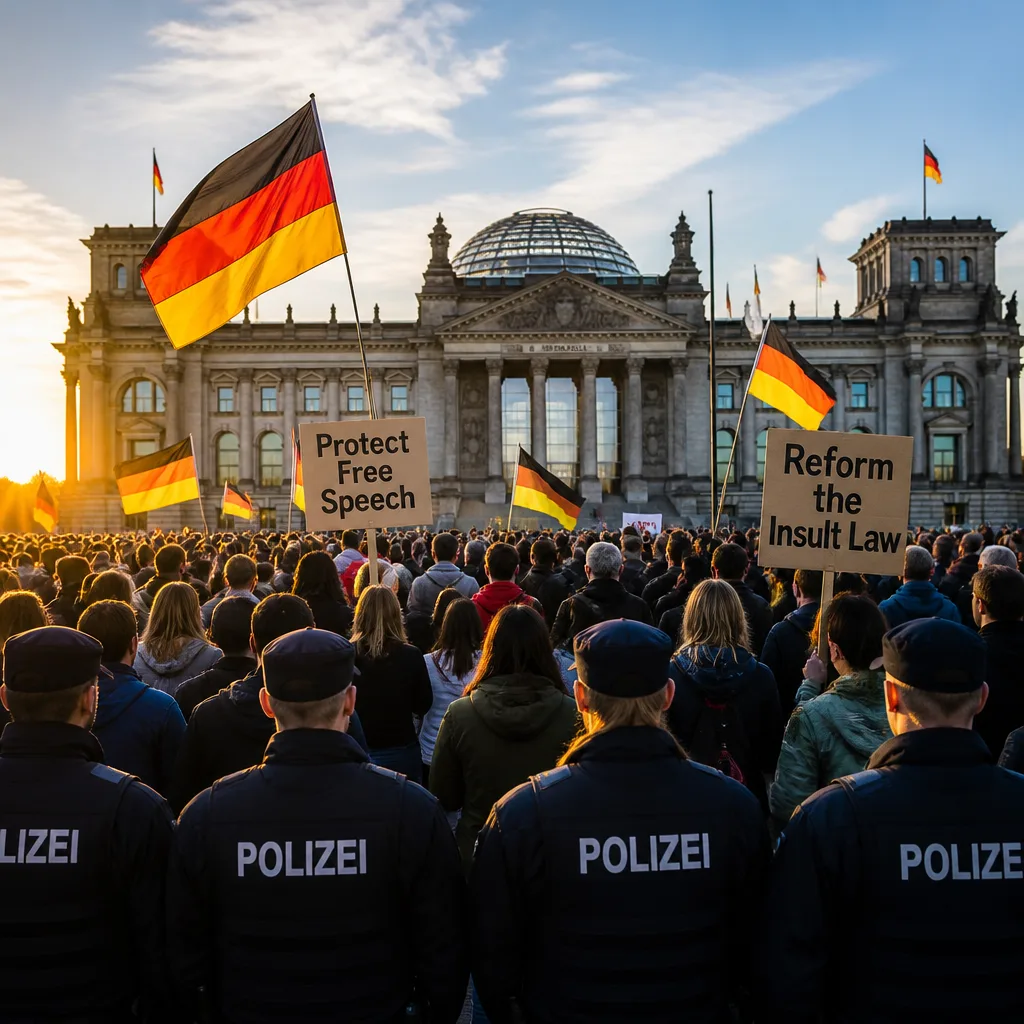
Germany’s mainstream and fringe parties have converged on an uncommon point of agreement: a statute that criminalises insults directed at politicians requires revision. The shift follows controversial probes into citizens who mocked Chancellor Friedrich Merz, calling him “Pinocchio” and “Lying Fritz”, which critics say gave politicians special legal protection and raised concerns about free political debate.
Broad consensus, narrow comfort on details
Lawmakers across the political spectrum told POLITICO they accept the need to change the law, but they differ sharply on the scope of reform. The centre-right Christian Democratic Union (CDU), the Greens and the centre-left Social Democratic Party (SPD) favour revising the rule. By contrast, the far-left Left Party and the far-right Alternative for Germany (AfD) want the provision abolished entirely.
- CDU and allied ministers argue for narrowing the law’s reach to its original purpose: protecting local office-holders who face particularly harsh personal attacks.
- Greens and SPD support revision but have not settled on precise wording or timing.
- Left Party and AfD call for abolition, arguing politicians must tolerate hard criticism.
Those who favour a narrower rule stress that robust criticism of federal and state political decisions is fundamental to democratic life and must be preserved. As Moritz Oppelt, the CDU justice minister in Baden-Württemberg, put it, federal and state leaders “can and must be able to withstand tough criticism.”
“We take seriously the criticism that, in practice, it may have created the impression of a special legal privilege for politicians,” said Susanne Hierl, a lawmaker from the CDU.
Origins and the argument for reform
According to the reporting, the contested provision was originally framed to protect local politicians, who often encounter intense, personalised hostility. CDU lawmakers now acknowledge the provision has been read and applied more broadly than intended, producing the perception — if not the reality — of a privileged legal status for office-holders.
Opponents of the law’s current form argue that senior politicians, including the chancellor, belong in a public square where harsh language and sharp mockery are part of political contestation. Luke Hoss of the Left Party pointed to comments by Merz that labelled some citizens “lazy” or “malingerers”, saying the special offence that applies only to politicians should be abolished.
Who benefits, who pays
Any change will have clear winners and losers. Narrowing or removing the law would benefit citizens, activists and satirists who risked criminal investigation for mocking high-profile figures. It would also relieve state prosecutors and police of politically sensitive cases that drew public criticism.
Conversely, local councillors and municipal politicians who face particularly toxic abuse could lose a legal protection that was originally intended to shield them. The CDU’s case for reform is explicitly framed to protect this cohort while preserving free speech on matters of state policy.
| Party | Position on the law |
|---|---|
| CDU | Revise—limit to local politicians |
| Greens | Revise |
| SPD | Revise |
| Left Party | Abolish |
| AfD | Abolish |
At stake is more than legal text. The debate tests how democracies balance protection from personal abuse with the need for vigorous, even acidic, political discussion. Politicians who are accustomed to being the subject of satire may decide it is better to face ridicule than to be seen as using criminal law to silence dissent.
For now, agreement that change is needed does not mean an easy legislative fix. Parties agree on the problem; the disagreement is over remedy and timing. That means the issue could linger as a political question through the parliamentary calendar, with reform shaped as much by tactical calculations as by principle.
What comes next will reveal which political actors prioritise institutional protection for office-holders and which place a higher premium on unfettered public debate. Either way, the row in Berlin will be watched by democracies elsewhere wondering how to draw similar lines between insult, offence and political critique.












