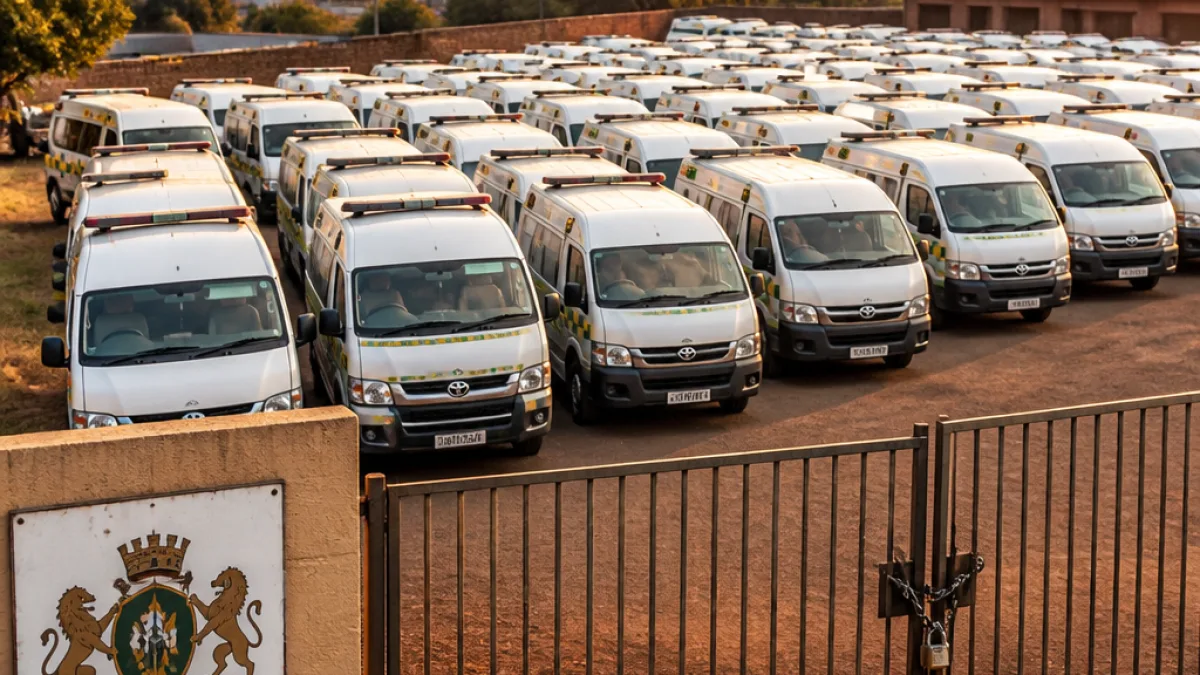
Johannesburg — Forty-one ambulances bought by the City of Johannesburg in 2019 at a combined cost of about R41 million have remained unused for six years while the city awaits a decision from Gauteng Health on whether they can be put back into service.
Vehicles bought but grounded amid provincial takeover
The ambulances were purchased by the city’s Emergency Management Services (EMS) at roughly R1 million each, municipal records show. Their operational use was interrupted when the provincial government began a process of provincialisation of ambulance services—bringing emergency medical services under Gauteng Health’s control.
Gauteng government spokesperson Elijah Mhlanga said the City submitted an application in July for an operating licence covering six stations. Final approval rests with the provincial head of department for health. Mhlanga also said the province would engage the city on "the fate of its 41 ambulances, including the possibility of their absorption as part of the broader provincialisation process."
“In the meantime, the provincial government will engage with the City of Johannesburg EMS (CoJEMS) to discuss the fate of its 41 ambulances, including the possibility of their absorption as part of the broader provincialisation process,” said Elijah Mhlanga.
Who owns the ambulances and who can operate them?
While the vehicles remain the property of the City of Johannesburg, they cannot be operated without an independent licence from the province, the City’s EMS said. The municipal spokesperson, Robert Mulaudzi, pointed out that although municipalities historically operated ambulances on behalf of the province, that responsibility has been progressively taken back by Gauteng since about 2009. Johannesburg and other metros were affected when the process was finalised around 2020.
Mulaudzi said the 41 ambulances were purchased shortly before the provincial takeover and were not among the vehicles transferred to Gauteng. "Because they were not part of the provincialisation, they belong to the City of Johannesburg," he said, adding that the city could not simply return them to service without the required provincial licence.
Practical implications for residents
For residents, the situation raises practical concerns: ambulances sitting idle represent a loss of emergency response capacity, while procurement funds remain tied up in unused assets.
- Number of ambulances: 41
- Purchase year: 2019
- Approximate total cost: R41 million
- Current status: Owned by City of Johannesburg but not operational; provincial licence pending
| Item | Detail |
|---|---|
| Ambulances bought | 41 |
| Estimated cost | About R41 million |
| Year of purchase | 2019 |
| Licence status | Application submitted (July); decision pending |
Why the licence matters
Under the provincialisation framework, municipalities that previously provided ambulance services do not automatically retain operational authority. Even though the City owns the 41 vehicles, provincial legislation and policy require an independent operating licence to run ambulances. Until that licence is granted or a decision is made to absorb the vehicles into the provincial emergency medical services, the ambulances cannot legally be deployed by the city.
The Gauteng government said it was not involved in the purchase, funding or acquisition of the vehicles and that discussions with the City of Johannesburg EMS over their future were planned as part of the absorption process.
Accountability and next steps
The delay leaves questions about procurement timing and coordination between municipal and provincial authorities. Residents and civil society groups who monitor service delivery may press for clarity on whether the ambulances will be made operational under provincial control, returned to the city for use after licensing, or otherwise reallocated.
For now, the immediate next step is the provincial decision on the City’s licence application for six stations and further engagement between Gauteng Health and the City on the potential absorption of the 41 ambulances into the provincial system.
City residents dependent on timely emergency medical response will watch closely for any move that returns these assets to service.