
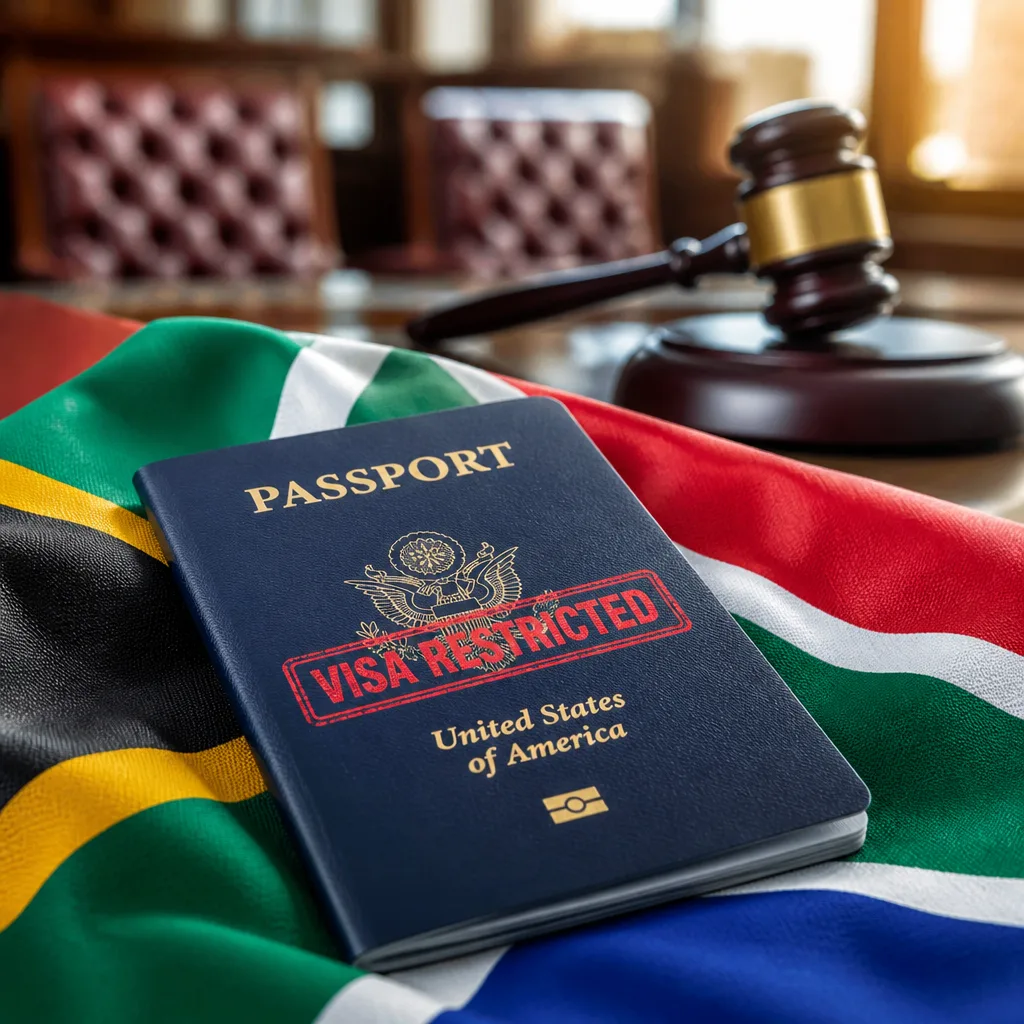
Former South African ambassador to the United States Ebrahim Rasool has warned that recent US visa restrictions aimed at South Africans may be a prelude to targeted sanctions against leaders of the African National Congress.
Rasool links visa curbs to wider pressure campaign
Speaking on CapeTalk, Rasool said the visa measures were not isolated. He described them as part of a coordinated effort to pressure South Africa over its transformation agenda and to reverse gains made since 1994.
“These visa restrictions, and I predict soon targeted sanctions against ANC leaders, will be imposed,” Rasool said.
Rasool pointed to a string of US actions and diplomatic moves he said illustrated growing strain between the two countries. He cited his own expulsion from his post in Washington, the cut to PEPFAR funding for HIV and AIDS, the withdrawal of WHO research funding, the closure of the USAID office in South Africa, and the imposition of tariffs as signs of a broader escalation. He also mentioned tensions linked to the International Court of Justice case involving Israel.
Why targeted sanctions, not AGOA removal?
Rasool argued that Washington’s choice to focus on visa restrictions rather than removing South Africa from the African Growth and Opportunity Act (AGOA) reflected a tactical calculation. He suggested that hitting AGOA could damage mostly white-owned businesses — including mines, factories and farms — and that targeting individuals would avoid that broader economic fallout.
He said advice favouring targeted measures had, in his view, been driven in significant part by groups such as AfriForum. Rasool characterised the visa restrictions as the “first instalment” of an approach intended to curb transformation in South Africa.
Context and consequences
If Rasool’s prediction proves accurate, targeted sanctions on ANC leaders would represent a marked escalation in bilateral pressure. Such sanctions typically include asset freezes, travel bans and restrictions on financial transactions involving named individuals. The political and diplomatic consequences could be significant, affecting South Africa’s international engagements and domestic politics.
The comments come against a backdrop of already heightened tensions in the relationship between Pretoria and Washington, including diplomatic disputes and contested policy positions. Rasool’s perspective links these developments into a single strategy aimed at preserving pre‑1994 economic structures and limiting transformation measures.
- Key actions Rasool cited: expulsion of the ambassador, cuts to PEPFAR funding, reduced WHO research support, closure of the USAID office, and tariffs.
- Rasool’s forecast: visa restrictions are a precursor to targeted sanctions against ANC leaders.
- Rationale offered: avoiding damage to predominantly white-owned businesses that benefit from AGOA.
| US action | Rasool's characterisation |
|---|---|
| Visa restrictions | First instalment of targeted pressure |
| PEPFAR funding cuts | Part of broader disengagement |
| Closure of USAID office | Evidence of reduced bilateral cooperation |
Some details of Rasool’s wider claims — including the motivations of external advisers and the specific targets of any future sanctions — may still be developing. Government officials in Pretoria and Washington have not been quoted in relation to Rasool’s prediction in the available report.
The possible imposition of targeted sanctions would raise immediate questions for the South African government about diplomatic strategy, domestic political unity and the protection of national leaders' travel and financial interests. It would also test South Africa’s international alliances and its approach to defending its transformation agenda on the world stage.
Further reporting will be needed to confirm whether Washington intends to escalate beyond visa measures and, if so, which individuals or entities might be affected.














