
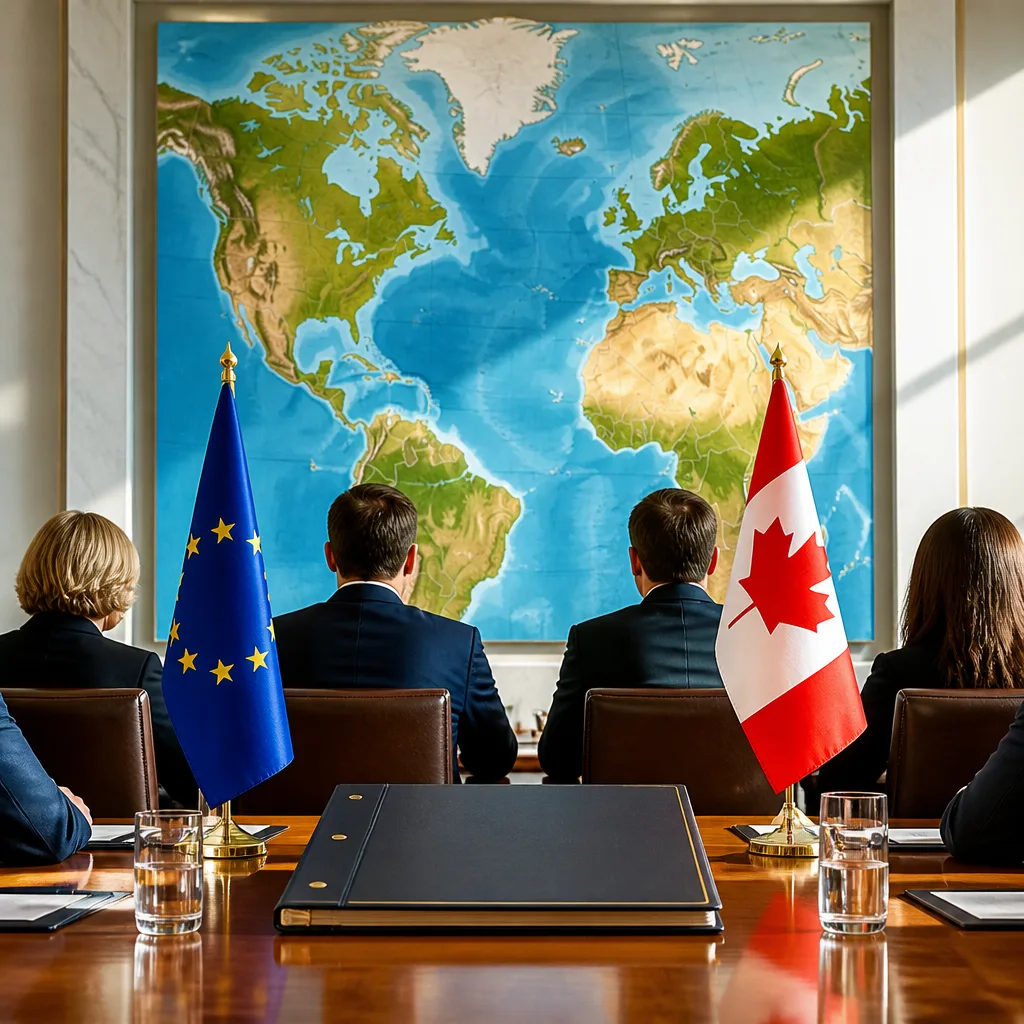
European Commission President Ursula von der Leyen used her State of the Union address on 16 September to propose that Canada become the EU's first "associate member", a move intended to deepen ties between the European Union and a like‑minded North American partner in a period of heightened international uncertainty, according to an opinion piece published in Le Monde.
A framework for closer ties
The comment piece, by political scientist Thierry Chopin, set out why Canada and the EU should consider a closer formal partnership and why the proposal matters. Chopin argued that the two sides already share broad interests across a range of fields, and that the current upheaval in international relations makes renewed cooperation between liberal democracies and open economies both useful and necessary.
He identified several practical areas in which the EU and Canada could deepen collaboration:
- Economic coordination — to withstand external trade pressures such as tariffs;
- Energy and mineral resources — Canada’s resource base could help meet European needs;
- Strategic and security cooperation — a response to changing transatlantic defence dynamics;
- People‑to‑people links — education, cultural exchanges and shared values that build trust.
Chopin cautioned that the central challenge is designing a durable institutional framework. The aim would be to combine ambition with realism — creating a partnership that is substantive but sensitive to domestic political constraints on both sides.
Model for other North Atlantic states
The writer also suggested the idea could be extended to other countries in the North Atlantic. He singled out Iceland and Norway, and even held open the possibility that the arrangement could be relevant to the United Kingdom. Chopin noted that these states already have varying degrees of access to the European internal market — for example through the European Economic Area — but may wish to avoid full EU membership for reasons such as sensitive national industries.
| Area | Why closer ties matter |
|---|---|
| Economy | Mutual benefits in trade and resilience against protectionist measures |
| Energy & Minerals | European demand for raw materials and Canadian supply potential |
| Security | Cooperation as Western security guarantees evolve |
| Culture & Education | Exchanges that sustain long‑term trust and alignment |
Chopin urged the construction of "a framework that gives this partnership both ambitious and realistic substance."
That formulation emphasises two linked imperatives: first, the need for institutional depth if cooperation is to be meaningful; second, a recognition that electoral politics and sectoral sensitivities (for example, fisheries in Iceland) limit how far partners may be willing to integrate.
Implications for global alignment
The proposal reflects broader debates about how democracies should align in the face of economic coercion and strategic competition. A bespoke Canada‑EU arrangement would not be the same as full EU membership; rather, it would offer structured cooperation tailored to mutual priorities.
For South Africa's foreign‑policy watchers, the debate is a reminder that new forms of cross‑border ordering are emerging outside traditional blocs. Whether the EU's concept of "association" gains traction will depend on political will on both sides of the Atlantic and on the technical design of any agreement — questions Chopin highlights as central.
As the conversation continues in capitals and Brussels, the EU's move to propose a formalised partner status for a non‑European democracy marks a significant moment in the search for resilient alliances among open economies.









