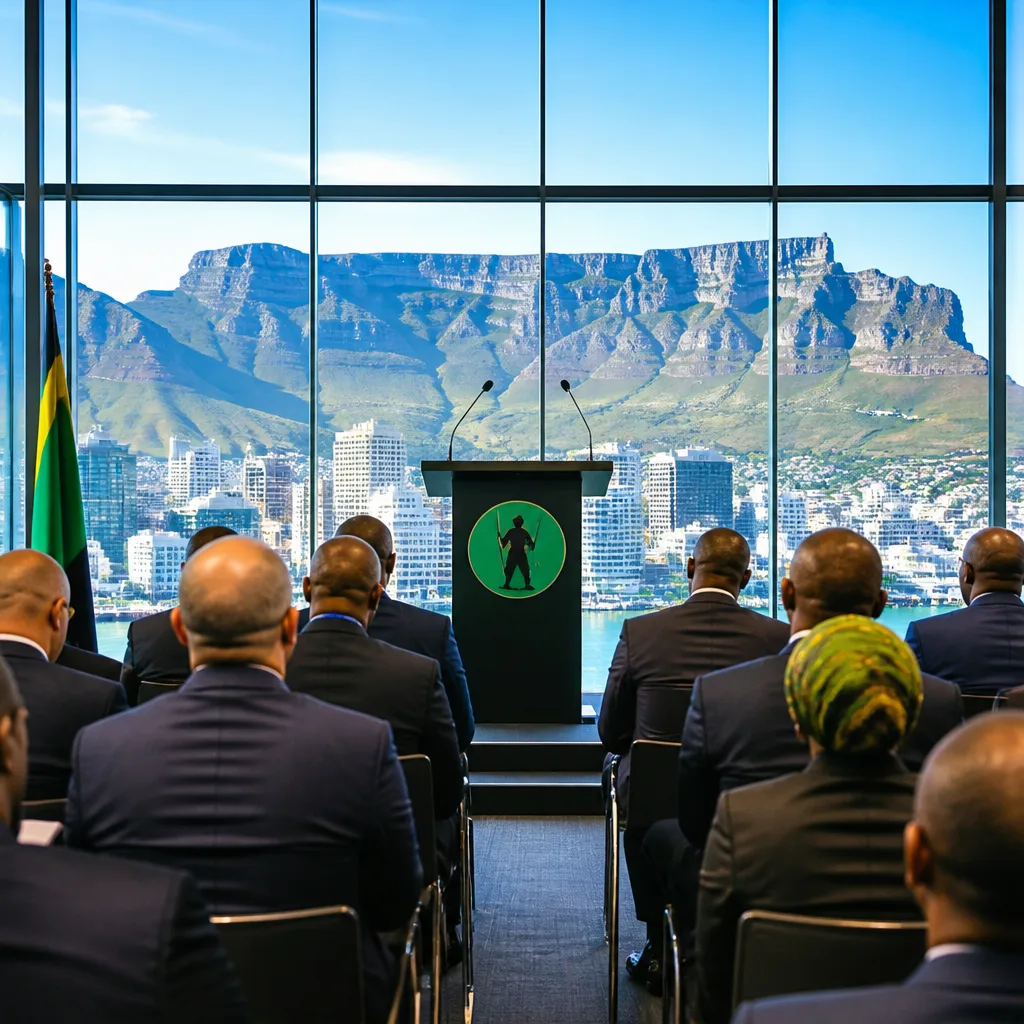
Duduzane Zuma, speaking to business leaders in Cape Town after his recent appointment as first deputy president of the MK Party, said his father, former president Jacob Zuma, had acted to restrain popular revolt among economically frustrated South Africans.
Appeal to stability, not innocence
At a Biznews event on Tuesday, Duduzane argued that Jacob Zuma’s continuing authority among sections of the population had a moderating effect on potential unrest. He did not seek to defend or assess the legal and political controversies that have long surrounded the former president, saying he was not speaking to whether those matters were justified.
“We should thank our lucky stars for that gentleman for one reason and one reason only,” Duduzane said. “He’s held back a lot of revolt in this country.”
That formulation places a distinct interpretation on Jacob Zuma’s role. Rather than describing his influence solely as a source of mobilisation for grievance politics, Duduzane presented it as a restraint — a mechanism that keeps frustrated constituencies attached to organised, electoral politics.
Who benefits and who pays
The intervention was directed at an audience of professionals, business leaders and political figures. It performs several functions at once: it reassures anxious establishment figures that the former president’s influence can preserve public order; it signals to disaffected voters that their grievances are seen and represented; and it stakes a claim for the MK Party as a vehicle that channels economic frustration into a political constituency.
- Benefits: The political establishment and business audience that heard the remarks may take comfort in the suggestion of stability; the MK Party gains a narrative that casts its founder as a moderating force.
- Costs: Framing a polarising figure as a stabiliser risks normalising his authority without addressing underlying economic grievances; it also complicates accountability debates around past conduct.
Context and consequences
Duduzane’s line of argument pivots on a distinction between mobilising dissatisfaction and restraining it. He argued that Jacob Zuma, as an elder statesman to some voters, had played the latter role — speaking people through their disappointments and keeping them within the ambit of electoral politics rather than letting them turn to extra-parliamentary action.
The claim has several immediate political consequences. It reframes Jacob Zuma’s persistent influence away from being purely disruptive and toward being a form of social containment — a resource that can be tapped to stabilise potentially volatile constituencies. For the MK Party, newly positioning itself in a crowded post-ANC landscape, the narrative is useful: it says to voters and donors alike that the party channels anger without unleashing it.
But the statement also raises questions. If a political figure’s authority is chiefly valuable because it keeps people from acting outside formal political channels, then the durability of that stabilising effect depends on ongoing attention to the economic and social drivers of discontent — not just the presence of a reassuring voice.
| Claim | Immediate implication |
|---|---|
| Duduzane: Jacob Zuma has "held back a lot of revolt" | Positions Zuma as a stabilising elder who keeps grievances channelled into electoral politics |
| Audience: business and establishment figures | Reassures investors and elites about containment of unrest but highlights unresolved economic frustrations |
By presenting an image of containment, Duduzane shifted the debate about his father’s role from one of merely polarising rhetoric to one that carries a measure of public-order value. That reframing may appeal to some within the business community, but it does not eliminate the political liability that association with a figure so tied to corruption scandals and legal battles can represent.
Ultimately the substance of Duduzane’s claim points back to a long-running political arithmetic in South Africa: parties and leaders derive strength from narratives that promise to translate anger into electoral power rather than street action. Whether that promise endures depends on whether economic grievances are addressed or simply managed by charismatic leadership.
The remarks add another dimension to the MK Party’s attempt to carve out relevance. They signal an intent to occupy the space of grievance politics while simultaneously offering the reassurance of containment — a combination that will be watched closely by political competitors, civil society and investors alike.