
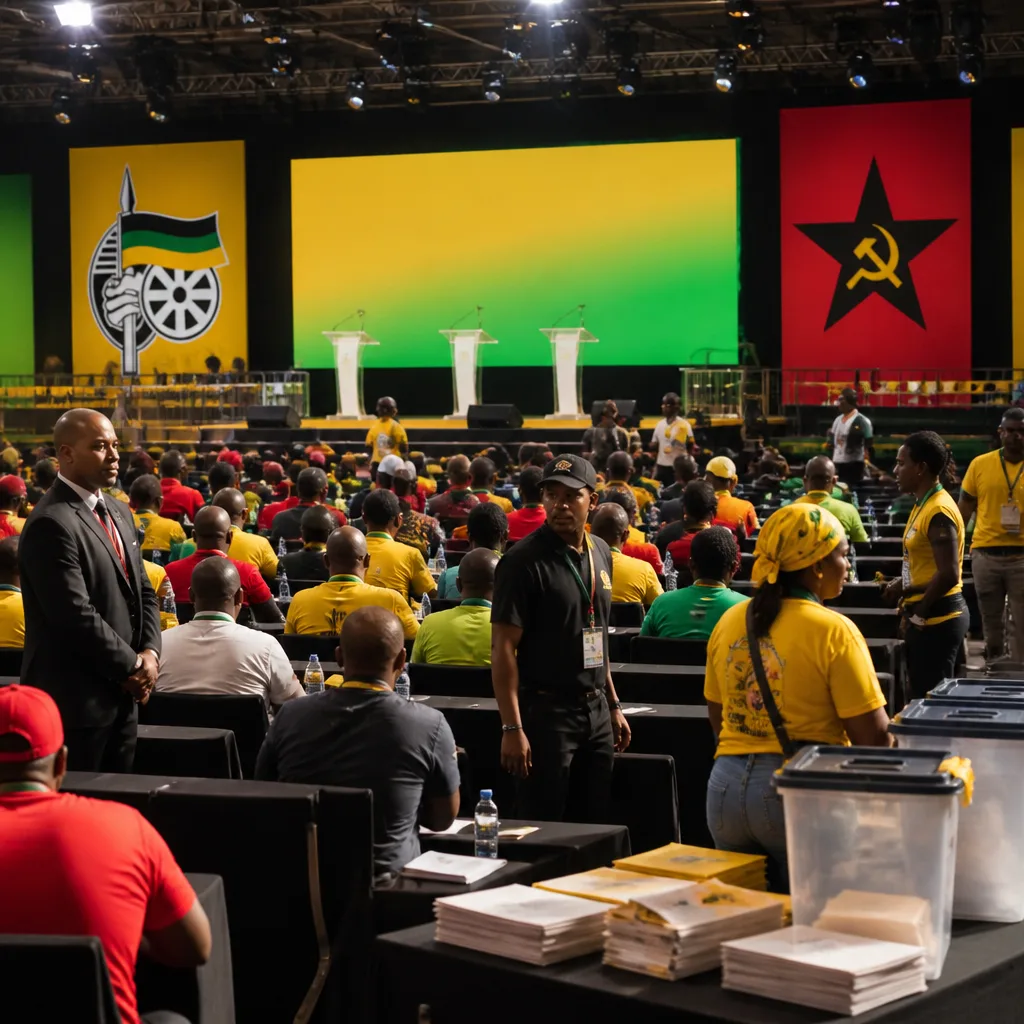
Cosatu will hold its 15th national congress in Midrand, Johannesburg, from Monday to Thursday, with leaders of the African National Congress (ANC) and the South African Communist Party (SACP) expected to address delegates amid a fraught debate over the federation’s alliance strategy.
Leadership elections and alliance questions
The congress will elect the federation’s top officials, including the president, first and second deputy presidents, general secretary, deputy general secretary and national treasurer. Those positions are currently held by Zingiswa Losi (president), Michael Shingange (first deputy president), Duncan Luvuno (second deputy president), Solly Phetoe (general secretary), Gerald Twala (deputy general secretary) and Freda Oosthuysen (national treasurer), according to Cosatu’s preparatory documents.
At its final central executive committee (CEC) meeting on 24 and 25 August before the congress, Cosatu reviewed the political, organisational, socioeconomic and international conditions confronting workers. The CEC — the federation’s highest decision-making body between congresses — also assessed progress since the 14th national congress in September 2022, when several affiliates publicly urged a break with the ANC and advocated support for the SACP at elections.
The unresolved question of whether Cosatu should remain in formal alliance with the ANC or pivot politically towards the SACP and other options is expected to animate discussions on the congress floor. The 14th congress produced sharp divisions, with affiliates such as the Police and Prisons Civil Rights Union, the South African Municipal Workers Union and Nehawu calling for a change of stance; those pressures have continued into the current sitting of delegates.
Outside the congress: protests and employer outreach
The congress period will also see activity beyond Midrand. On Tuesday, Zwelinzima Vavi, general secretary of the rival SA Federation of Trade Unions, is scheduled to address members of the National Education and Allied Workers Union. Those members plan to stage a protest against labour broking at Moreson Pluimvee Boerdery in Brandfort in the Free State, according to the union’s programme.
Meanwhile, the Department of Employment and Labour’s Compensation Fund will run awareness sessions on the Compensation for Occupational Injuries and Diseases Act (COIDA) for exempted employers and the hospitality sector from Monday to Tuesday in Kimberley, Northern Cape. The department said these sessions are part of an ongoing programme this financial year that has already visited Mpumalanga, the Western Cape, Gauteng and the Eastern Cape.
Compliance figures highlighted
The department provided compliance figures for the Northern Cape hospitality sector: there are 1,246 registered hospitality employers in the province, of which 498 were compliant with COIDA at the time of reporting. That equates to a 39.97% compliance rate and 60.03% non-compliance, the department said. In Kimberley specifically, the department noted there are 215 registered hospitality employers.
| Indicator | Northern Cape total | Kimberley |
|---|---|---|
| Registered hospitality employers | 1,246 | 215 |
| Compliant employers (COIDA) | 498 (39.97%) | — |
- Who benefits: Cosatu affiliates and rank-and-file members seeking clearer political direction and protections for workers.
- Who pays: Employers in the hospitality sector face compliance scrutiny; non-compliance carries potential liabilities under COIDA.
The congress will be closely watched in political circles because any official shift in Cosatu’s stance towards the ANC or greater alignment with the SACP would have implications for coalition politics and electoral dynamics. The outcome of the federation’s leadership elections may also determine how strongly the organisation pursues either continuity inside the tripartite alliance or a more confrontational, independent course.
Delegates will return to their unions with mandates that could reshape the labour federation’s posture in national politics and on workplace issues. The province-level compliance figures provided by the Compensation Fund underscore the parallel challenge: while unions deliberate national strategy, municipal and provincial enforcement around worker compensation and employer obligations continues to demand resources and attention.












