
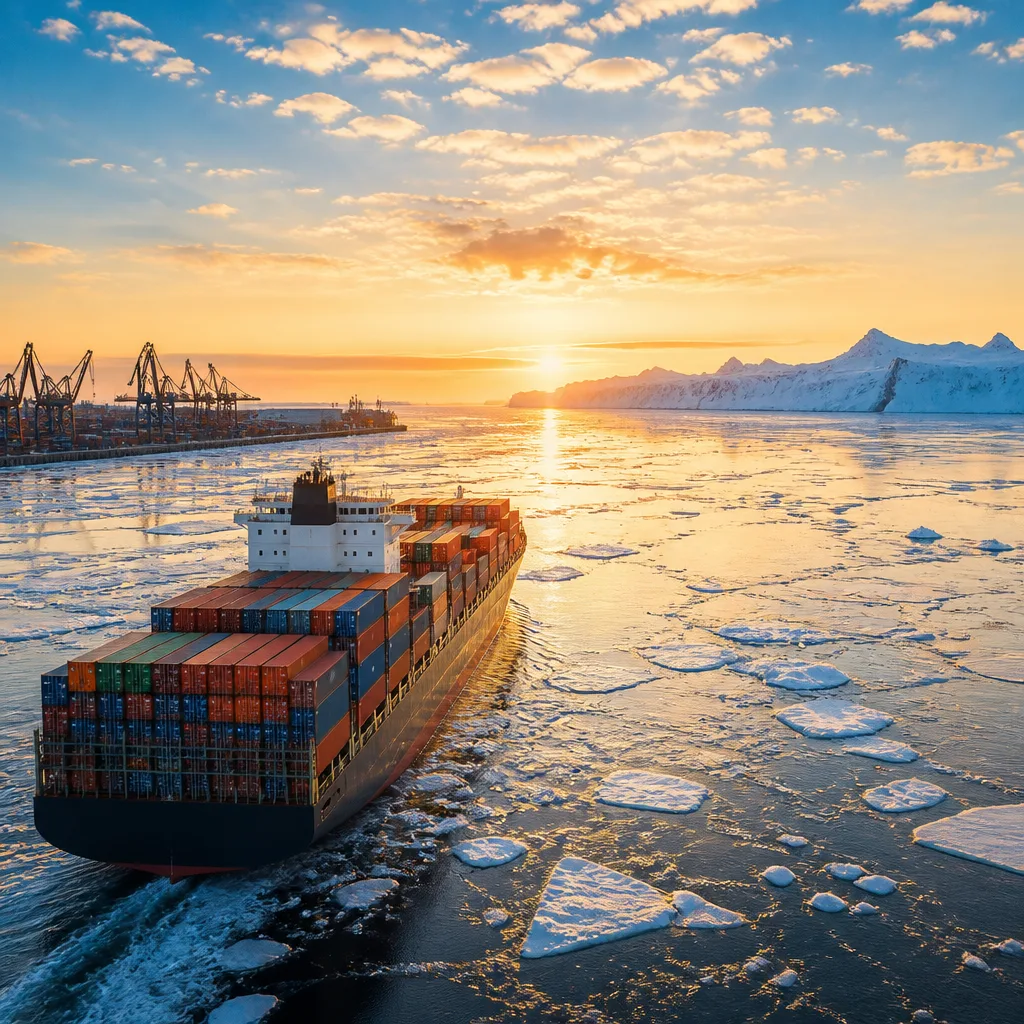
A Chinese container ship has departed for Europe via the Arctic’s Northern Sea Route (NSR), part of a new weekly service that significantly shortens transit time compared with the Suez Canal passage but has drawn warnings from environmental groups about threats to fragile polar ice.
Fast lane to Europe, new weekly service
The ship, named Dubai Tower, sailed from the eastern Chinese port of Ningbo on a Saturday evening bound north. According to a timetable published by Sea Legend, the vessel will cross the Bering Strait and then proceed westward along Russia’s northern coastline. It is scheduled to arrive at Felixstowe, United Kingdom, on 7 September, followed by calls at Hamburg in Germany and Gdynia in Poland later that week.
The NSR offers a much shorter route between East Asia and Europe than the traditional pathway through the Suez Canal and also allows ships to avoid the Red Sea, a route that has faced security threats after recent Middle East hostilities.
Growing but seasonal, and not without controversy
The NSR is only navigable during times of the year when seasonal ice melt permits transits without icebreakers. Shipping analysis cited by the source shows an increase in container transits: 23 container ships used the route last year, up from 15 in 2024. Some major shipping lines, however, have stated they will not use Arctic transshipment routes.
- Notable pledges: France’s CMA CGM, Switzerland-headquartered MSC and Germany-based Hapag-Lloyd have pledged to avoid Arctic transshipment routes.
- Early transits: Denmark’s Maersk was the first major carrier to use the passage in 2018.
At the same time, analysts cited in the reporting highlight that the Arctic could become strategically important for future trade, particularly for China, which has referred to a concept of a "Polar Silk Road" as part of a wider interest in northern sea access.
"Major shipping companies... have pledged to 'avoid Arctic transshipment routes.'"
Security, climate and commercial trade-offs
The move to open a weekly NSR service follows disruptions to global shipping tied to the Middle East conflict and attacks on shipping in the Red Sea region. The NSR lets carriers sidestep that corridor, shortening voyages and reducing exposure to those security risks. The source notes the Red Sea route has been targeted by Iran-backed Houthi attacks in Yemen.
Environmental groups, however, are warning that an uptick in commercial transits could accelerate the loss of Arctic sea ice, which is already under pressure from rising global temperatures. The debate highlights a trade-off between shorter, potentially cheaper logistics on the one hand and increased environmental risk on the other.
| Item | Detail |
|---|---|
| Vessel | Dubai Tower |
| Departure port | Ningbo, China |
| Expected first European call | Felixstowe, UK — 7 September |
| Other planned stops | Hamburg (Germany), Gdynia (Poland) |
| Transit increases | 23 container ships in 2025; 15 in 2024 |
For South African readers, the story is a reminder that shifts in global shipping corridors can affect how and when goods arrive on our shores. Shorter routes can reduce transit times and possibly costs for some trades, but environmental and geopolitical consequences could reshape maritime insurance, routing choices and corporate pledges.
This story also forms part of a larger conversation about the future of global shipping: how companies balance speed, cost and risk; the role of climate change in opening new passages; and the environmental responsibility that comes with expanded access to previously protected regions.











