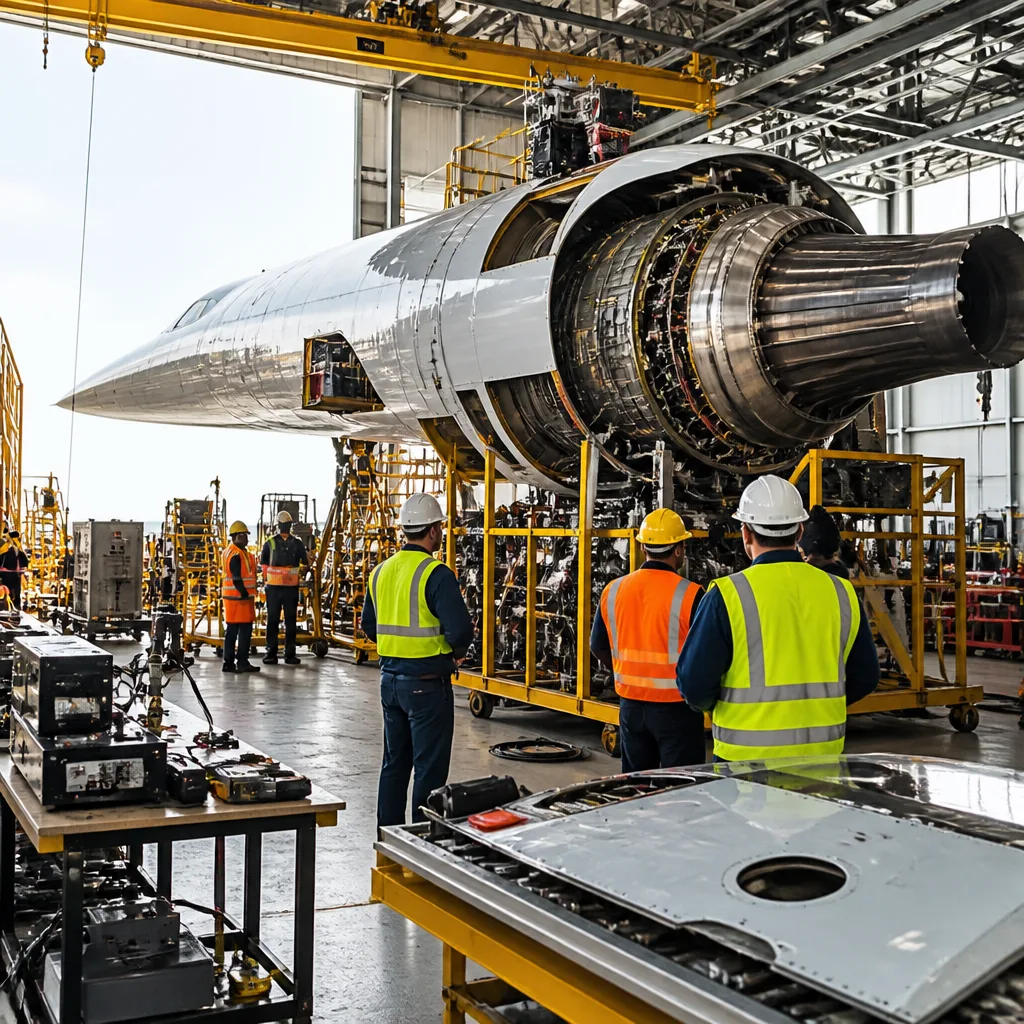
The Chinese experimental aircraft known as the TMS-10 has entered its final assembly phase and is scheduled to make a first test flight by the end of the year, developers said. Built by Tianmushan Laboratory in collaboration with Beihang University, the full‑scale demonstrator is being positioned as a potential business‑class passenger aircraft seating 10–15 people.
What the TMS‑10 promises
Engineers expect the demonstrator to be capable of supersonic cruise at up to Mach 2 — roughly 2,090 km/h — while also supporting subsonic flight at about Mach 0.95 (around 1,175 km/h). If such speeds are realised in a production design, developers suggest city‑pair times could shrink dramatically; the report noted a route that now takes about two hours could be cut to around 30 minutes.
The project follows a smaller 1:18‑scale prototype flown in June 2025, which operated at low speeds below Mach 0.2 to evaluate takeoff, handling and landing characteristics. The full‑scale TMS‑10 will push the programme into the supersonic regime and test noise‑management measures intended to limit sonic booms reaching the ground.
Design choices and technical challenges
Unlike NASA’s X‑59 experimental aircraft — which aims to quieten the sonic signature so ground observers hear only a gentle ‘bump’ — the TMS‑10 uses aerodynamic layout choices to prevent strong shock waves from forming and combining. Its forward canard and a T‑tail are intended to alter the way pressure waves develop around the nose and wings, while features at the rear are designed to redirect and weaken sound energy.
Project engineers continue to work on key propulsion elements. According to the report, the team still needs to finalise and validate the engine core and exhaust for the design to meet both performance and acoustic goals.
- Developer: Tianmushan Laboratory with Beihang University
- Passengers: 10–15 (business‑class focus)
- Target speeds: Mach 2 (~2,090 km/h) and Mach 0.95 (~1,175 km/h)
- First test flight: on schedule by end of year (developers’ timeline)
| Characteristic | TMS‑10 (reported) |
|---|---|
| Scale | Full‑scale demonstrator (after 1:18 prototype) |
| Low‑speed tests (prototype) | Below Mach 0.2 (June 2025) |
| Cruise speed goal | Mach 2 (~2,090 km/h) |
| Subsonic capability | Mach 0.95 (~1,175 km/h) |
Context for travellers and operators
If the TMS‑10 design eventually leads to certified passenger aircraft, operators could market very short intercity trips — a change in how business travellers and high‑value passengers plan journeys. However, numerous hurdles remain: thermal and structural loads at high speeds, engine performance, regulatory acceptance of sonic‑boom management and the economics of small, premium seating aircraft.
For local travellers, the prospect of return supersonic services is an intriguing one, though widespread impact depends on whether manufacturers can scale the technology to larger passenger counts and meet noise and emissions rules set by civil aviation authorities globally.
The TMS‑10 project is part of a renewed global push to revive commercial supersonic flight after the end of services like Concorde. Several programmes worldwide are exploring different technical routes: some aim to dampen sonic booms, others to prevent strong shock waves from forming in the first place. Each approach brings trade‑offs in design complexity, cost and passenger comfort.
For now, the TMS‑10 remains an experimental step. The next milestones to watch are engine validation, exhaust tests and the planned first test flight before year‑end — each will reveal how readily these concepts might translate into routine high‑speed travel.