
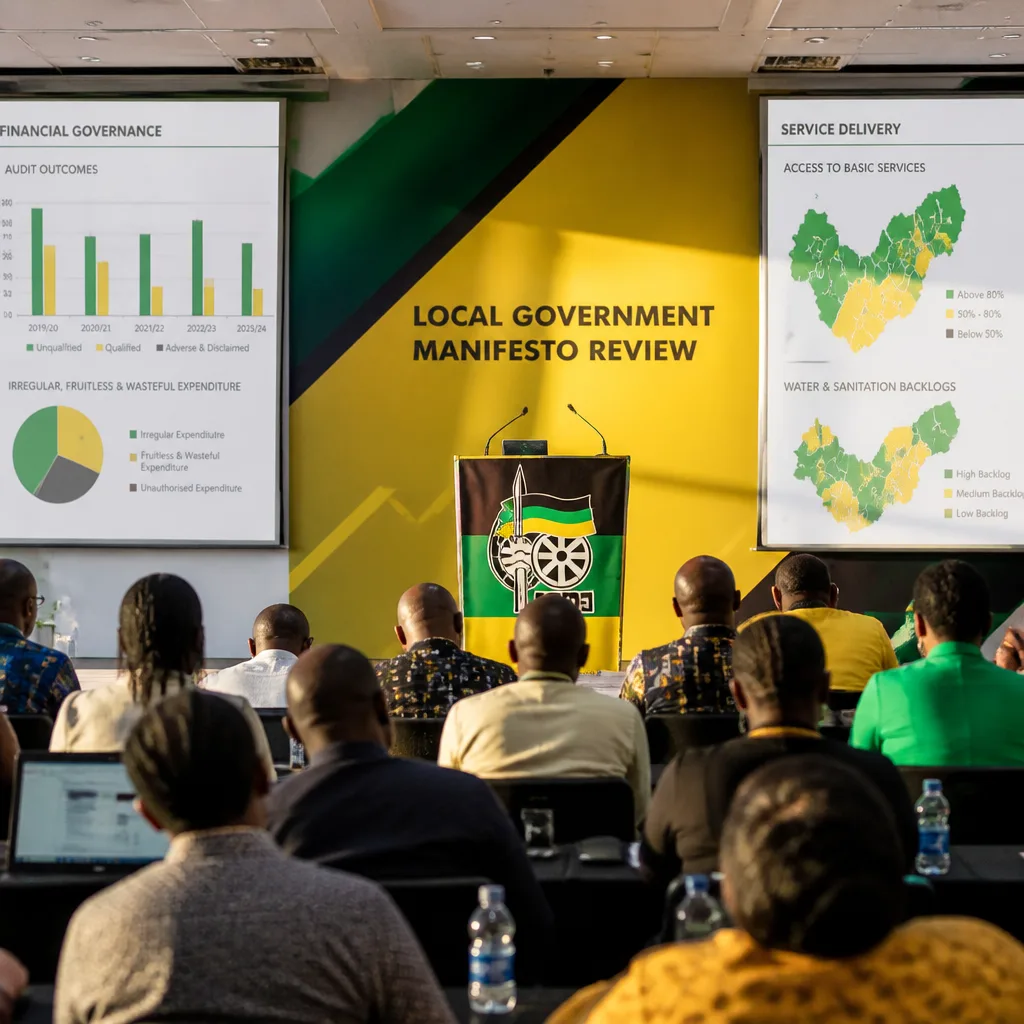
The African National Congress (ANC) is asking South Africans to give it “another time” to run municipalities, saying it has reviewed policy failings and is renewing its approach to local governance ahead of the 2026 Local Government Elections.
Stella Ndabeni, chairperson of the ANC’s Local Government Intervention Task Team (LGITT), made the appeal during a media briefing at Chief Albert Luthuli House in Johannesburg, according to reporting by Inside Politics. Ndabeni acknowledged shortcomings in municipal performance and set out a programme of public briefings that will scrutinise the party’s 2021 local government manifesto before the party formally unveils its 2026 manifesto.
"Yes, we acknowledge fully that we have failed in certain instances, and this is why we are appealing to South Africans to say, give us another time to improve where we have not done well. Give us another time to fix the mistakes that we have made," Ndabeni said.
From admission to accountability
The LGITT leader said the ANC has taken the electorate’s dissatisfaction seriously, pointing to declining support since the 2021 local government elections and the May 2024 general election. As part of its recovery plan the party will hold a series of manifesto review briefings, which the ANC says will provide "honest and evidence-based assessments" of the previous manifesto and offer the party an opportunity to explain how lessons learned will shape commitments for 2026.
Ndabeni described the process as more than rhetorical contrition: the briefings are intended to show how past implementation has influenced future policy choices and to demonstrate "strengthened mechanisms" for accountability. She told the briefing the ANC is not starting from scratch, but is attempting a critical, internal review that will be published in the run-up to the manifesto launch in Johannesburg.
Service delivery, financial governance and transformation
The ANC’s LGITT highlighted several priorities it says municipalities must address. These issues, the party argues, will form part of the criteria by which municipal performance is judged in future:
- Financial governance — tighter controls to prevent waste and corruption;
- Service performance — moving beyond clean audits to measure actual impact on communities;
- Transformation — addressing historical inequalities while maintaining municipal infrastructure;
- Asset management and compliance — better upkeep of roads and municipal assets and adherence to legal standards.
Ndabeni argued that audit outcomes alone are insufficient and that evaluation should consider the extent to which residents actually receive services. She said the party has identified weaknesses and will bolster accountability mechanisms accordingly.
Timetable to the manifesto
The ANC has scheduled the public launch of its 2026 Local Government Elections Manifesto in Riverside, Johannesburg, on 22 August. Ahead of that launch the party will host a sequence of briefings intended to report back on the 2021 manifesto implementation and explain changes it proposes for the coming elections.
| Event | Date |
|---|---|
| Local government elections (previous manifesto) | 2021 |
| General election mentioned by the party | May 2024 |
| Planned 2026 manifesto launch | 22 August 2026 |
The LGITT’s message is a calculated blend of contrition and confidence: by admitting failures the ANC hopes to reclaim voters who punished it at the ballot box in recent contests. The party is framing the manifesto review briefings as a transparent rehearsal of accountability, arguing that strengthened oversight and clearer performance measures will produce better outcomes in municipalities.
Who benefits and who pays is the underlying calculus. If the ANC succeeds in convincing voters that it has materially changed how it manages municipal finances and services, it stands to regain control — and the authority that comes with administering local budgets and procurement. Conversely, citizens will bear the cost of yet another electoral experiment if promised reforms fail to translate into improved water, electricity, sanitation and road maintenance.
As the 22 August launch approaches, the ANC’s challenge will be to turn internal reflection into verifiable reforms that opposition parties, civil society and voters can independently assess at municipal level.












