
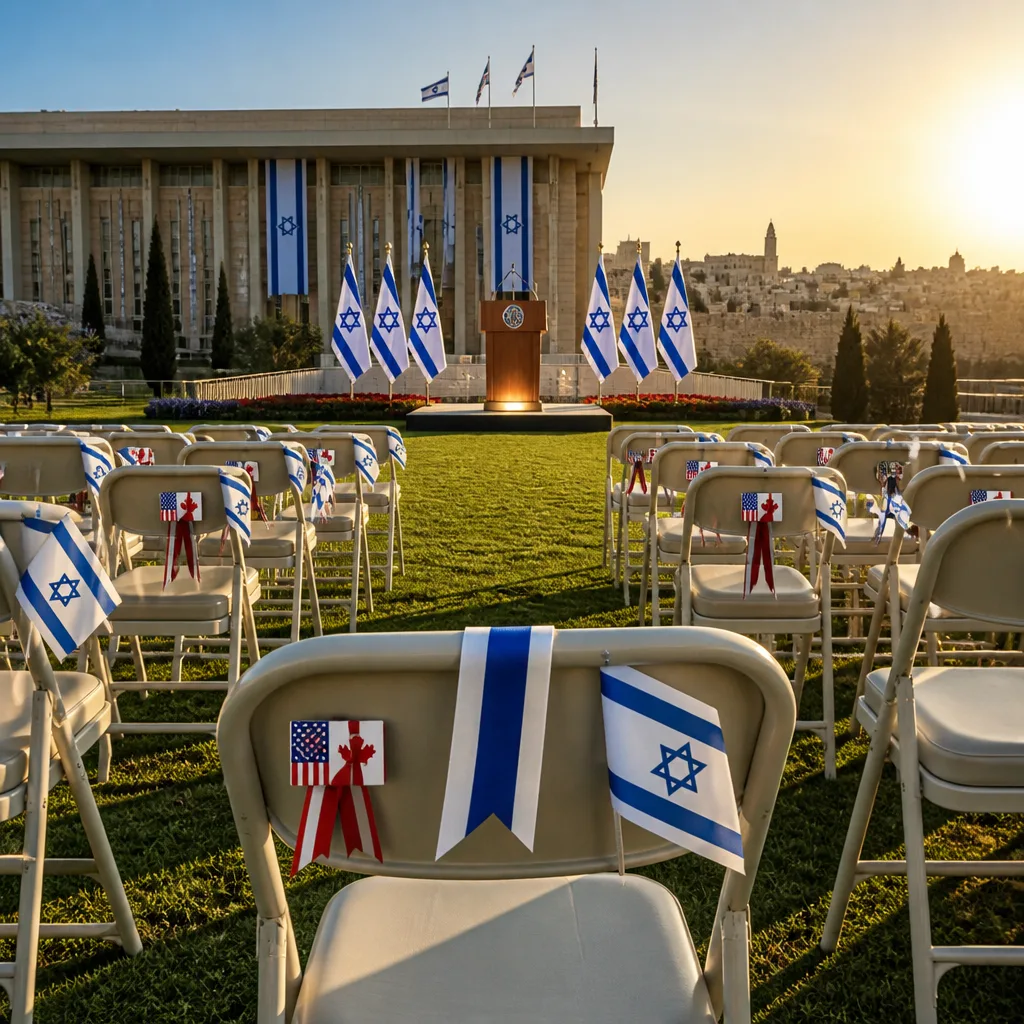
Israel recently celebrated the arrival of its 100,000th North American immigrant, a milestone marked in Jerusalem at a ceremony attended by President Isaac Herzog and senior officials. Yet the community that this figure represents has no distinct elected voice in the Knesset, a gap that underscores broader questions about how immigrant groups translate presence into political power in Israel.
Milestone without a political vehicle
The family honored at the presidential reception — Jeffrey and Atara Douglas and their three children — arrived in Israel earlier this month and were welcomed by senior figures including the president and the aliyah and integration minister. The celebratory setting drew attention to an absence: there was no elected representative of the North American immigrant community in attendance because, as commentators note, there simply is none.
That absence is not merely symbolic. In upcoming party contests, the major political formations have made limited institutional space for new immigrants. For example, the ruling Likud party has reserved a slot for a new immigrant at No. 43 on its candidate list; current polling places Likud at roughly 23–24 seats, a gap that makes the reserved slot effectively unreachable in the near term.
“Slot 43 is not really about Israelis looking down on olim from the West. What it points to is harder to fix,”
Political analysts argue that the history of immigrant political power in Israel suggests a specific dynamic: groups that have won influence did so after experiencing hardship or marginalization that galvanized collective action. The columnist traces that pattern through prior waves of immigration — from Mizrahi Jews who formed new political forces after experiences of discrimination to post-Soviet immigrants who quickly built political clout amid economic and social dislocation.
Why representation hasn’t emerged
Several factors help explain why North American olim have not coalesced into a distinct political bloc. First, the community is relatively heterogeneous in its social and economic profiles and motivations for immigrating. Second, many Anglo immigrants arrive with established professional credentials and networks that may reduce immediate incentives to form a grievance-driven political movement. Third, mainstream parties have limited incentives to create meaningful list placements for niche constituencies when electoral mathematics favor broad coalitions.
- Size: 100,000 North American immigrants since 2002 is significant but dispersed.
- Party placement: Likud’s reserved No. 43 list slot is outside current realistic seat projections.
- Historical pattern: Prior immigrant political success in Israel often followed sharp collective grievances.
Those factors combine to make institutional representation unlikely in the short term unless a catalyzing event spurs collective mobilization or an established party creates a genuinely winnable slot for an Anglo representative.
Broader political implications
The debate touches on how democratic systems absorb new populations and how political parties allocate representation. In Israel’s proportional system, list placement is the crucial mechanism for entry to the legislature. Reserved slots, pledges or outreach can create pathways, but they do not guarantee seats unless parties win commensurate votes.
The columnist’s framing — that immigrant political power has historically arisen from anger and exclusion — suggests a paradox: communities that fare worse materially and socially have sometimes achieved greater political leverage than relatively privileged newcomers. That dynamic raises questions about the kinds of grievances that drive party formation and the incentives parties face when balancing coalition-building with targeted representation.
For the North American olim community, the path to formal political voice could take multiple forms: building a cross-party advocacy network, pressing major parties for winnable placements, or coalescing around a specific policy issue that cuts across Israel’s political divides. None of those outcomes is guaranteed, and the existing institutional setup gives established parties significant control over who gains legislative access.
The presidential reception underscored the importance the state places on aliyah and integration, even as it highlighted the limits of symbolic recognition when unaccompanied by political mechanisms that translate numbers into representation.