
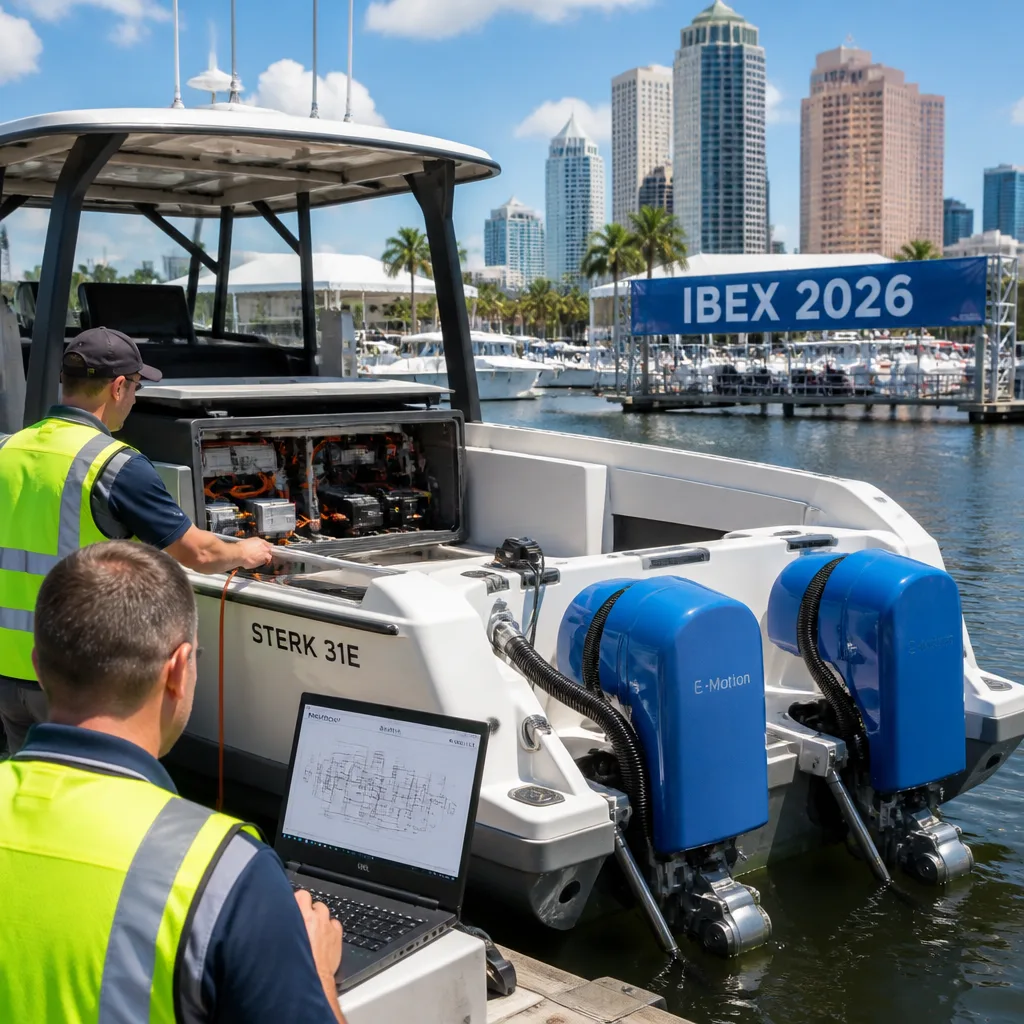
Vision Marine Technologies has begun a technical collaboration with Avikus, the HD Hyundai subsidiary that develops intelligent navigation and operator‑assist systems, to integrate Avikus’s NEUBOAT capabilities with Vision Marine’s twin‑motor E‑Motion high‑voltage electric propulsion architecture. The joint work uses the STERK 31E as the first validation platform and is aimed for public display at IBEX 2026 in Tampa, scheduled for Oct. 6–8.
Project scope and engineering approach
The program will establish an integration framework connecting vessel controls, propulsion and intelligent navigation. Avikus contributed an initial NEUBOAT operator‑assist and auto‑docking system for the STERK 31E, and its engineering team is providing technical support. Vision Marine’s engineers have completed a substantial portion of vessel‑side engineering and system‑interface development to bring the two platforms together.
Planned NEUBOAT functionality being evaluated subject to successful integration and validation includes:
- object recognition;
- route planning and smart autopilot;
- adaptive cruise and collision‑avoidance assistance;
- auto‑docking assistance.
Avikus’s stack pairs camera‑ and LiDAR‑based perception with object‑recognition hardware, vessel‑control interfaces and an integrated user display. Vision Marine’s objective is to advance the E‑Motion architecture beyond pure electric propulsion into a more comprehensive vessel technology architecture linking propulsion, steering, helm controls, safety systems and intelligent navigation.
Validation platform and public demonstration
The STERK 31E, selected as the program’s first validation platform, was showcased at Lake Berryessa in California earlier this summer. The companies intend to show the integrated system at IBEX 2026 in Tampa, giving industry attendees an opportunity to see the combined electric propulsion and operator‑assist features in a marine exhibition context.
| Item | Detail |
|---|---|
| Validation platform | STERK 31E |
| Target demonstration | IBEX 2026 (Oct. 6–8, Tampa) |
| Core technologies | NEUBOAT (Avikus) + E‑Motion (Vision Marine) |
Commercial and technical implications
The collaboration represents a strategic step for Vision Marine to expand the remit of its electric propulsion business into integrated vessel systems. If validated, the combined stack would marry high‑voltage electric propulsion with perception‑based navigation and automated assistance — capabilities shipowners and boat builders are increasingly evaluating as they assess electrification alongside autonomy and operator support.
For Avikus, the agreement provides an integration pathway into a high‑voltage electric propulsion architecture on a commercially available platform. The NEUBOAT system, which combines camera and LiDAR sensing with control interfaces and displays, is designed to support functions that reduce operator workload and enhance safety in close‑quarters maneuvers such as docking.
Both companies are proceeding on a non‑exclusive basis and, according to the project summary, have not formalized the collaboration with a binding written agreement. The engineering teams remain engaged in joint development and system testing, with further validation contingent on continued integration work and test outcomes planned ahead of IBEX.
The demonstration at IBEX will offer industry stakeholders a concrete example of how electric propulsion can be paired with advanced perception and autopilot features, a pairing that could influence future product road maps for boat builders, electrification suppliers and maritime autonomy vendors. It will also serve as a market test for operator acceptance of assisted navigation features in recreational and commercial marine applications.
As the companies continue integration work, attendees at IBEX 2026 should expect updates on the degree of automation achieved, the performance of the perception and control interfaces in close‑quarters operations, and any roadmap Vision Marine and Avikus present for wider rollouts beyond the STERK 31E validation platform.















