
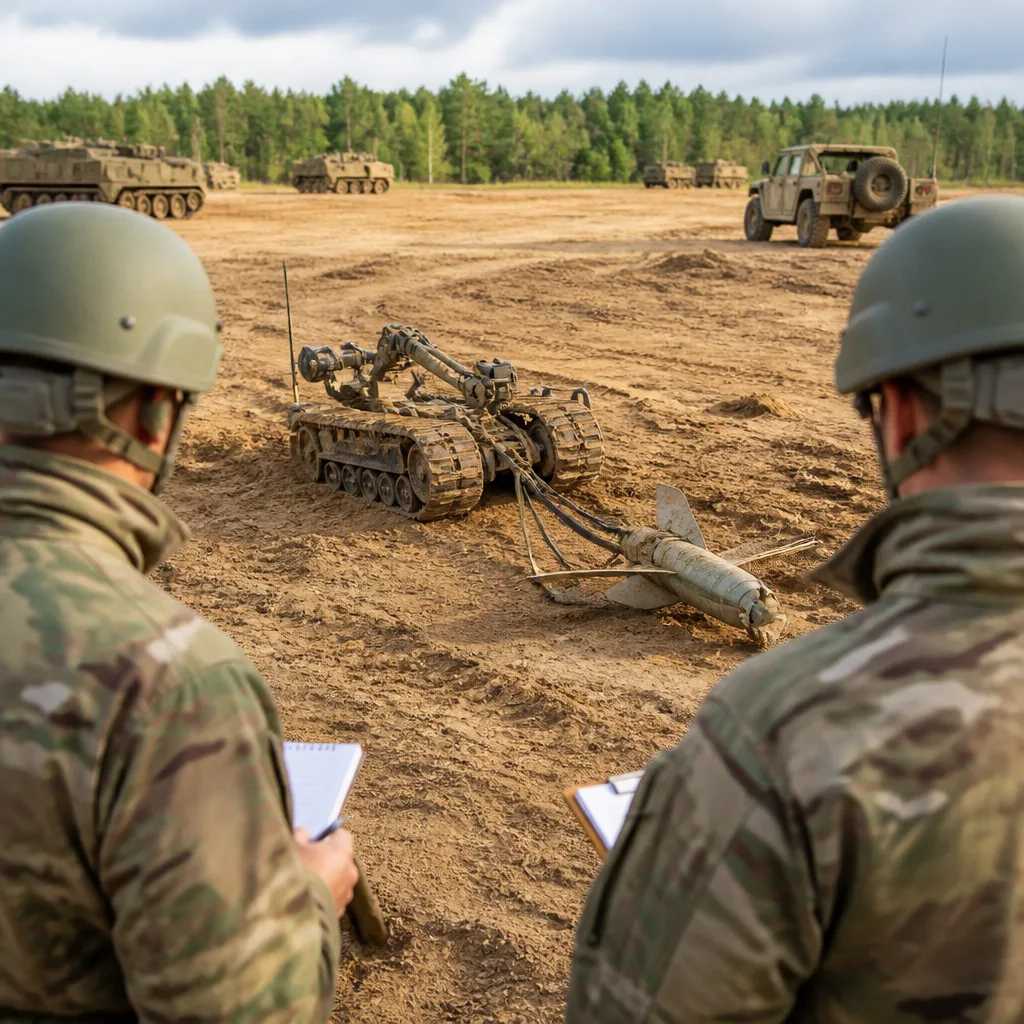
CAMP GRAYLING, Mich. — A robotic mine-clearing system tested by the Army Reserve stopped working during a live demonstration Tuesday, underscoring the technical and operational challenges of fielding autonomous systems for one of combat engineering’s most dangerous tasks.
Failure found during planned test
The demonstration, part of the Michigan National Guard’s Northern Strike 26-2 exercise, marked the first time a reserve unit field-tested a robotic version of the Mine Clearing Line Charge, or MICLIC, which detonates a rocket-towed explosive line to clear a lane through a minefield. Rather than soldiers manually moving and positioning the charge, the system drove itself into place.
The event was designed to push new hardware in conditions resembling combat, and during the demonstration “something in the technology quit mid-demonstration,” Col. Jeffrey Roberts of the Army Reserve’s 75th Innovation Command said. The malfunction was logged as part of the exercise’s objective: to identify faults and fix them before deploying equipment where lives would be at stake.
“We want to test this technology as we would use it in combat,” Roberts said. “In fact, even today we discovered an issue with some of the technology. It stopped working when it shouldn’t have. And now we know that we need to go redesign some of that to make it better, more effective for the warfighter.”
Context: exercise scale and participants
Northern Strike 26-2 runs through Aug. 14 and has drawn more than 9,000 personnel from 36 states and territories plus five international partners, according to the Michigan Department of Military and Veterans Affairs. The breach demonstration at Camp Grayling was led by the Army Reserve’s 428th Engineer Company with support from the British Army and the 75th Innovation Command, a Houston-based reserve unit that integrates soldiers with civilian technical expertise into Army modernization efforts.
| Exercise detail | Figure |
|---|---|
| Personnel involved | 9,000+ |
| States and territories represented | 36 |
| International partners | 5 |
| Exercise end date | Aug. 14 |
What went wrong — and why the failure matters
Officials said the stop demonstrated the value of testing new systems in a controlled environment before using them overseas. Full-size bulldozers reconfigured to run autonomously also were evaluated downrange, with operators controlling the machines from a van supplied by the U.S. Army Corps of Engineers.
The malfunction highlights several operational and programmatic questions that can shape future procurement and fielding decisions:
- Reliability of autonomous systems under combat-like conditions;
- Integration of robotic tools with existing breaching tactics and engineer units;
- the pace and procedures for redesign and iterative testing after a failure is detected.
Leaders framed the exercise as a deliberate opportunity to discover problems before deployment. The demonstration occurred shortly after Secretary of the Army Daniel Driscoll and Michigan Gov. Gretchen Whitmer announced Camp Grayling as one of four Army test ranges opened to private defense firms to accelerate equipment testing. The test at Camp Grayling thus represented a smaller-scale example of that public-private testing posture: new hardware, soldiers operating it, and defects recorded while consequences remained manageable.
Implications for modernization and soldier safety
The Army’s effort to free soldiers from the most hazardous engineering tasks drives development of robotic breaching tools. But the incident at Camp Grayling underscores the trade-off between rapid adoption of autonomy and ensuring systems function reliably in the field.
By logging the issue in a training environment, the service can iterate on designs with the goal of improving effectiveness and reducing risk to personnel. The involvement of the 75th Innovation Command — a reserve element that connects military modernization priorities with soldiers who possess civilian technical skills — emphasizes the role of cross-sector expertise in addressing such failures.
For now, the event serves as a reminder that autonomous platforms can reduce exposure to danger only after they demonstrate consistent performance in relevant operational settings.















