
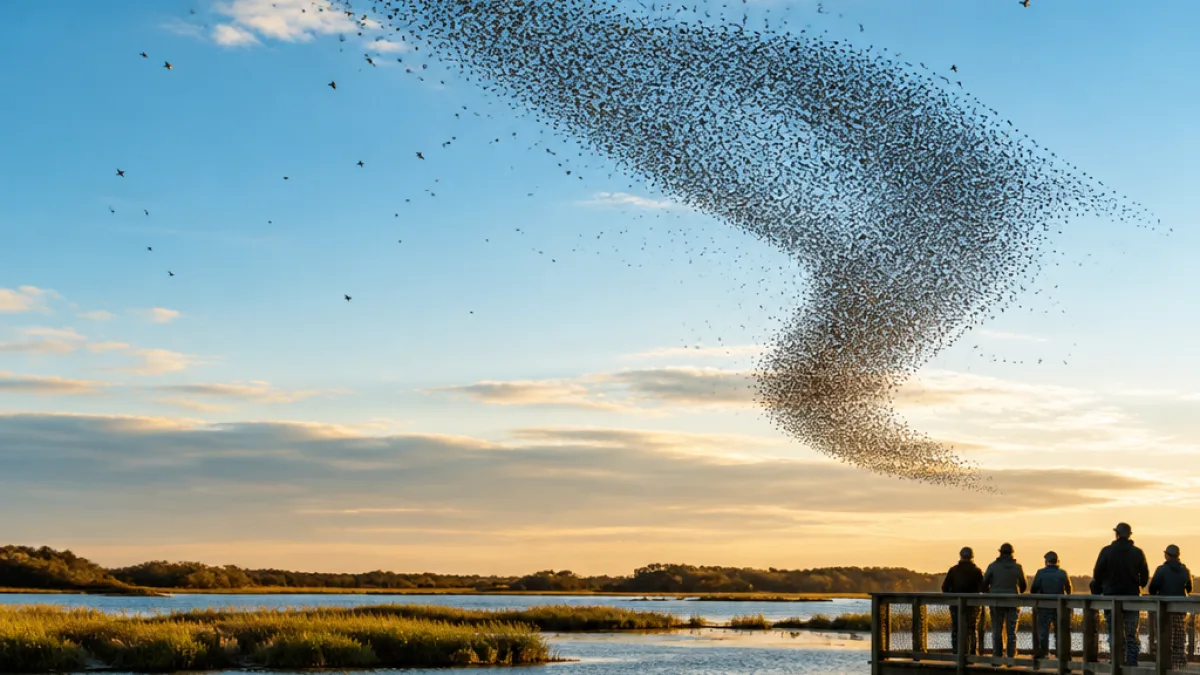
NEWBURYPORT — Thousands of tree swallows converged over Parker River National Wildlife Refuge in mid-September, forming a dense, rotating cloud of birds that the U.S. Department of the Interior affectionately called a "birdnado." The event, captured on video and shared by federal officials, is part of an annual fall migration pattern along the Massachusetts coast.
What visitors saw
On Sept. 14, observers at the refuge watched as flocks of tree swallows gathered above tidal marshes and open water before continuing their southbound migration. The birds circled and swooped in tight formations, creating a dark, twisting mass in the sky that at first glance resembled a small tornado.
"When enough swallows show up at once, migration starts looking a lot like Twister... the original... not the remake,"
The tongue-in-cheek line came from the Department of the Interior’s social media post accompanying the video. Along with the dramatic visuals, the footage highlighted a routine behavior: swallows pausing to rest and feed on insects and available berries before resuming their journey.
Why it happens here
Massachusetts’ coastline and marsh systems provide an ideal stopover for tree swallows during fall migration. Mass Audubon lists the tree swallow as the state’s most abundant swallow species, and the birds are well adapted to roosting in large numbers near salt marshes and shoreline habitats.
Experts say the spectacle is not an isolated oddity but a predictable part of the seasonal movements of these birds. The U.S. Fish and Wildlife Service describes massing events at Parker River as an annual phenomenon, with the number of birds swelling quickly as migrants gather to feed on emergent insects and other available food sources.
Scale and behavior
Tree swallows are social birds outside the breeding season, and their flocking behavior can produce concentrated swarms that number from the tens of thousands to — in some cases described by ornithologists — the hundreds of thousands. Around sunset, swallows commonly assemble into dense evening roosts, circling above a marsh or other secure site as more individuals join and then drop down to settle for the night.
| Feature | Typical observation |
|---|---|
| Timing | Late summer into fall migration (August–September) |
| Flock size | Tens of thousands; can build toward hundreds of thousands |
| Common locations | Coastal marshes, salt flats, and refuge roosting sites |
Local and visitor implications
For birdwatchers and photographers, the phenomenon offers a striking opportunity to observe migration dynamics in real time. Parker River National Wildlife Refuge, managed by the U.S. Fish and Wildlife Service, is a known hotspot for fall migration and draws visitors hoping to witness shorebirds, waterfowl and flocking swallows.
Officials and conservation groups encourage visitors to enjoy the spectacle from appropriate distances to avoid disturbing roosting birds. Disturbance during these gatherings can force birds to expend energy they need for migration, so minimizing noise, keeping dogs leashed and staying on designated trails are practical steps for responsible viewing.
- Best viewing: shoreline overlooks and refuge observation areas near dusk.
- Respect wildlife: maintain distance and follow refuge rules to avoid disturbing roosts.
- Safety: use binoculars or telephoto lenses rather than approaching birds.
Conservation context
While the gatherings are a natural part of the tree swallow’s life cycle, they also highlight the importance of intact coastal and marsh habitats. These areas offer the food and shelter migratory birds need to complete long-distance journeys. Habitat loss, pollution and climate-driven changes to insect availability can influence the timing and success of migration.
The Parker River refuge continues to serve as a critical stopover for a variety of migratory species. Incidents like the recent “birdnado” can raise public awareness about the value of protecting coastal refuges and the species that depend on them.
The spectacle on Sept. 14 underscores a seasonal rhythm along the Massachusetts coast: every year, the skies can darken not with storm clouds, but with the synchronized movement of thousands of small bodies on a determined migration south.
















