
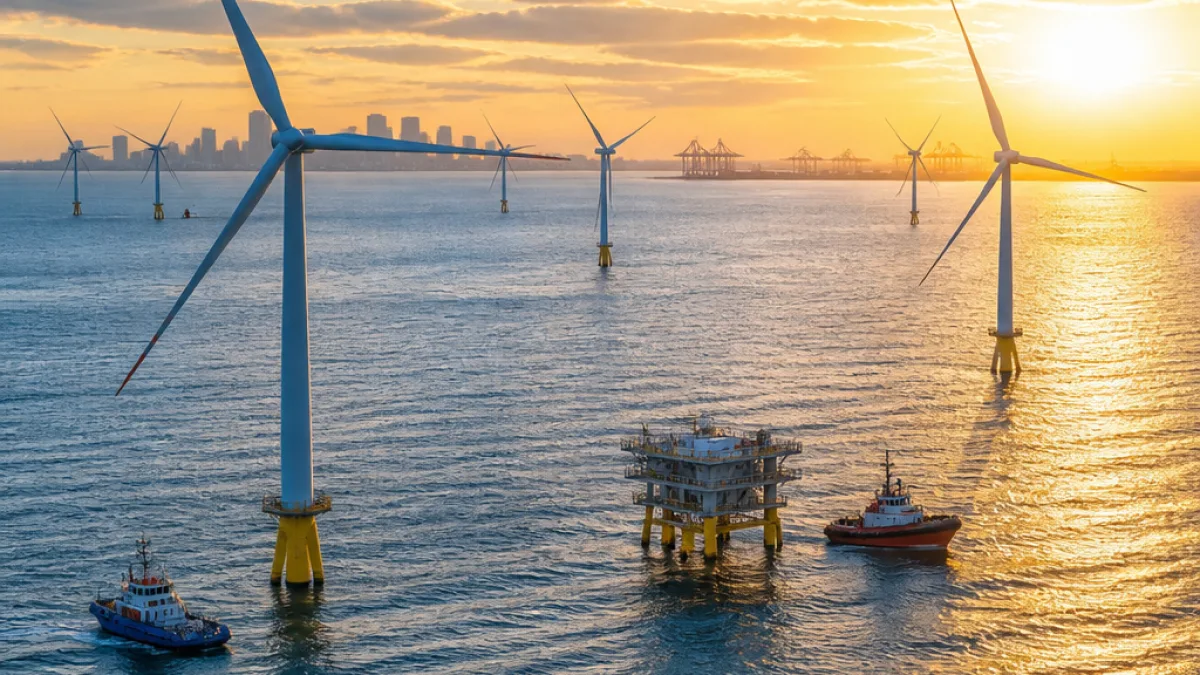
Boston — Vineyard Wind and GE Vernova announced a settlement Wednesday that ends a contentious legal fight over one of the largest offshore wind developments in the United States and removes a major source of uncertainty for the project off Massachusetts.
What the settlement does
Under the agreement, GE Vernova withdrew a formal notice seeking to terminate its role in Vineyard Wind 1, and both sides agreed to dismiss all outstanding legal claims, according to statements released by the companies. Financial and other terms of the settlement were not disclosed.
The resolution follows months of escalating litigation after GE Vernova said it intended to exit contracts covering turbine construction and maintenance, asserting the company had not been paid more than $300 million for work on the project. Vineyard Wind countered in Massachusetts state court, obtaining an injunction that required GE Vernova to continue servicing the wind farm while disputes were litigated.
Technical and operational context
The disagreement was tied in part to problems stemming from a turbine blade failure in 2024 that scattered debris onto nearby beaches and led to extensive inspections and repair work. Vineyard Wind maintained it was entitled to withhold payments to offset costs it attributed to turbine defects and project delays; GE Vernova said the unpaid amounts gave it contractual grounds to terminate.
Resolving the dispute was widely viewed as critical because GE Vernova remains the specialized turbine manufacturer needed for commissioning and ongoing servicing. Vineyard Wind had warned in court that replacing the manufacturer at this late stage could have seriously disrupted operations.
Project scale and current status
The Vineyard Wind 1 development is a roughly $4.5 billion project comprising 62 turbines with a total capacity of about 806 megawatts. The project is designed to supply power equivalent to the needs of more than 400,000 homes and businesses. The companies said Wednesday that all of the turbines are now capable of producing electricity.
| Item | Detail |
|---|---|
| Project name | Vineyard Wind 1 |
| Cost | $4.5 billion (approx.) |
| Number of turbines | 62 |
| Capacity | About 806 MW |
| Estimated homes powered | More than 400,000 |
| Owners | Avangrid Renewables and funds managed by Copenhagen Infrastructure Partners (equal ownership) |
Implications for Massachusetts
The settlement clears a legal and commercial overhang on a project that's been closely watched as a test case for large-scale offshore wind in the United States. For Massachusetts, the outcome reduces near-term uncertainty about clean energy supply, project jobs and the economic activity tied to construction and operations.
- Energy supply: With turbines producing electricity, the project should contribute to regional renewable generation targets.
- Workforce and local economy: Continued commissioning and servicing preserve jobs tied to the installation and maintenance phases.
- Legal precedent: The settlement ends litigation that raised questions about contractual risk allocation in complex offshore projects.
What remains unclear
While the settlement ends court battles and restores GE Vernova’s role, the companies did not disclose how the parties resolved the underlying financial dispute, including the specific amounts at issue or any payments that might have been made to settle claims. Officials also did not outline a timetable for when the project will achieve any remaining milestones or provide fuller details about long-term maintenance arrangements.
Vineyard Wind is owned equally by Avangrid Renewables and funds managed by Copenhagen Infrastructure Partners, per the project’s website.
Why this matters
The Vineyard Wind case has attracted attention beyond Massachusetts because it touches on the broader question of how commercially and legally fragile early U.S. offshore wind projects might be when technical defects, cost overruns or disagreements arise. The ability of a project owner and a turbine manufacturer to reach a private settlement — rather than let a dispute force a costly supplier change or protracted litigation — may influence how future projects approach contract terms, risk sharing and contingency planning.
For Massachusetts consumers and policymakers, the settlement reduces one immediate source of uncertainty about the deployment of large-scale offshore wind capacity intended to help meet the state’s clean energy goals.
Reporting from the companies provided the basis for this account; further details about the settlement were not released as of Wednesday.
















