
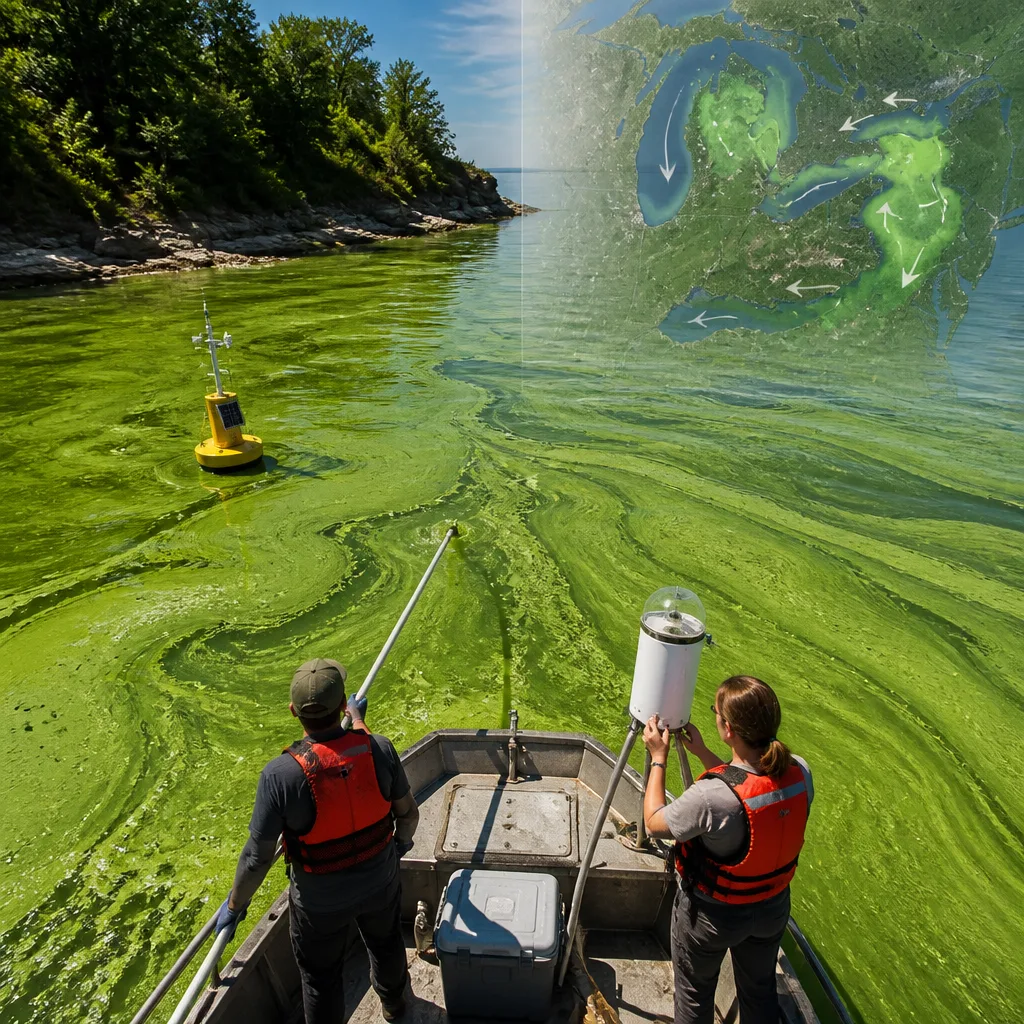
The harmful algal bloom stretching across the western basin of Lake Erie currently covers just under 400 square miles, with the densest concentrations in Maumee Bay, federal and local researchers say. Scientists are pursuing four targeted lines of study to better understand what the blooms produce, what causes them and how they may affect human health — including a newly intensified look at whether toxic compounds can become airborne.
Four coordinated research tracks
The Great Lakes Center for Freshwaters and Human Health has organized research into four principal areas. Together, the projects aim to link environmental drivers, toxin chemistry, aerosol formation and direct human health outcomes.
- Nutrients and environmental variability: Investigators are examining how inputs of phosphorus and nitrogen, along with weather conditions, affect bloom formation and intensity.
- Toxin identity and mixtures: Researchers are cataloging the different toxins and other substances produced by blooms and assessing health effects when multiple compounds appear together.
- Aerosolization: This work focuses on bubble formation at the water surface and the potential for toxins such as microcystin to enter the air.
- Human inhalation impacts: A five-year study will track health effects tied to breathing airborne toxins associated with blooms.
“There are over 300 different types of microcystin, but that is only one of the things that are coming out of these blooms,” said Sara Guiher, a harmful algal bloom and water quality specialist with Ohio Sea Grant Extension. She noted that the aerosolization research team is collaborating with climate and weather modelers to explore whether information about airborne toxin presence and movement can be incorporated into forecasting tools.
“They are working with modelers who look at climate and weather to see if we can incorporate it maybe into forecasts – you know – toxins are presents, they are going into the air, and how they might move,”
Why aerosolization matters
Most public attention on harmful algal blooms has focused on contaminated drinking water or direct contact during recreational activities. The new aerosolization studies examine whether bubbles and surface agitation can carry toxin-containing particles or droplets into the air, creating an inhalation exposure pathway.
Researchers say determining the extent to which toxins become airborne could change how officials assess risk near shorelines and inform public-health guidance, particularly for waterfront communities, beaches and people who work on or near affected waters.
Complex chemistry, complex risks
Beyond airborne pathways, scientists emphasize the chemical complexity of blooms. The second project is cataloging a broad array of compounds produced by cyanobacteria and is investigating how combinations of chemicals might interact to influence toxicity. Guiher highlighted microcystins as one class among many; the program’s scope is deliberately broad to avoid focusing on a single compound.
| Research area | Primary focus |
|---|---|
| Nutrients and variability | Phosphorus, nitrogen, weather drivers |
| Toxins and mixtures | Identification of compounds, human health implications |
| Aerosolization | Bubble formation and airborne transport of toxins |
| Inhalation health study | Five-year investigation of health effects from airborne exposure |
Officials also point to existing forecasting tools. The National Oceanic and Atmospheric Administration maintains a Lake Erie Harmful Algae Bloom Forecast that provides maps and projections of bloom extent and movement — a resource local agencies use to guide advisories and management actions.
Public guidance and timing
September is typically a month when blooms begin to subside, officials said, but clusters of algae that remain can still contain harmful substances. Public-health guidance continues to advise avoiding contact with dense mats or scums and to heed local advisories for drinking water and recreational use.
The coordinated research effort aims to produce better evidence to inform those advisories, refine forecasting systems and clarify risks from both waterborne and airborne exposures. As the five-year study and aerosolization experiments advance, scientists say they expect to provide more nuanced recommendations for communities and managers facing recurrent blooms in the Great Lakes region.
Reporting for this story relied on updates from the Great Lakes Center for Freshwaters and Human Health, Ohio Sea Grant Extension and federal forecasting resources.