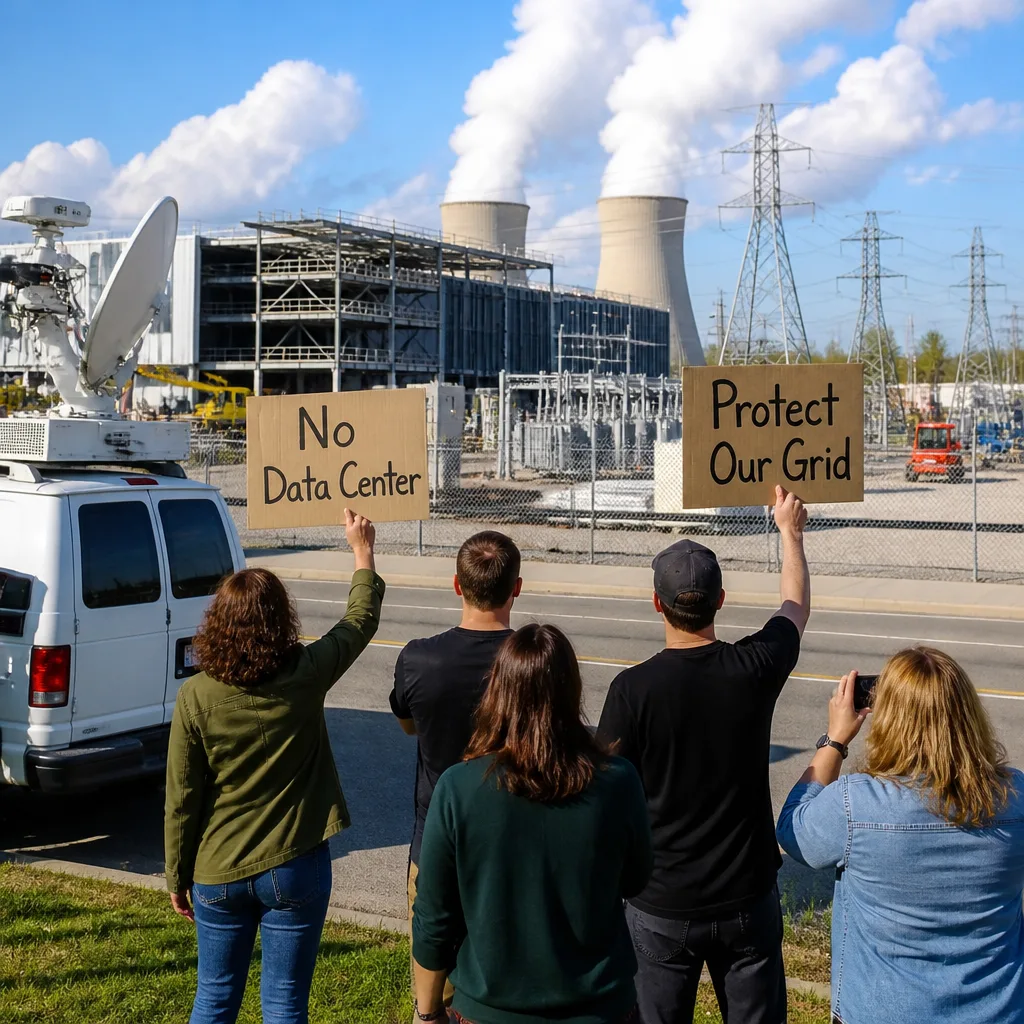
OpenAI CEO Sam Altman warned this week that the artificial intelligence industry has faltered in explaining the benefits of its technology, leaving developers vulnerable to a growing public backlash that has already thwarted or delayed a wave of data center projects in the United States.
Altman made the remarks in an interview with Bloomberg Television, saying the industry’s own communications failures have helped fuel local resistance to new data center construction. The backlash, he said, is not abstract: in one recent quarter, community opposition contributed to the blocking or postponement of at least $130 billion in U.S. data center projects, according to a count compiled by Data Center Watch.
“I think we have done a bad job ourselves, maybe better than some others, worse than some others,” Altman said, adding that people become anxious when they believe technology leaders seek to consolidate power or limit public control.
Local pushback meets planning and energy limits
The public resistance that Altman described has intersected with concrete infrastructure constraints in parts of Europe, demonstrating that the hurdles to expanding computing capacity are both political and physical. In Denmark, grid operator Energinet temporarily suspended new grid connections after discovering an accumulation of proposed projects far exceeding the country’s peak demand.
Energinet reportedly identified roughly 60 gigawatts of proposed projects queued against a national peak demand of about 7 gigawatts, prompting a pause while authorities devised new prioritization rules. Danish data center capacity at the start of the year was small relative to the queue: roughly 398 megawatts online and an additional 208 megawatts under construction.
| Metric | Value |
|---|---|
| Estimated U.S. projects blocked/delayed (one quarter) | $130 billion |
| Danish queued projects | ~60 GW |
| Danish peak demand | ~7 GW |
| Danish capacity online | 398 MW |
Industry communications and policy consequences
Altman’s critique frames the debate over the future of AI infrastructure in communicative as well as regulatory terms. He suggested that where developers failed to convey why facilities are needed and how they will operate, communities filled the information vacuum with concern — about energy use, local impact and the concentration of technological power.
For policymakers and company executives, the episode offers multiple lessons. First, technical explanations about energy consumption and sustainability plans are unlikely to persuade without early community engagement and transparent, locally tailored plans. Second, the Danish example shows that even well-crafted messaging will not overcome hard limits such as grid capacity. That has implications for siting decisions, investment timing and coordination with utilities.
- Community outreach will likely become a required component of project planning, not an afterthought.
- Coordination with grid operators and energy planners is essential, especially in regions close to capacity limits.
- Regulatory frameworks that mandate disclosure of energy and sustainability performance can shift the debate from projection to data-driven assessment.
European regulators have taken steps in that direction. Since 2024, data centers above a specified power threshold have been required to report energy and sustainability metrics into a continent-wide database, rules that aim to ground planning discussions in verifiable information rather than rhetoric.
The tally of delayed or blocked U.S. projects in the referenced quarter approaches the total number for the prior year, underscoring the scale of resistance. For AI companies racing to scale computing capacity, managing local expectations and navigating physical limits on power infrastructure are emerging as central strategic challenges.
As debates over the societal role of AI continue, Altman’s comments spotlight a broader dilemma for the industry: winning hearts and minds may be as important as building the next data center.