
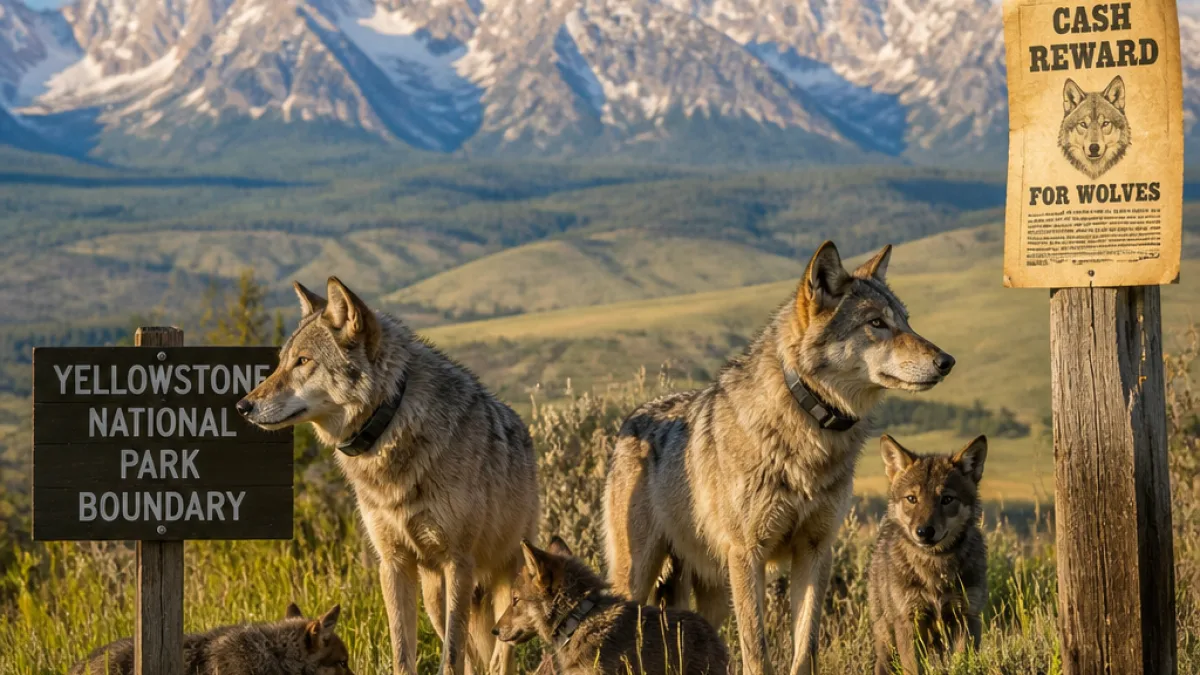
Mollie’s Pack, one of Yellowstone National Park’s most storied wolf families, has largely returned to its traditional park territory after spending part of the summer outside the park, wildlife officials said — a shift that increases the likelihood the pack’s remaining members, including pups and an elderly female, will avoid Wyoming’s opening wolf hunting season.
Back in home range
Yellowstone Wolf Project Leader Dan Stahler told reporters the animals “have mostly been back in the park, and that includes the pups,” signaling a retreat from the Absaroka Range northwest of Cody where the pack drew intense attention earlier this summer. That movement outside park boundaries prompted public threats from some hunters and, in response, an offer of a $10,000 bounty intended to expose anyone who legally kills the wolves.
“They’ve mostly been back in the park, and that includes the pups.”
Stahler declined to discuss exact pack composition but confirmed there were “some surviving pups” a few weeks ago. In July, WyoFile reported the pack then numbered five adults and five pups, with three adults fitted with tracking collars. Among the remaining adults is Wolf 1090F, a roughly 12-year-old female who is now one of the oldest wolves documented in Yellowstone and Wyoming.
Why the return matters
Yellowstone National Park prohibits hunting, so wolves inside park boundaries are not subject to the state’s harvest regulations. Mollie’s Pack’s movement back into Yellowstone’s core territory — described by biologists as stretching from Yellowstone Lake through Pelican Valley and north into Lamar Valley — reduces the immediate risk posed by hunters during the state-managed season, which begins Tuesday.
Wyoming Game and Fish Department Deputy Director Jeff Davis acknowledged the stakes. “This would be a big damn thing,” he told WyoFile when asked about the prospect of Wolf 1090F becoming the oldest recorded wolf in state history. Davis’ comment underscores both the symbolic value of long-lived wolves and the difficult policy choices state wildlife managers face when prominent packs range near hunting areas.
Pack history and public reaction
Mollie’s Pack traces its lineage to wolves reintroduced to Yellowstone in 1995-96 and is named for former U.S. Fish and Wildlife Service Director Mollie Beattie. The pack’s temporary shift onto the Absaroka Range earlier this summer provoked heated responses: some hunters publicly vowed to pursue the animals where legal, while at least one individual offered a bounty to identify people who legally killed wolves.
The exchange highlighted the tensions that persist in Wyoming between wildlife recovery advocates and hunters and ranchers who contend with wolves on the landscape. Those tensions inform management decisions and fuel public debate over where and how wolves should be allowed to live and be managed.
Current status and known numbers
Yellowstone biologists have been tracking Mollie’s Pack but have not released a current, detailed count. The last publicly reported snapshot from July showed:
- Adults: 5 (three with collars)
- Pups: 5
- Notable individual: Wolf 1090F, ~12 years old
| Metric | July report |
|---|---|
| Adults | 5 (3 collared) |
| Pups | 5 |
| Oldest noted wolf | 1090F (~12 years) |
Management implications
State managers must balance species conservation, legal hunting frameworks and private-landowner concerns. Because Yellowstone remains a refuge from harvesting, the pack’s presence inside park borders provides a temporary buffer. Yet wolves are wide-ranging, and vulnerable members may still move outside protected boundaries at times.
Officials from both the park and state agencies typically avoid sharing precise locations or detailed pack compositions to minimize harassment and reduce human-wildlife conflict. That discretion aims to protect animals that can become easy targets when their whereabouts are publicized.
What to watch
Biologists will monitor Mollie’s Pack through the coming weeks to see if they remain within the park as the state season unfolds. Key indicators to follow include pup survival, movements of collared adults and whether the elderly female, Wolf 1090F, continues to avoid mortality.
The story of Mollie’s Pack is a reminder of the complex interplay between conservation success and human dimensions of wildlife management in Wyoming. The pack’s partial retreat into Yellowstone gives managers, advocates and the public a brief respite to consider policies and protections for wolves that remain contentious across the region.
Reporting from Cody and Yellowstone National Park. — Cody Marsh, State Correspondent
















