
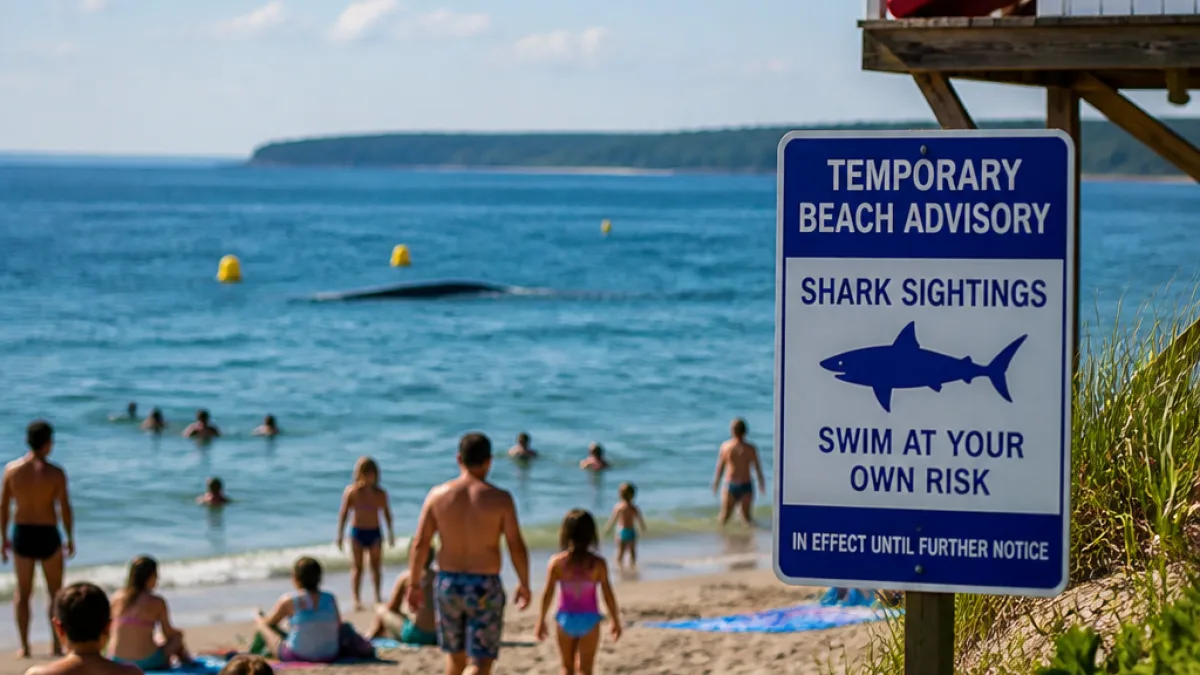
LINCOLNVILLE — Recent reports of multiple white shark sightings in southern Maine have drawn attention statewide, but at Lincolnville Beach on Wednesday many visitors said the coastal waters remain part of their regular summer routine.
Jenny Richardson-Rossbach, who moved to Thomaston five years ago from Monterey Bay, California, said she has noticed more sharks around Maine in recent years but does not plan to curtail family beach time.
“It makes me a little nervous, but it’s also like, if you’re gonna play in the ocean, there’s big stuff in there,” Richardson-Rossbach said as she held her infant daughter, who wore a shark-patterned onesie.
State officials and marine scientists say it is premature to declare southern Maine an established seasonal habitat for migratory white sharks. Matt Davis, hired as Maine’s first shark biologist after the state’s first fatal shark attack in 2020, noted that more sightings could reflect broader changes in populations rather than a permanent shift in distribution.
What officials and beachgoers are seeing
In recent weeks, numerous white sharks have been reported in southern Maine waters. Incidents include a Scarborough episode in which a 71-year-old lifeguard was pulled underwater after a shark grabbed his flotation device; a temporary suspension of swimming at Reid State Park in Georgetown following a sighting; and additional sightings at Wells Beach. Those events have heightened awareness, particularly in communities along the southern coast.
Despite these reports, many midcoast visitors remain unalarmed. “That’s their home. That’s where they live. It’s like going into the woods and not expecting to see a bear,” said a woman on a bench at Lincolnville Beach who gave only her first name, Janet.
Possible reasons behind increased sightings
Experts say the uptick in sightings could be connected to long-term conservation measures. Federal protections for white sharks and for seal populations — a primary food source — have been in place for decades, and some biologists believe those policies may be allowing populations to rebound toward historical levels.
That recovery, combined with natural migratory patterns, might explain why sharks are appearing more frequently along the Maine coast in summer months. State biologists caution, however, that further study is needed to determine whether the sightings represent a seasonal shift in habitat or simply more frequent encounters as populations recover.
Local response and public safety
Local officials have taken precautionary steps in response to individual sightings, including temporary closures of swimming areas. Lifeguard services and park managers are monitoring beaches and adjusting advisories as appropriate.
- Scarborough: lifeguard dragged underwater by flotation device after shark interaction.
- Reid State Park, Georgetown: swimming temporarily suspended after a sighting.
- Wells Beach: additional sightings reported.
Beachgoers we spoke with at Lincolnville said they take basic precautions and consider sharks part of coastal life, similar to encounters with other wildlife. For many, the variety of beaches along midcoast Maine offers alternatives when concerns arise in other regions.
What swimmers should know
State wildlife and marine officials recommend staying informed about advisories, swimming at staffed beaches when possible and following posted guidance. Avoiding dawn and dusk hours, staying in groups and refraining from entering water with open wounds or when wearing shiny jewelry are commonly advised precautions around shark habitats.
While media attention often focuses on dramatic incidents, experts emphasize that shark encounters remain uncommon relative to the number of people who use Maine’s beaches each year. Continued monitoring, reporting and research by the state biologist and federal partners will be important to clarify patterns and guide public advice.
For now, many Maine residents and visitors say they will continue to enjoy the coast while taking sensible precautions.
















