Poll finds race within margin of error; voter motivations differ
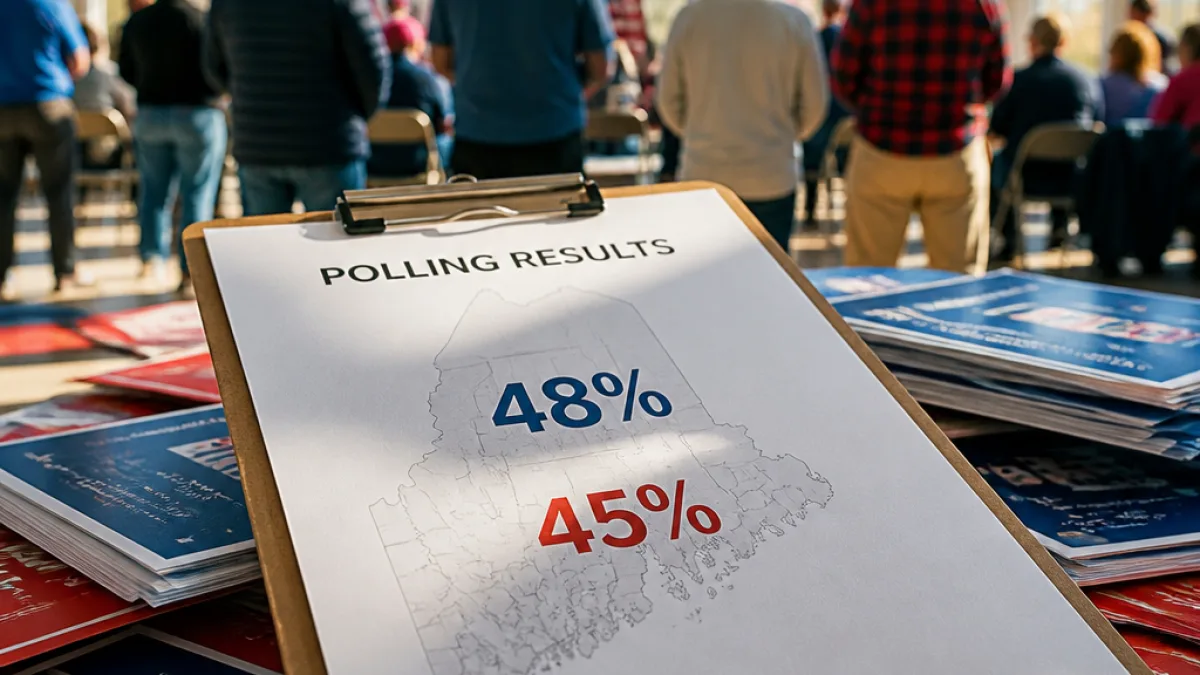
A new CNN/SSRS poll released Wednesday shows a narrowly divided contest for Maine's U.S. Senate seat, with Democrat Troy Jackson at 48% and Republican incumbent Sen. Susan Collins at 45%. The survey of 880 registered voters, conducted from Aug. 31 to Sept. 6, places the gap well inside the poll's ±3.7 percentage-point margin of error.
While the topline numbers suggest a neck-and-neck race, the poll reveals contrasting reasons behind each candidate's support. Among respondents who said they would back Jackson, roughly three in 10 described their vote as a vote for him; the larger share — about seven in 10 — characterized their choice as a vote against Collins. By contrast, those who said they would vote for Collins were far more likely to report positive reasons: roughly three-quarters said their vote was for Collins herself, while one-quarter said it was primarily a vote against Jackson.
Undecided voters and national politics shape the picture
The survey also found a significant bloc of voters who remain open to persuasion: 18% said they had either not chosen a candidate yet or could be swayed to change their pick. The poll measured how respondents framed their Senate vote in relation to President Donald Trump: 46% said their vote was intended as a message opposing the president, 17% said it was a message supporting him, and 37% said their vote was not a message to the president at all.
Voters identified the top issues driving their choices. The economy and the cost of living, along with concerns about the state of U.S. democracy, topped the list — a reflection of both pocketbook and institutional anxieties among Mainers. The survey also found widespread dissatisfaction with national leadership, with two-thirds of respondents disapproving of how the president is handling the job and 84% saying they are either angry or dissatisfied with the way things are going in the country.
Favorability split and gubernatorial note
The poll showed a mixed picture on personal impressions: Collins held a higher favorable rating than Jackson but also carried a higher unfavorable rating. Those contrasting impressions underscore a polarized electorate in which name recognition does not translate uniformly into unconditional support.
The CNN/SSRS survey additionally asked about Maine's gubernatorial race but did not include Independent Rick Bennett on the ballot options. In the two-way matchup between Democrat Hannah Pingree and Republican Bobby Charles, Pingree led 52% to 39%.
- Poll sample: 880 registered voters
- Field dates: Aug. 31–Sept. 6
- Margin of error: ±3.7 percentage points
| Candidate | Share |
|---|---|
| Troy Jackson (D) | 48% |
| Susan Collins (R) | 45% |
| Undecided / could change | 18% |
Implications for both campaigns
Campaign strategists are likely to zero in on the motivations highlighted by the poll. Jackson's advantage in the survey appears to be driven in part by voters motivated to remove Collins, while Collins' support appears more affirmative. For both sides, the presence of nearly one-fifth of voters who are undecided or persuadable means late-campaign outreach and turnout operations could be decisive.
Voter concern about the economy and about democracy suggests both campaigns may tailor messaging toward those areas in the weeks before November. Given the high level of dissatisfaction with national conditions reported in the poll, local and retail campaigning that addresses cost-of-living pressures and democratic institutions could resonate with segments of the electorate that have not yet made up their minds.
Because the survey's margin of error overlaps the margin between the two candidates, the numbers do not predict a clear winner. They do, however, offer a snapshot of a divided electorate where the reasons behind votes — whether affirmative support or opposition to an opponent — may be as consequential as the raw totals themselves.
As the campaign season progresses, both campaigns will likely emphasize different interpretations of the data: Jackson's camp can point to a lead in the poll, while Collins' team can stress the high share of voters who say they plan to vote for her rather than merely against her opponent. For Maine voters, the poll underscores that the race remains competitive and that the selection of strategy and turnout efforts could determine the outcome.