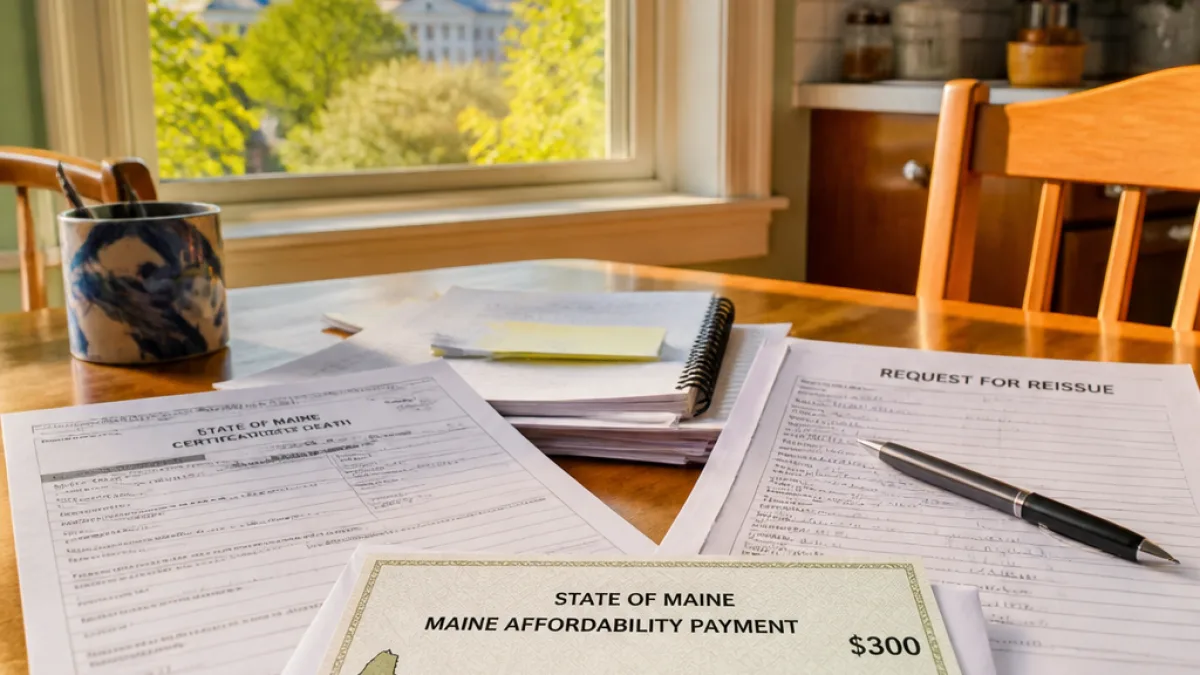
A one-time Maine affordability payment of $300 has left some families wondering what to do when the relief check is addressed to a relative who has died. The state began mailing the payments in late July, and because eligibility was determined by 2025 tax filings, checks are being sent to some deceased Mainers or to estates that filed taxes after the taxpayer’s death.
Why checks are arriving for deceased people
The Maine Department of Administrative and Financial Services required issuing payments when records show a 2025 tax filing — whether the return was filed before the taxpayer’s death or the estate filed afterward. That administrative rule means beneficiaries, surviving spouses and estate representatives are receiving checks tied to those filings.
State officials say a surviving spouse or an authorized representative of the deceased’s estate is permitted to cash the payment. Some financial institutions will accept checks made out to deceased account holders; others will not, which can leave family members unsure how to proceed.
Options if the bank won’t accept the check
If a bank refuses to accept a check made out to someone who has died, Maine Revenue Services offers a formal way to have the payment reissued in the name of the person handling the estate or the surviving spouse. The state provides a downloadable form for that process, and it is also available on request by emailing income.tax@maine.gov.
- Attempt to cash the check at a bank that will accept payments addressed to a deceased person.
- If unsuccessful, download or request the reissue form from Maine Revenue Services.
- Complete the form, attach the original check and mail both to the address on the form.
- If you are a family representative (not a spouse), include the additional documentation listed on the form to show authority to act for the estate.
The form spells out different documentation requirements depending on whether the claimant is a spouse or an estate representative. For survivors who are married to the deceased, the process is generally simpler; representatives of an estate must provide additional paperwork as outlined by the state.
Who qualified for the payment
To have received the $300 relief payment, the recipient had to meet Maine’s residency and income rules tied to the 2025 tax year. The state requires that recipients be full-year Maine residents, and it set federal adjusted gross income caps by filing status.
| Filing status | AGI cap |
|---|---|
| Married filing jointly | $100,000 |
| Head of household | $75,000 |
| Single or married filing separately | $50,000 |
Those caps determine eligibility regardless of whether the taxpayer is living at the time checks are mailed, if the 2025 filing shows them within the thresholds.
Practical notes for families and estate representatives
Family members who receive a check addressed to a deceased loved one should first try their own bank; acceptance policies vary. If the bank declines, follow the state’s reissue process and mail the form with the original check to Maine Revenue Services. The form itself is not posted directly on the state’s general web pages but is available as a PDF download or by email request to income.tax@maine.gov.
Questions about individual situations can be directed to the Office of Maine Revenue Services or to the Ask 8 Investigates team at 8investigates@wmtw.com, which is collecting viewer queries about the affordability payments and other consumer concerns.
The state’s approach aims to ensure people who were eligible under 2025 tax records receive the intended relief, while giving surviving spouses and estate representatives a clear path to claim the funds when checks go to deceased individuals.