
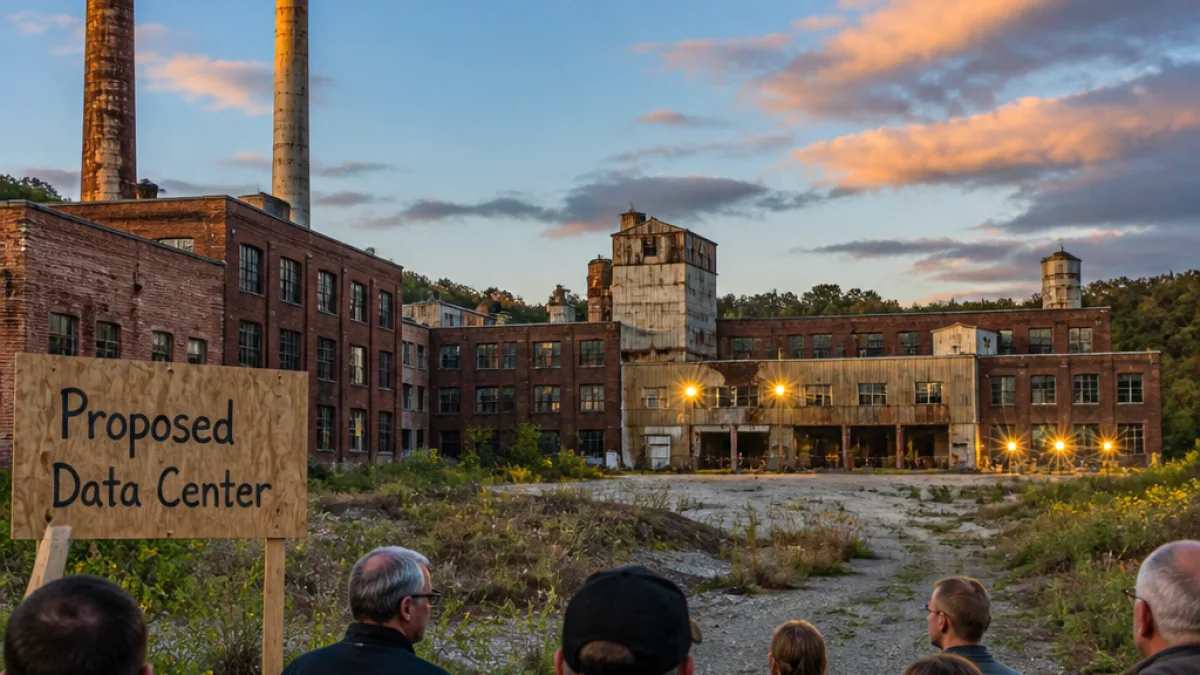
JAY, Maine — Town officials in Jay have publicly supported a plan to build a large AI-style data center on the former Androscoggin Mill property, a proposal that highlights the tensions between economic need and environmental or infrastructure concerns that have recently driven resistance to similar projects elsewhere.
Why Jay is betting on a data center
The proposal targets the roughly 1,000-acre mill site that once anchored Jay’s economy. Before a 2020 explosion destroyed the complex, the mill employed more than 1,500 people. In a town of about 4,600, losing that employer left a substantial gap in jobs and local tax revenue.
Developer Tony McDonald has pitched the data center as a path to recovery. According to reporting summarizing McDonald’s presentation, the completed facility could create about 125 to 150 full-time high-paying jobs — a modest number relative to the mill’s former workforce but significant for a small town still searching for new anchors of economic activity.
"Would a data center be loud? Can't be as loud as the mill! Could it smell bad? The mill smelled like rotten eggs! Would it pollute the environment? The river was covered in toxic foam in the mill days!"
That line of argument — which contrasts the data center’s impacts with the mill’s worst legacies — helped persuade Jay’s five-member select board to back the proposal while the state weighs broader policy options.
How the debate in Jay fits a larger trend
Across the United States, communities are weighing similar proposals for large-scale AI and cloud-computing data centers. Supporters highlight jobs, tax revenue and reuse of industrial land; opponents raise concerns about high electricity and water use, environmental impacts and strain on local infrastructure. In Maine, calls for a statewide moratorium on certain data center approvals have surfaced amid those concerns.
Jay’s situation differs in key respects because the town is actively seeking substantial investment after the mill’s closure. Town leaders appear willing to accept trade-offs that other communities have rejected — in part because the immediate economic need looms large.
Local considerations and unanswered questions
Public documents and reporting so far make clear some central points but leave many operational details unresolved. Important factors that will shape community impacts include:
- Energy demand and source: Data centers consume large amounts of electricity; whether that power would come from the regional grid, private onsite generation or renewable sources is critical to environmental and cost outcomes.
- Water use and cooling strategy: Some facilities rely on significant water cooling; the plan’s approach will affect local water resources and regulation.
- Tax arrangements and long-term local benefits: The number of jobs is one metric, but municipal revenues, supply-chain opportunities and secondary economic effects determine the net benefit to Jay.
Supporters emphasize that the site is already industrial and that the facility could be quieter and cleaner than the mill in its heyday. Skeptics point to statewide cautionary moves and the broader public debate about siting energy-intensive facilities near small municipalities.
Numbers at a glance
| Metric | Figure |
|---|---|
| Population of Jay | ~4,600 |
| Former mill employment | >1,500 |
| Projected data center jobs | 125–150 |
Next steps and what to watch
The town’s backing does not mean the project will proceed without scrutiny. State-level debate about moratoriums and tighter review processes remains active, and any developer must still resolve permitting, power contracts and environmental compliance. For Jay residents, the coming months will be a test of whether the promise of new investment outweighs concerns about resource use and long-term community impacts.
As the proposal advances, residents and local officials will likely focus on concrete commitments from the developer regarding energy sourcing, water management and local hiring. Those details will be central to determining whether the project provides a durable economic boost or creates new challenges for the community.
Reporting on the proposal continues; officials in Jay and proponents of statewide review have signaled the debate will inform broader policy around where and how to site the facilities powering artificial intelligence and cloud computing.
Nora Whitfield is the state correspondent for WE NEWS.
















