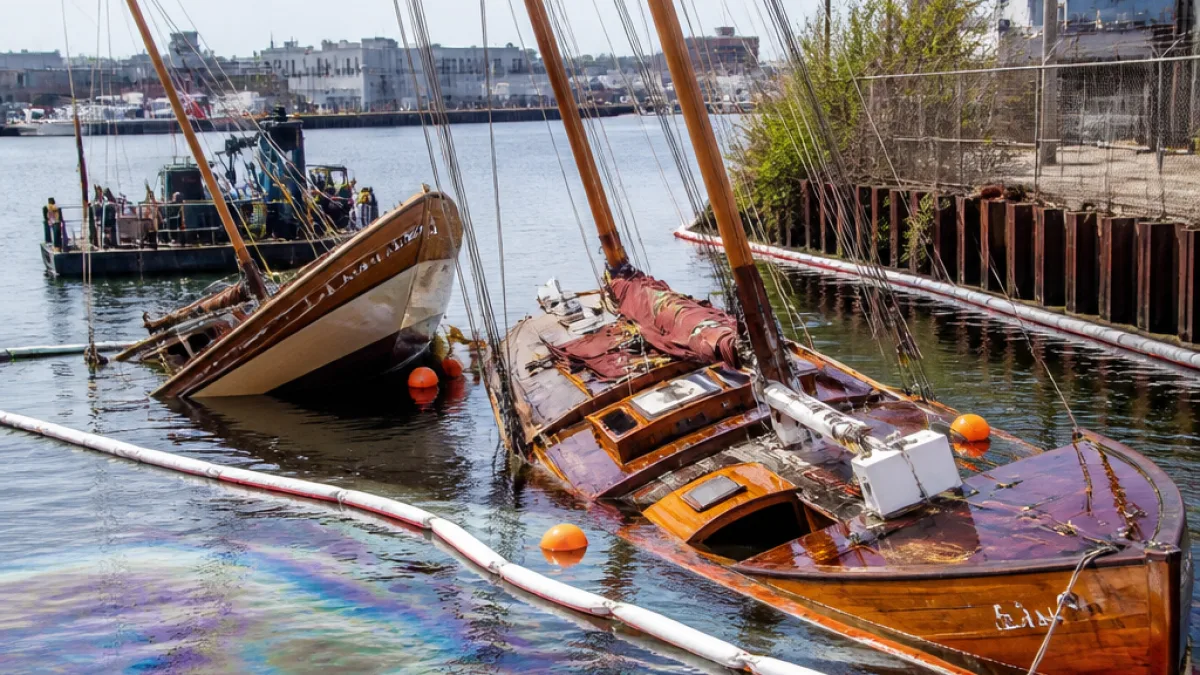
Two well-known wooden schooners with long ties to New England maritime history — the 121-foot Pilot and the 128-foot Victory Chimes — sank this summer at a Brooklyn inlet adjacent to the heavily polluted Gowanus Canal, raising questions about the fate of historic vessels and the responsibilities of their new owners.
Historic vessels, modern trouble
The Pilot, just over a century old, and the Victory Chimes, built in 1900 and depicted on the 2003 Maine state quarter, were owned by Crew, a New York company that converts historic boats into floating bars and restaurants. Both schooners went under while moored on the city’s waterfront around the time strong squalls moved through the area in early July.
Crew’s chief executive, Alex Pincus, said the company is coordinating with insurers, marine salvage teams and surveyors to determine next steps. He described raising large wooden vessels as a complicated undertaking that requires specialized gear and careful planning.
“Raising wooden vessels of this size is a highly complex operation that requires specialized equipment, careful planning and extensive coordination,”
Still, members of the maritime and local paddling communities are urging the company to act swiftly to preserve the ships and to explain what happened.
Calls for answers and accountability
Brad Vogel, a member of the Gowanus Dredgers canoe club, said the potential loss of the schooners would be “a shame” and “in some ways unforgivable,” and urged transparency from the owner about salvage plans and the cause of the sinkings.
"People in Maine, people in New York City, do want answers, and want to know what’s going on. And it’s not at all certain that there is a commitment to raising the vessels,"
Vogel and others who paddle near the sunken ships say the presence of historic craft in such a toxic waterway intensifies concerns about both cultural loss and environmental risk. The Gowanus Canal has a long history of contamination and is a Superfund site; an inlet serving as final resting place for century-old wooden hulls raises questions about leakage of onboard materials and submerged debris.
Why the Victory Chimes matters to Maine
The Victory Chimes is listed on the National Register of Historic Places and represents the last surviving example of a Chesapeake ram, a shallow-draft schooner adapted to narrow waterways. Its image was selected for Maine’s state quarter in 2003, making it an emblem of the state’s seafaring past. Preservationists in Maine and beyond have expressed alarm at reports that the ship may be lost.
Technical and logistical hurdles to salvage
Raising large wooden vessels intact is technically demanding. Shipwrights, marine surveyors and salvage firms typically must evaluate hull integrity, stabilize structures, patch breaches, and coordinate with divers and cranes or lifting barges. In urban waterways like the Gowanus inlet, that work must also account for restricted access, nearby infrastructure and environmental permitting.
Crew has said assessments and planning are under way. Insurance processes and the need to engage specialized salvage contractors can slow decisions, though critics say speed is important to preserve fragile wooden hulls.
What is known about the two schooners
| Vessel | Length | Year | Notes |
|---|---|---|---|
| Pilot | 121 ft | ~100+ years old | Served in wartime; sank in July |
| Victory Chimes | 128 ft | 1900 | On National Register; appears on Maine quarter; sank in July |
Local and regional reactions
- Maritime preservation advocates say swift action is required to protect historic fabric and salvage any artifacts.
- Paddlers who use the Gowanus inlet for recreation are seeking clear information about environmental risks and clean-up plans.
- State and federal historic preservation entities may become involved if salvage or recovery actions proceed, particularly for a National Register-listed vessel.
For Maine residents who recognize the Victory Chimes from the state quarter and the region’s maritime lore, the news underscored how artifacts of local heritage can end up far from their original waters. The sinking also highlights broader challenges around preserving wooden vessels once they leave private ownership and enter commercial ventures that repurpose historic craft.
What to watch next
Key developments to monitor include whether Crew files a detailed salvage plan, the results of marine surveys that determine the cause of the sinkings, and any involvement by preservation authorities given the Victory Chimes’ National Register status. Environmental agencies and local community groups may also press for assessments of pollution risk tied to the submerged vessels.
The fate of both schooners remains unsettled as experts weigh the technical, financial and regulatory steps required to attempt a recovery. For now, two symbols of an older seafaring era lie submerged near one of New York City’s most notorious waterways, prompting questions about stewardship and the responsibilities owners bear for maritime heritage.