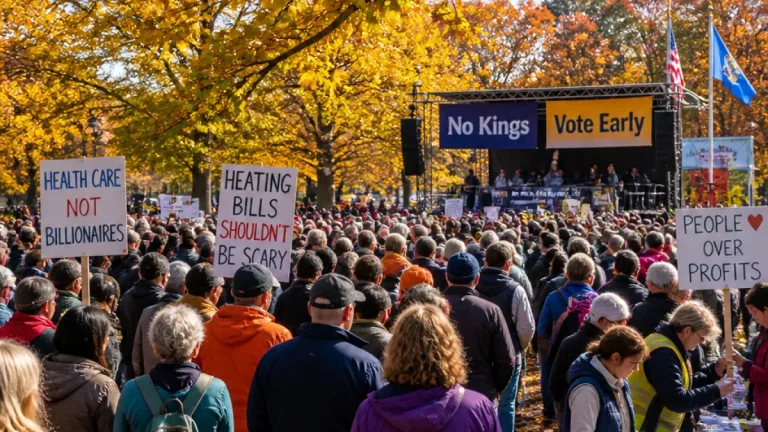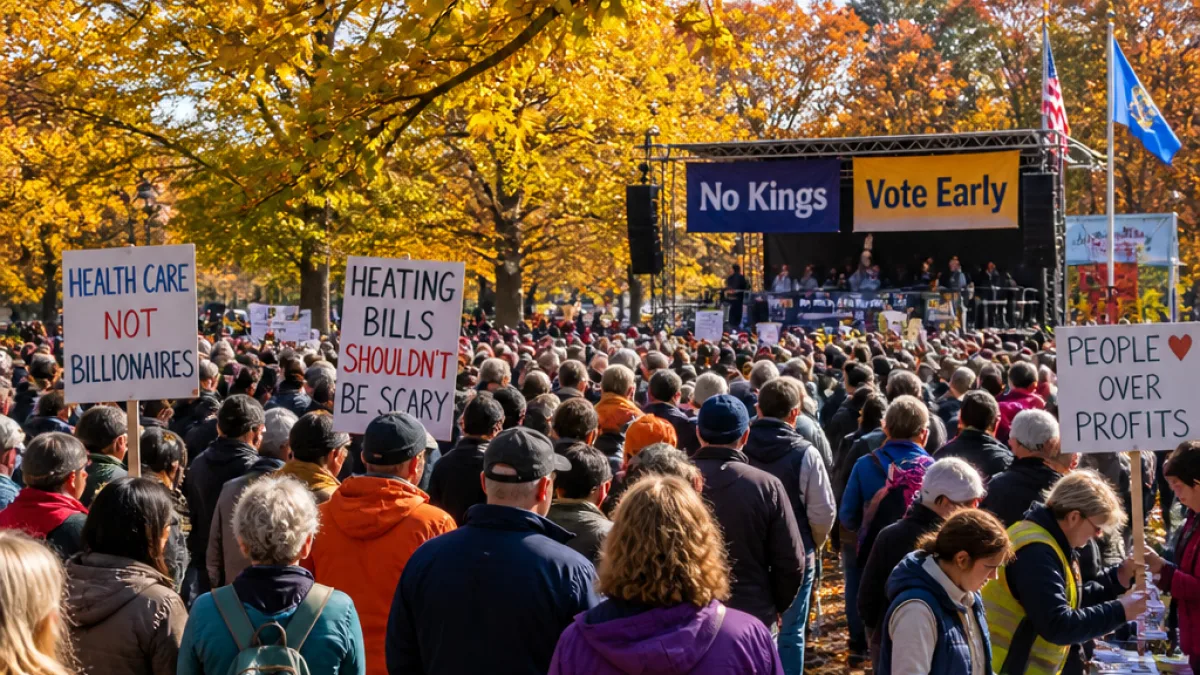
PORTLAND — Roughly 400 people gathered at Deering Oaks on Saturday to urge Mainers to vote early and to push for Democratic wins in the approaching midterm elections, organizers said. The rally, put together by Indivisible Greater Portland, was held on the fourth national “No Kings” day and targeted the re-election bid of five-term Republican Sen. Susan Collins.
Speakers at the event included Democratic gubernatorial candidate Hannah Pingree, U.S. Senate candidate Troy Jackson and U.S. Sen. Elizabeth Warren of Massachusetts. They addressed a range of issues — health care, the war in Iran, rising heating oil costs, immigration and abortion — and criticized the actions of President Donald Trump and the policy positions of Collins.
“Democracy is on the line here in Maine and across the country,” Pingree said. “Don’t leave it to chance.”
Local turnout and national context
Organizers said the Portland rally was part of a broader effort to mobilize voters across the state and nation. The “No Kings” protests began in prior years as demonstrations against what participants characterized as executive overreach by the Trump administration. This year, the focus shifted toward electoral engagement, with leaders urging early voting ahead of Election Day, Nov. 3.
At the rally, sentiment against both Collins and the president was visible on signs and banners. Participants repeatedly tied national disputes and controversies to local concerns, arguing that federal policy decisions affect everyday life in Maine, particularly on affordability and energy costs.
Speakers and key messages
The event’s speakers emphasized different campaign themes but converged on the need for voter participation. They argued that electing Democrats to key offices could influence the direction of national policy and affect local issues important to Mainers.
| Speaker | Role | Primary focus at rally |
|---|---|---|
| Hannah Pingree | Democratic gubernatorial candidate | Democracy and voter participation |
| Troy Jackson | U.S. Senate candidate (D) | Criticized Collins; urged turnout |
| Elizabeth Warren | U.S. Senator (D-Mass.) | National policy critiques and support for Jackson |
Speakers and attendees named several issues they linked to their vote: health care access and affordability, responses to the war in Iran, the rising cost of heating oil in Maine’s cold months, immigration policy and abortion rights. They held Collins responsible, in varying ways, for the state’s affordability challenges.
- Event: “No Kings” day rally organized by Indivisible Greater Portland
- Location: Deering Oaks, Portland
- Estimated attendance: about 400 people
- Notable speakers: Hannah Pingree, Troy Jackson, Elizabeth Warren
- Election date: Nov. 3 (midterm elections)
Why the rally matters in Maine
The Senate contest between Troy Jackson and Susan Collins is widely viewed by Democrats as a target race in their effort to build a Senate majority. Events like Saturday’s are intended both to galvanize the party base and to encourage undecided or infrequent voters to take part this fall. With early voting already underway in many parts of the country, organizers emphasized that turnout before Election Day can be decisive.
For many at Deering Oaks, the rally was a moment to register frustration as well as solidarity. Chris Beasley, an 86-year-old from Cape Elizabeth, carried a handmade sign and described a sense of betrayal among some citizens toward the federal government’s direction. He said the gathering was a reminder that the choice of representatives should align with democratic values.
As the campaign season tightens, rallies in population centers such as Portland will likely continue to play a role in candidate messaging and voter mobilization efforts. With less than three weeks remaining until the midterms, activists and campaigns are shifting resources to field organizing and turnout operations — the practical mechanisms that they say will determine the outcome in close contests.
Reporting from the rally underscores how national debates are being localized in Maine, with advocates connecting distant policy decisions to local economic and social concerns as they urge voters to participate.