London ready for rare late-evening partial solar eclipse
Londoners are being encouraged to head for the capital’s hills and open spaces on Wednesday 12 August to witness a rare partial solar eclipse expected to obscure about 90% of the Sun. The event is brief but spectacular: it starts at 6.17pm, reaches its maximum at 7.13pm and finishes at 8.06pm.
Royal Museums Greenwich — the body that includes the Royal Observatory — explains the phenomenon as the alignment of Earth, Moon and Sun so that the Moon passes in front of the Sun, casting a shadow on Earth. The observatory stresses that the next total solar eclipse visible from the UK is not due until 2090, making this an event worth seeing for many.
“A solar eclipse occurs when the Earth, moon and sun align. The moon passes in front of the sun and blocks its light, casting a small shadow on Earth.”
For Londoners wanting good sightlines and a bit of atmosphere, a number of elevated and open locations are recommended. Greenwich Park is likely to be a magnet for families and amateur astronomers; it pairs the Royal Observatory with a wide vista across the western sky. In south-east London, Telegraph Hill near Nunhead is suggested as a quieter alternative for those who want views but hope to avoid the biggest crowds.
- Greenwich Park — central vantage point next to the Royal Observatory and the Prime Meridian.
- Telegraph Hill — a popular local hill with wide west-facing views.
- Other high ground and large open spaces across London — rooftops, parkland and riverside promenades will also offer clear views.
Event timing at a glance
| Stage | Time (BST) |
|---|---|
| Start of eclipse | 6.17pm |
| Maximum eclipse | 7.13pm |
| End of eclipse | 8.06pm |
The Royal Observatory has clear guidance on safety. It warns that people must never look directly at the Sun without suitable filters. Specialist eclipse glasses meeting the recognised standards or a properly fitted solar filter on binoculars or telescopes are essential to prevent serious and permanent eye damage.
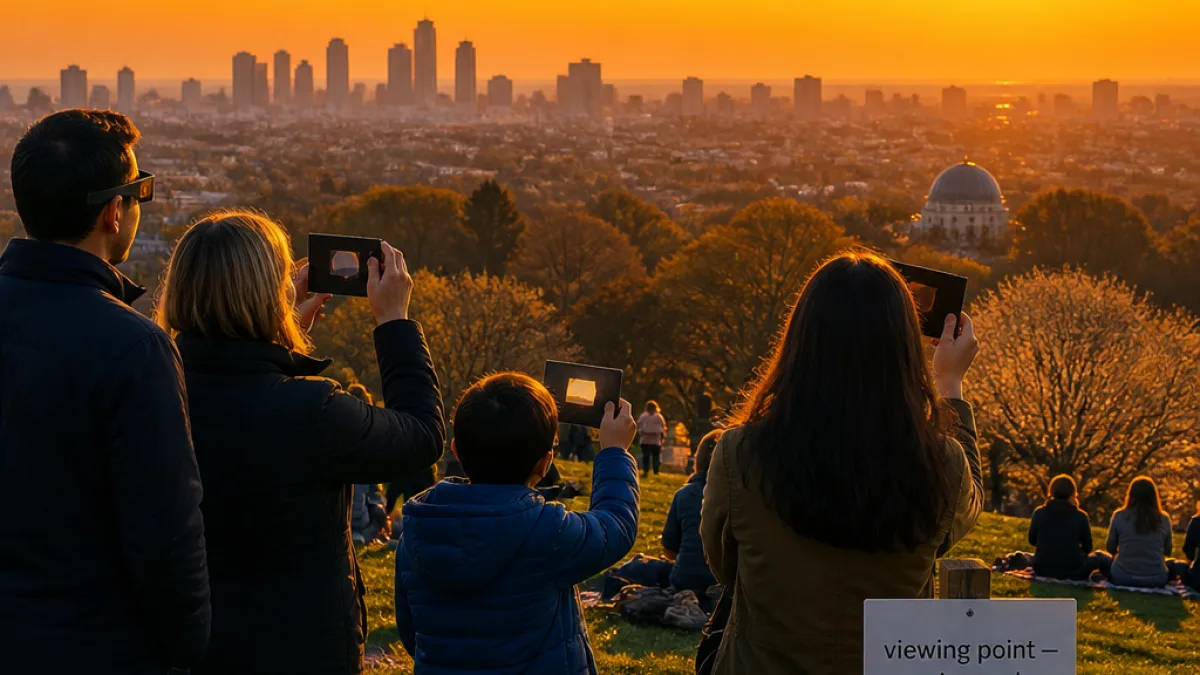
“A person should never look directly at the sun without the appropriate filters,” the observatory states, offering information on how to watch the event safely. Schools and community groups often arrange supervised viewings with protective eyewear — images from previous partial eclipses show children in parks wearing safety glasses while observing the Sun.
Practical points for London viewers: arrive early to secure space in busy parks, bring a chair or blanket, and check the weather forecast. Cloud cover can spoil the view, so those planning to travel across the city should consider a couple of backup locations. Public transport is likely to be busier than usual around popular viewing spots, so allow extra journey time.
Though Cornwall and parts of the south-west are forecast to receive the most dramatic coverage of the eclipse — with locations such as Land’s End and The Lizard Peninsula expected to see up to 95% obscuration — London’s position will still offer an impressive spectacle across the late summer sky.
Local authorities and parks teams have in the past issued public information on where gatherings are permitted and what facilities will be available. Anyone planning to host a group view should check with the relevant borough or park management for any temporary restrictions or guidance.
For those who cannot attend in person, the Royal Museums Greenwich and other scientific institutions typically provide live coverage and explanatory material online. But for many residents, the appeal of watching the crescent Sun sink towards the western horizon from a favourite local high point will be hard to resist.
From my vantage points around the city, I expect an evening of families, amateur photographers and small astronomy groups huddled in parks with protective glasses at the ready — a reminder that even in a busy metropolis, the sky can still produce moments that stop people in their tracks.