
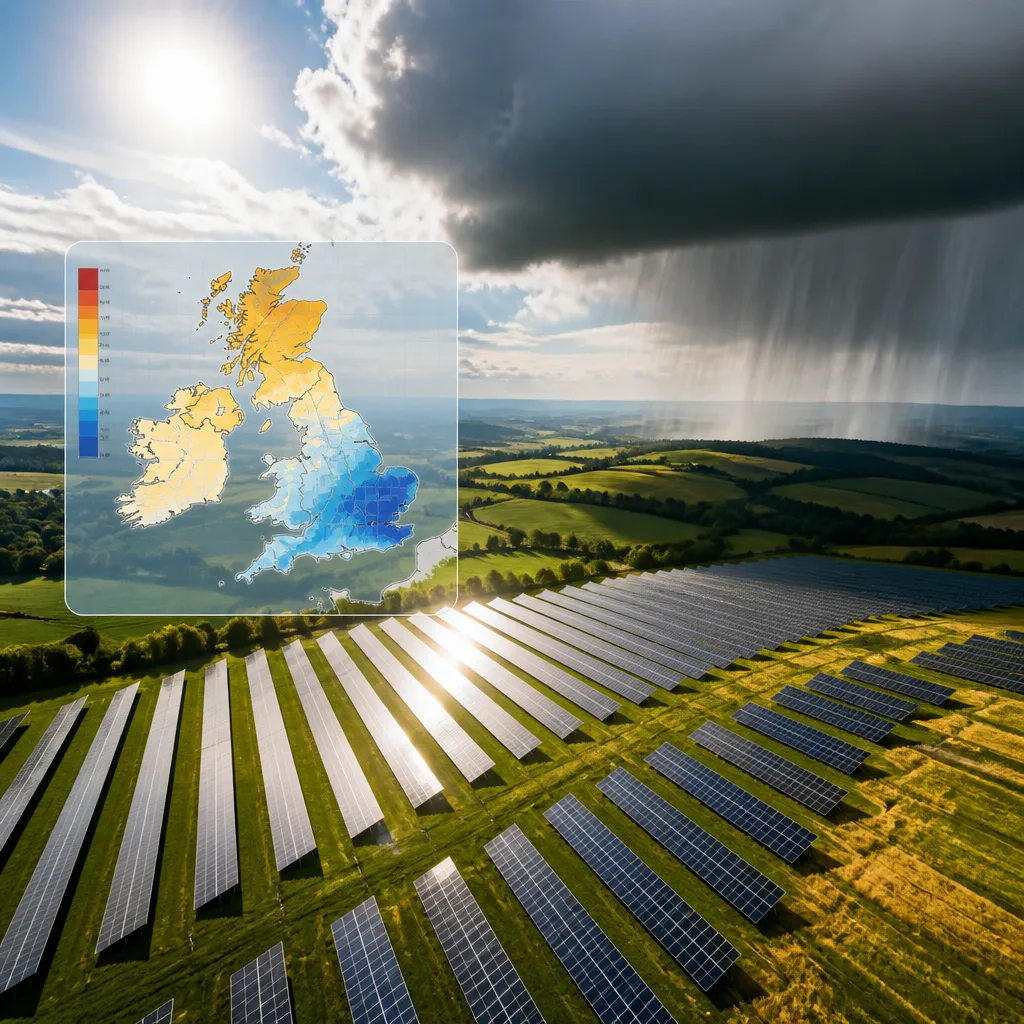
Sunshine levels this summer diverged sharply from long-term norms across several of the world’s biggest solar markets, a new industry analysis has found, complicating forecasts for renewable generation and exposing investors and grid operators to greater risk.
What happened and where
Solargis, a Slovakia-based provider of solar data and software, reports that the June-to-August period in 2026 produced regions that were markedly sunnier than usual and others that saw pronounced shortfalls. The pattern reflects an interplay of extreme heat, drought, intense rainfall and persistent cloud cover linked with monsoonal and storm activity.
Notable departures from historical averages included:
- Southern England and western France: irradiance more than 20% above normal following one of the warmest, driest summers on record for parts of Western Europe.
- Malaysia, Indonesia and the southern Philippines: sunshine roughly 30% above historic levels.
- Eastern India: states affected by heavy monsoon rains saw irradiation up to 20% below average.
- Southern Brazil, northern Argentina and Uruguay: irradiation more than 20% below normal.
- Northern Europe: above-average precipitation left some areas as much as 25% below typical sunshine values.
Why the variation matters
Solar irradiation is sensitive to a range of atmospheric factors — cloud cover, persistent rainbands, smog and wildfire smoke among them. For systems operators and investors who rely on historical averages to predict output, such sharp deviations can translate into real operational and financial headaches.
“Summer 2026 has demonstrated the extent to which solar resource conditions can diverge from historical averages across major markets,”
The Solargis commentary underlines two linked consequences. First, variable generation forecasts based on past patterns become less reliable when extreme weather grows more frequent. Second, the greater uncertainty places a premium on higher-resolution weather data and risk-management strategies to protect returns and maintain grid balance.
Implications for grids and markets
Grid operators increasingly depend on weather-driven renewables to meet demand. When actual generation departs significantly from predictions, it forces faster and costlier balancing actions — dispatching flexible generators, buying spot market power or curtailing demand. That can raise system costs and, in extreme cases, amplify supply risks.
On the investment side, the report raises questions about the suitability of using long-term historical yields for project finance or power purchase agreement assumptions without additional hedging. Solargis points to market participants — including hedge funds and trading firms — hiring weather specialists to build more responsive models.
Data at finer scale as a practical response
Solargis recommends more granular, location-specific weather monitoring and modelling as a way to reduce exposure. High-resolution irradiation data can help developers, grid planners and traders better anticipate shortfalls or windfalls and price them into contracts.
| Region | Observed change vs historic |
|---|---|
| Southern England & western France | +20% (approx.) |
| Malaysia, Indonesia, southern Philippines | +30% (approx.) |
| Eastern India | -20% (approx.) |
| Southern Brazil, northern Argentina, Uruguay | -20%+ (approx.) |
| Northern Europe | -25% (approx.) |
The table summarises the broad ranges reported; local results will vary within countries and between sites. The report does not suggest these departures undermine the long-term case for renewables, but it does stress that the long-run investment thesis needs to be supported by improved weather intelligence.
What to expect and what to do
For system planners and asset owners the practical steps are clear: integrate higher-resolution weather forecasts into operational models, expand real-time monitoring at plant level, and consider financial instruments or contract clauses that share weather-driven risk. Short of that, reliance on coarse historical means is increasingly hazardous as climate-influenced extremes become more common.
For policymakers there is also a message: building a resilient, net-zero grid requires investment not only in generating capacity and storage, but in the meteorological infrastructure and forecasting systems that underpin reliable integration of variable renewables.
The Solargis findings are a timely reminder that as the climate changes, so too must the tools used to plan, operate and finance the energy transition.









