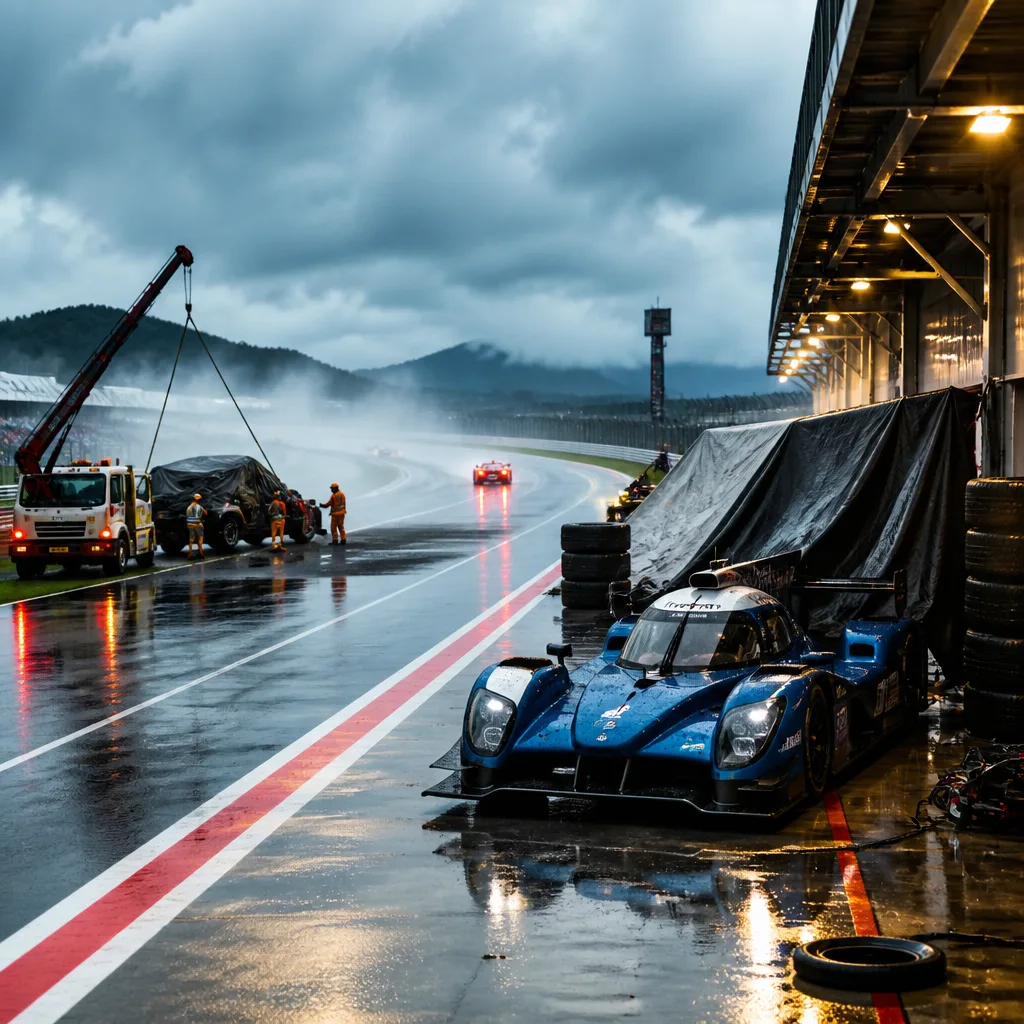
Qualifying for the FIA World Endurance Championship (WEC) 6 Hours of Fuji was abandoned early after persistent heavy rain and reduced visibility made running unsafe. Race officials invoked the regulations that transfer grid-setting to the fastest times recorded in practice sessions, leaving the No. 36 Alpine at the head of the field.
What happened at Fuji
Stormy conditions and low visibility curtailed the qualifying programme. The session was brought to an end following a crash in the LMGT3 category when François Heriau left the track in the No. 21 AF Corse Ferrari 296 GT3 Evo at Turn 2. The incident produced the red flag that ended on-track activity for qualifying.
Under the WEC sporting rules, when the scheduled Hyperpole or qualifying cannot take place, the starting grid is determined from the prior practice times. Specifically, Article 10.2.2 of the 2026 WEC regulations stipulates that the grid for Hypercar and LMGT3 will be established using times from the first qualifying practice. If that session is not available, times from all three practice sessions are used.
Immediate consequences for the grid
Applying those rules elevated the No. 36 Alpine Endurance Team to pole position. Alpine ran a condensed driver pairing in that car — Jules Gounon and Victor Martins — after trimming the line-up for both the No. 35 and No. 36 entries for the remainder of the season.
The sister car, the No. 35 Alpine, which is the defending winner at Fuji, will start second on the grid. That car will be driven by Charles Milesi and Ferdinand Habsburg after the team removed Frédéric Makowiecki from its roster for the rest of the campaign.
Penalties affected other contenders. The Aston Martin No. 007 Valkyrie had been the second fastest in practice, but a sanction for causing a collision in Free Practice 3 dropped it two places on the grid. That promoted the No. 19 Genesis GMR-001 to a third-place start, with the No. 17 GMR-001 lining up fifth — both Genesis entries having shown strong pace in wet conditions.
| Position | Car | Notes |
|---|---|---|
| 1 | No. 36 Alpine | Pole from practice times |
| 2 | No. 35 Alpine | Defending winner, condensed driver pairing |
| 3 | No. 19 Genesis GMR-001 | Promoted after Aston Martin penalty |
| 5 | No. 17 Genesis GMR-001 | Strong wet-weather showing |
LMGT3 class and implications
In LMGT3, the No. 77 Proton Racing Ford Mustang claimed the class pole position on the basis of being fastest across the three practice sessions. The crash that ended qualifying will also change how teams approach the race: practice-derived grids benefit those who found pace and balance in the wet sessions, while teams that had been targeting late qualifying improvements now face an altered starting order.
For race strategy, the decision to use practice times is significant. Wet running in practice rewards different set-ups and tyre choices than a dry qualifying lap; teams that committed to a wet-weather programme gained advantage when the proper qualifying laps could not be completed.
- Key factor: heavy rain and low visibility forced the session to stop early.
- Regulation applied: Article 10.2.2 — grid set from practice times when qualifying cannot be run.
- Front runners: No. 36 Alpine on pole; No. 35 Alpine second; No. 19 Genesis promoted to third.
Weather remains the dominant variable going into the 6 Hours of Fuji. Teams that showed wet-weather pace may now be better placed at the lights; conversely, cars optimised for a late dry qualifying lap might have to adapt their race strategy.
Expect continued attention on forecast trends ahead of the race. If wet conditions persist, visibility and tyre choice will again be decisive. If conditions improve, the practice-based grid may not reflect single-lap potential in a dry opening stint — but it is now the reference by which the race will begin.