
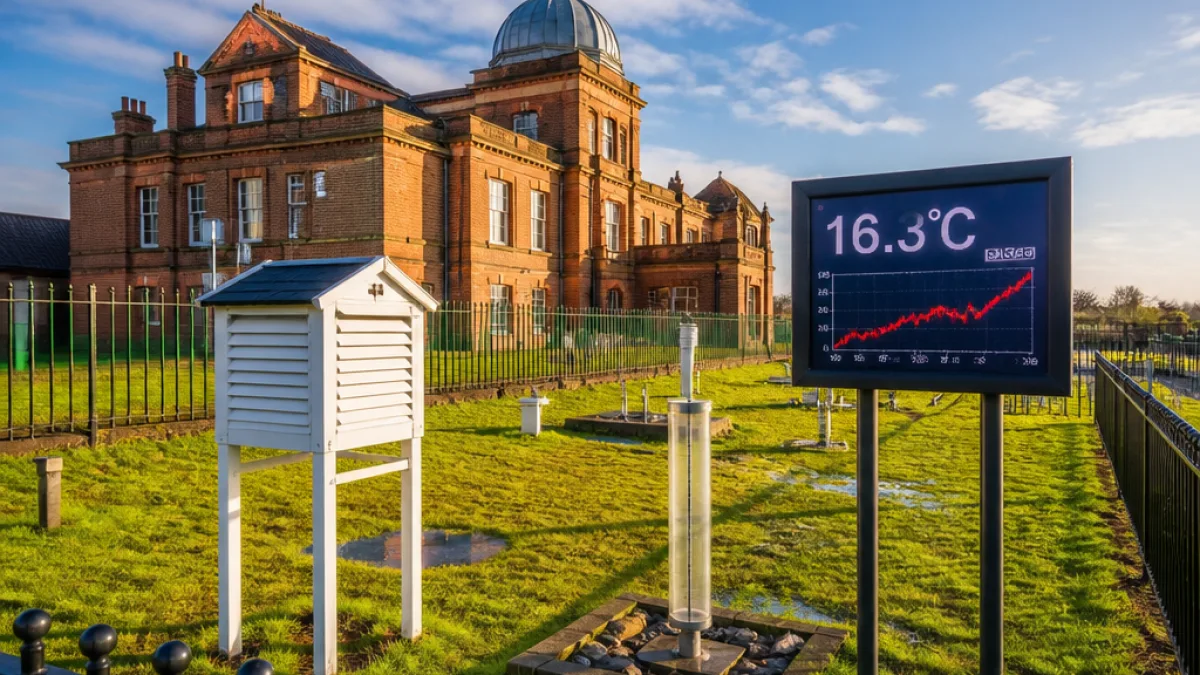
Warmest meteorological summer on record at Armagh Observatory
Armagh Observatory has confirmed that August 2026 was warmer, slightly wetter and duller than typical for the month, and that taken together with June and July this year constituted the warmest meteorological summer on record at the Observatory.
The Observatory’s data show the mean temperature for August was 16.3°C, some 1.7°C above the long‑term (1796–2020) August average of 14.6°C and approximately 0.8°C above the most recent 1991–2020 30‑year August average of 15.5°C. The month now ranks equal ninth among warmest Augusts at Armagh, sharing that position with Augusts in 1976, 1880 and 1856.
Observers also noted the continuation of a warming trend across recent decades: the 1961–1990 August average was 14.8°C, while the 1991–2020 figure is 15.5°C, indicating an increase of roughly 0.2°C per decade. Over the past fifteen years, only five Augusts have fallen below the most recent 30‑year average, a statistic the Observatory says suggests the observed August warming trend is persisting.
Heatwaves, daily highs and lows
August produced a short spell of high temperatures in Armagh. The highest maximum air temperature recorded was 27.9°C on 12 August, followed by 26.8°C on 13 August and 25.2°C on 11 August. Those three days each reached or exceeded 25.0°C, forming an August heatwave — the first such August heatwave at Armagh since 2022.
Despite the highs, the warmest day in August was only the third warmest day of the year at the Observatory; two June days were hotter, at 29.8°C on 25 June and 28.0°C on 23 June.
"This was the warmest meteorological summer on record at Armagh," the Observatory reported.
Night‑time lows and notable figures
Night temperatures showed variance, with the lowest minimum air temperature recorded at 5.0°C on 24 August. Other cool nights included 7.4°C on 22 August and 7.7°C on 21 August. Conversely, the warmest night reached a very mild 17.5°C on 13 August.
| Metric | Value |
|---|---|
| Mean August temperature | 16.3°C |
| Long‑term August average (1796–2020) | 14.6°C |
| Highest daily maximum (Aug) | 27.9°C (12 Aug) |
| Lowest night minimum (Aug) | 5.0°C (24 Aug) |
Local implications and context
For residents of Armagh and surrounding rural communities, the Observatory’s analysis underlines continuing shifts in seasonal conditions that affect agriculture, water management and public health planning. Warmer summers with episodic heat can increase stress on livestock and crops and alter the timing of agricultural operations. Even where rainfall totals are only slightly above average, the pattern of wetter or duller months can affect grass growth, harvest windows and pest pressures.
- Trend continuation: August warming appears part of an ongoing multi‑decade rise in summer temperatures at Armagh.
- Heat events: Three consecutive days at or above 25°C formed an August heatwave, a relatively rare event in recent years.
- Variability: Warm daytime maxima contrasted with cool nights, indicating persistent day‑to‑night temperature swings.
The Observatory’s data offer a local perspective on broader climatic patterns observed across the UK and Ireland. For communities across County Armagh, the findings provide a timely prompt for farmers, local authorities and health services to consider how to adapt to warmer summers and more frequent temperature extremes.
Full data and further commentary are available from Armagh Observatory’s detailed monthly report.










