Scientists have re‑examined an oft‑cited 19th‑century episode of space weather disruption and concluded that the published year is almost certainly wrong. The correction follows a detailed review of contemporary scientific records, newspaper reports and railway timetables that shows the widely mentioned 1841 narrative cannot be substantiated, while notable geomagnetic activity occurred in other years.
What the review found
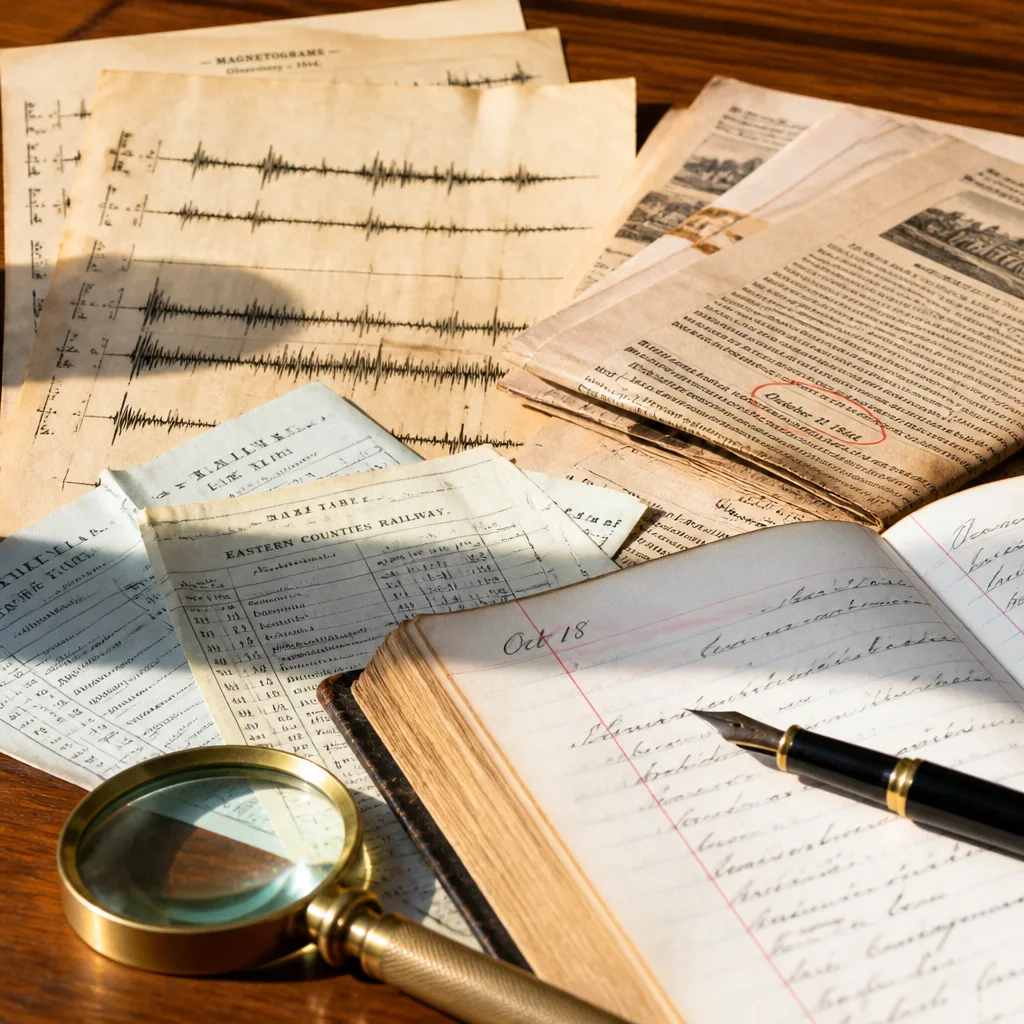
The authors analysed early magnetograms from the Greenwich magnetic observatory and a range of contemporary sources. While there are records of “extraordinary” magnetic observations as far back as 1840, they found no supporting evidence—such as auroral reports or press accounts—for the specific October 18, 1841 incident that had been cited in the literature.
"No citation is provided that would enable an investigation into the veracity of the statement," Wild et al. wrote.
Instead, the team identified strong geomagnetic activity around 18 October 1848, which was corroborated by newspaper accounts and sunspot observations made by the British astronomer Temple Chevallier on 19 October 1848. The researchers also consulted contemporary railway timetables and found entries for a 10:05 pm express train departing from Exeter that cover the period 11 March 1848 to 26 July 1849, suggesting the original 1841 date may be a typographical mistake in earlier literature.
Implications for the historical record
The authors conclude that, with the 1841 account effectively ruled out, the earliest documented example of space weather affecting technology remains an incident from March 1847. That event involved “spontaneous electrical currents” disrupting telegraph systems on the Midland Railway during a time when a “brilliant aurora” was observed across the British Isles.
This clarification matters because historical case studies help scientists and historians understand how solar and geomagnetic activity have interfered with early electrical infrastructure. Correct dating is key both for matching solar observations (such as sunspots and aurorae) to geomagnetic records and for assessing the vulnerability of contemporary systems to similar events.
Sources and evidence
The reassessment drew on several lines of evidence:
- Archival magnetograms from Greenwich that record strong geomagnetic storms (notably in 1840 and 1848);
- Contemporary newspaper reports confirming auroral displays and geomagnetic disturbance in October 1848;
- Sunspot observations by Temple Chevallier on 19 October 1848;
- Railway timetables showing an Exeter departure time consistent with the later period (March 1848–July 1849).
| Date | Record |
|---|---|
| 1840 | Greenwich magnetograms report extraordinary magnetic observations |
| 18 Oct 1841 | No corroborating auroral or press reports found |
| March 1847 | Documented telegraph disruption on Midland Railway during bright aurora |
| 18–19 Oct 1848 | Strong geomagnetic activity confirmed by newspapers and Chevallier's sunspot observations |
Confidence and remaining questions
The authors are explicit about the limits of their enquiry. They note that the 1841 claim lacked a citation that could be traced, which hindered initial verification. Their multidisciplinary approach—combining instrumental magnetograms with contemporary press and timetable evidence—provides a stronger basis for dating the event, but the literature will likely benefit from further archival work in other collections.
For today’s readers and planners, the paper underlines a broader point: historical records of solar and geomagnetic activity are an essential resource for understanding the range of natural disturbances that have affected electrical and communications systems. Correcting the timeline sharpens that resource and improves how scientists match solar phenomena to technological impacts.
The study appears in the journal Space Weather (2026). A DOI is provided by the authors for reference.