
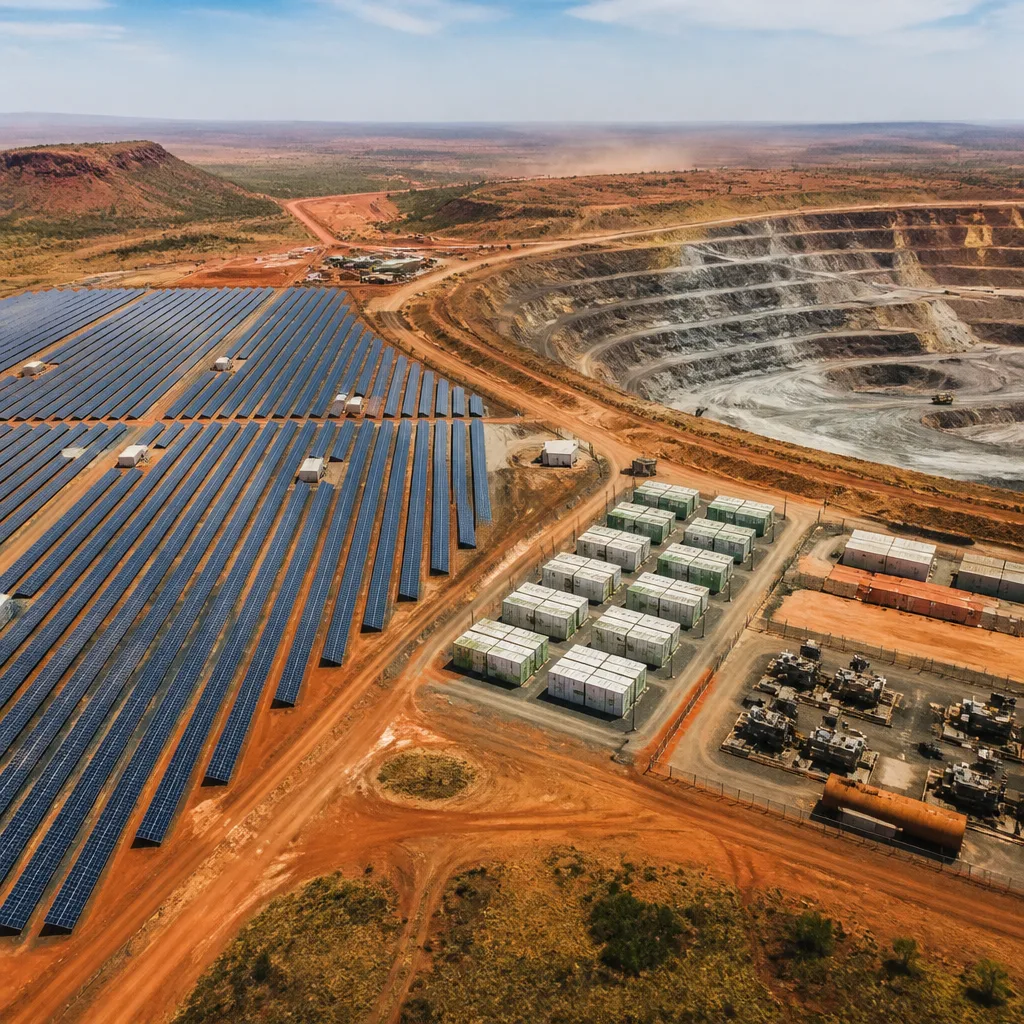
Demands for reliable and cheaper power from the copper-rich Katanga mining belt have helped drive a dramatic rise in solar deployment in the Democratic Republic of Congo, new data and a major project reveal.
Imports and installations jump
Energy think-tank Ember reports that DR Congo has become Africa’s fourth-largest importer of Chinese solar panels over the past year, with imports valued at $249m. Spending on batteries was even larger at $429m. Ember estimates a staggering 544% year-on-year increase in solar installations for 2026, saying new capacity added this year equals roughly 63% of the country’s existing grid generation.
Mining drives demand for continuous power
The energetic push into renewables is concentrated in the Katanga region, where miners require steady power to expand operations. At the Kamoa Copper project near Kolwezi, developers have completed a vast solar-plus-storage scheme that challenges assumptions about renewables supplying continuous industrial loads.
| Metric | Value |
|---|---|
| Solar panel imports (past year) | $249m |
| Battery imports | $429m |
| Kamoa solar array | 233 MW |
| Battery storage at Kamoa | 526 MWh |
| Continuous minimum output claimed | 30 MW |
| Panels installed at Kamoa | 357,000 |
| Population with grid access (2024) | 21.5% |
The Kamoa installation comprises some 357,000 solar panels over an area compared to 230 football pitches. It began commercial operation on 12 August, built by CrossBoundary Energy, a specialist in distributed energy schemes for businesses and industrial users.
“What we’re showing now, in the first month of operation, is that it’s working,” said Richard Stanford, CrossBoundary’s chief technical officer. “It does what it says on the label.”
What this means for costs and industry
For mining companies, two clear commercial incentives explain the uptake. First, access to reliable baseload-style power is critical for continuous mining operations; the Kamoa project’s combination of large-scale panels and substantial battery storage is designed to meet that need. Second, diesel price volatility — exacerbated by conflicts in Ukraine and the Middle East — has pushed firms to reduce exposure to fuel markets and shrink operating costs.
By replacing or displacing diesel generation, large solar-plus-storage projects can materially lower variable costs and reduce the risk of production disruptions from fuel supply or price spikes. The addition of grid-equivalent output equal to well over half of existing generation capacity this year is significant in a country where only 21.5% of people had electricity access in 2024.
- Miners gain cheaper, more predictable power and can expand output without reliance on diesel.
- Large-scale storage addresses intermittency concerns that have historically limited renewables in heavy industry.
- Rapid import growth suggests broad private-sector investment rather than solely donor-funded programmes.
Broader implications and unanswered questions
The surge in imports and the Kamoa example indicate a market-led reconfiguration of power in resource zones, but several issues remain. It is unclear how much of the new capacity will benefit local communities outside mining concessions, or whether projects will integrate with national grid-building plans. A concentrated solar boom driven by multinational miners may not directly increase household electrification unless specific grid or distribution projects follow.
Moreover, while early operational success is promising, longer-term performance, maintenance, and financing of battery systems will determine whether these schemes deliver sustained cost savings and reliability. For policymakers, the central question is how to channel private investment in renewables so it supports broader development goals rather than remaining locked to industrial enclaves.
For Britain and other countries watching commodity markets, a more reliable and cheaper Congolese copper supply would ease input costs for manufacturers and could help stabilise prices in industries reliant on electrification and clean-energy technologies.
The Kamoa project is a test case for whether large-scale renewables coupled with storage can become the default power solution for heavy industry in low-access countries. Early signs are that, at least in DR Congo’s mining heartland, the economics and operational demands are aligning to make that transition worthwhile.














