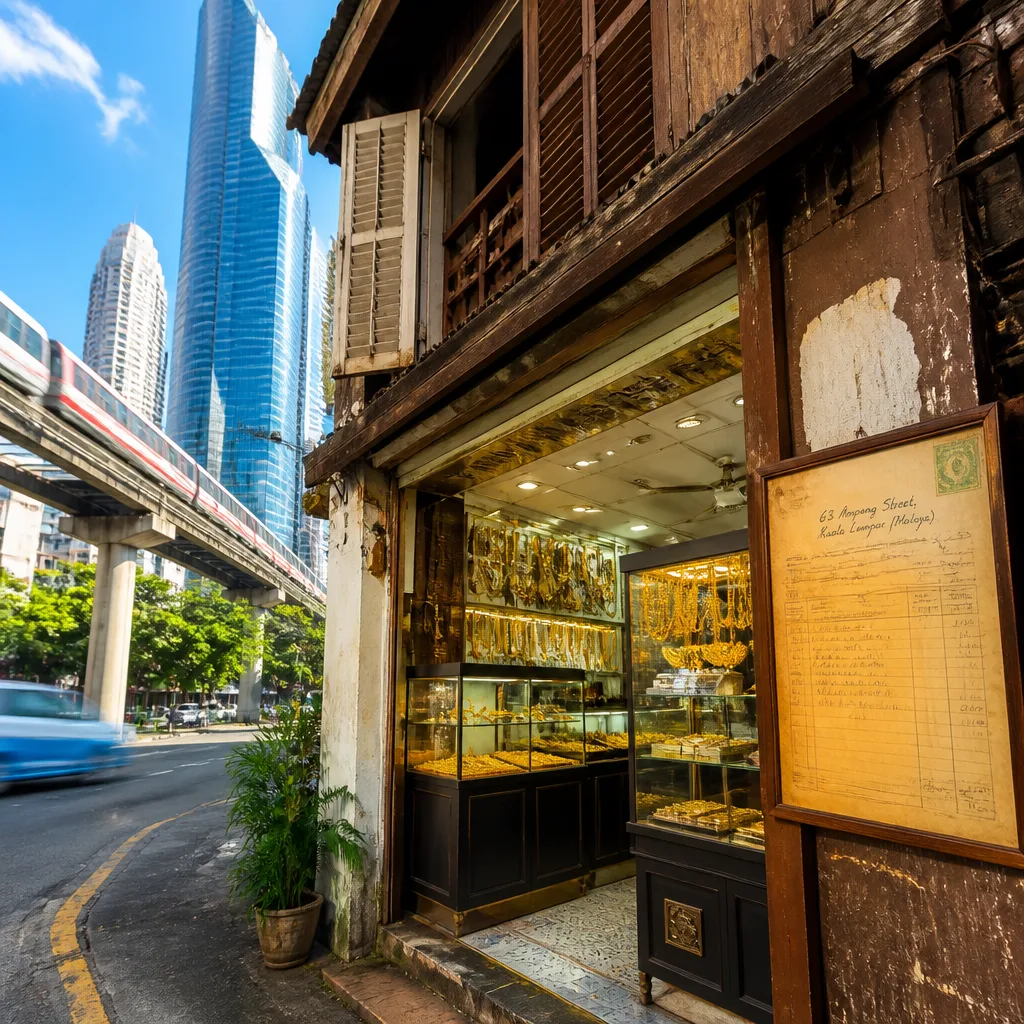
Kuala Lumpur’s central shopping streets carry layers of history beneath their glass-fronted façades. A yellowing receipt framed at the entrance of Abdul Razak Gold House quietly points to a different era: an address recorded as “63 Ampang Street, Kuala Lumpur (Malaya)”, a reminder that the city’s geography and names have shifted as fast as its skyline.
Family business, changing city
The retail outlet, now a brightly lit bullion and jewellery shop, began as a modest goldsmith’s stall in older shophouses. Today it sits in a commercial heartland dominated by towers and the elevated tracks of the city’s rail network. For Mohd Razalie Abdul Rasul, 37, who runs the business, the shop’s evolution mirrors his own generational outlook: retaining continuity with the past while adopting new approaches to survive and prosper.
Abdul Razak Gold House has been reinventing itself for roughly six decades, expanding its activities into bullion trading and acquiring the neighbouring property. The proprietor describes a practical handover process and a shift in mindset as the business prepares for the next generation to take charge.
“My dad is still a mentor, but the way he thinks and I think is totally different,”
He added: “We have to think very modern. We have to stay one step ahead.” Those sentences capture the tension at the heart of Kuala Lumpur’s present moment — an impulse to preserve familiar threads of place and memory while adapting to technological, economic and architectural change.
What the shop tells us about the city
The story of one family business highlights broader questions about urban development. Streets once lined with small, locally owned traders have been absorbed into a modern commercial core where brand-new facades and corporate outlets sit beside surviving mom-and-pop shops. For long-standing proprietors, adaptation has meant more than a new shopfront: it has required new business lines, different customers and fresh strategies for passing a livelihood to children who see the world through a different lens.
Visitors who notice the old receipt are seeing a small archive moment — a tangible link to a pre-independence Malaysia and to the city’s earlier layout, when Ampang Street was known by that name and not yet as Lebuh Ampang. For residents and businessowners alike, such artefacts are useful anchors in a city that continues to be transformed by construction and investment.
- Continuity: The family firm’s survival across decades demonstrates adaptability.
- Modernisation: Expansion into bullion trading and property acquisition underline commercial evolution.
- Intergenerational shift: Younger owners balance heritage with the need to innovate.
These dynamics are not unique to Kuala Lumpur. Cities around the world wrestle with how to sustain historical character while meeting contemporary economic and infrastructure demands. But local particulars — the renaming of streets, the memory contained in a paper receipt, the presence of overhead rail — make Kuala Lumpur’s negotiation especially vivid.
| Then | Now |
|---|---|
| Address: 63 Ampang Street, Kuala Lumpur (Malaya) | Lebuh Ampang, amid skyscrapers and train lines |
| Small goldsmith’s counter under shophouses | Brightly lit jewellery and bullion store |
| Older generation running the business | 37-year-old owner expanding and preparing handover |
For shoppers and visitors, the city’s modern amenities can obscure these substrata. Yet small museums, family shops and everyday documents preserve a sense of continuity. In the case of Abdul Razak Gold House, the framed receipt does more than mark an old address: it anchors the store in a narrative of change and resilience.
For policy-makers and planners, the lesson is practical: modern infrastructure and regeneration schemes benefit from being paired with measures that support legacy businesses and the intangible heritage they embody. For consumers and tourists, noticing small traces of the past — a receipt, a shopfront, a shopkeeper’s recollection — enriches the experience of the contemporary city. And for the families who run these businesses, the balancing act between tradition and innovation is both personal and practical, demanding an approach that honours what came before while preparing for what comes next.
That pragmatic attitude — visible in the next-generation owner’s willingness to diversify and buy adjoining property — may be the most realistic route to preserving memory in a city that is, by design, always moving forward.