
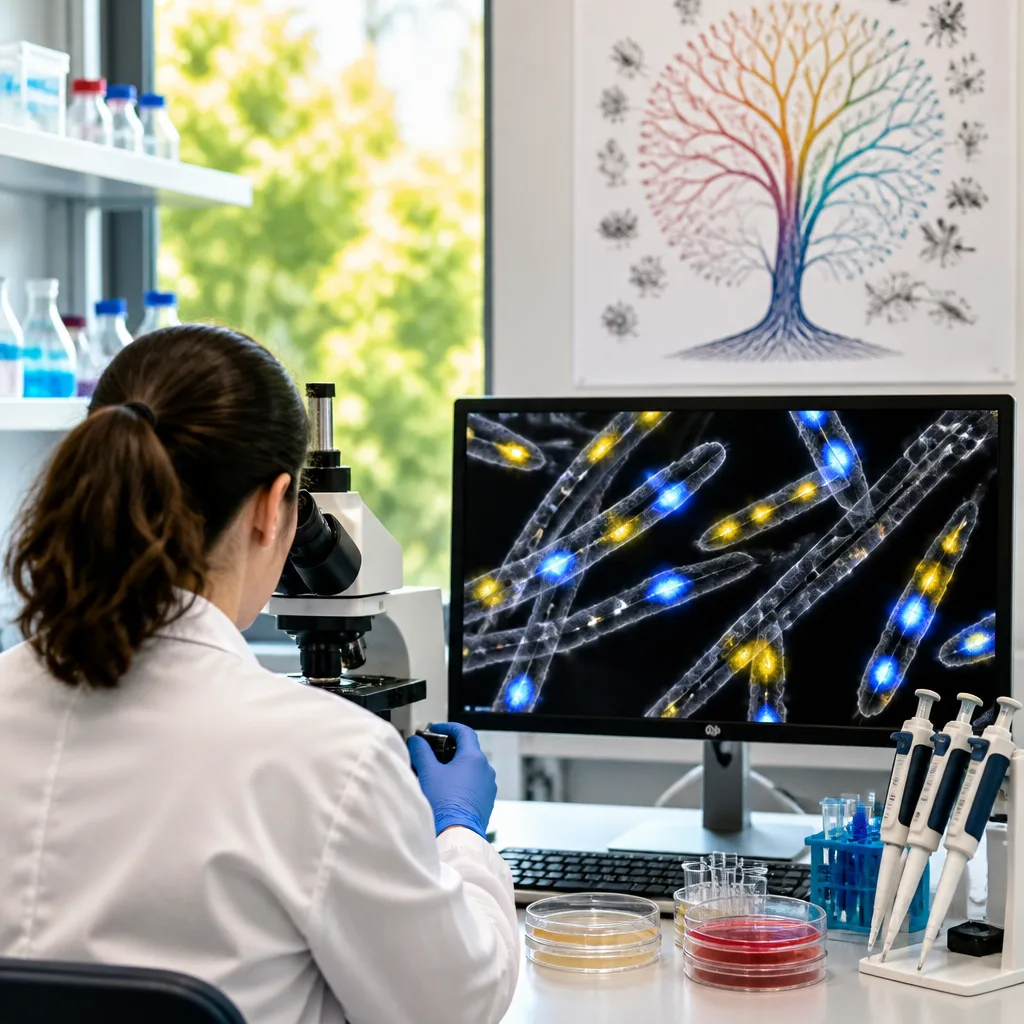
Researchers have identified calcium-regulated communication structures in bacteria, a finding that challenges assumptions about how early life organised multicellular cooperation.
What was discovered
A team led by Junior Professor Dr Khaled Selim at the Institute of Phototrophic Microbiology has reported that bacteria possess intercellular connecting structures whose function is regulated by calcium ions (Ca²⁺). The structures are analogous, in functional terms, to those in higher eukaryotic tissues — such as the human heart and nerve networks — where calcium exchange coordinates essential signalling and physiological activity.
"It came as a big surprise to us that one of the earliest life forms on Earth ... had already developed communication structures regulated by calcium signals similar to those found in the cells of higher organisms," Dr Selim said.
Why it matters
The finding reframes how biologists think about the apparent gulf between prokaryotic cells (bacteria, which lack a nucleus) and eukaryotic cells (which have a nucleus and form the tissues of animals, plants and fungi). Traditionally, complex intercellular communication mechanisms have been associated with later-evolving, multicellular eukaryotes. Demonstrating that bacteria use calcium signalling to regulate connecting structures suggests that some functional principles of higher organisms were present much earlier in evolutionary history.
That raises scientific questions rather than definitive conclusions. The researchers describe their work as offering "new insights into evolution" — notably about how fundamental physiological motifs might be conserved or repurposed across billions of years of life’s history.
How the discovery was framed
The team emphasised the surprise of the result. The source material notes that these communication structures are important for tissues such as the heart and for neuronal signalling in animals, and that calcium ions play a central regulatory role. Finding analogous calcium-regulated processes in bacteria suggests greater cellular sophistication among early lifeforms than many had supposed.
- Organism types involved: bacteria (prokaryotes) compared with higher eukaryotic cells.
- Molecular cue: regulation by calcium ions (Ca²⁺).
- Research group: Institute of Phototrophic Microbiology, led by Dr Khaled Selim.
Context and consequences
The authors stop short of claiming that this overturns evolutionary theory, but they do pose an implicit challenge: if relatively simple cells had already evolved mechanisms that resemble those of complex tissues, how do we account for the timing and pathways by which such systems arose? The finding invites closer examination of the evolutionary steps that lead from single cells to organised multicellularity, and of whether similar biochemical strategies were conserved or re-evolved independently in different lineages.
Practically, revealing calcium regulation in bacterial communication may affect how scientists study microbial communities, biofilms and photosynthetic bacteria in particular. Understanding the signalling architecture could inform laboratory studies of microbial cooperation, stress responses and the evolution of cellular machinery.
| Feature | Higher eukaryotes | Bacteria (reported) |
|---|---|---|
| Nucleus | Present | Absent |
| Intercellular connecting structures | Known; regulate tissues such as heart and neurons | Present and regulated by Ca²⁺ (per new study) |
The study’s restrained presentation is important: it documents a previously unappreciated similarity in regulatory chemistry between bacterial and eukaryotic systems. It does not, by itself, map the evolutionary route that produced the resemblance — whether by deep conservation from a common ancestor or by convergent evolution — nor does it provide timelines beyond noting the ancient position of bacteria in life’s history.
Further research will be needed to determine the molecular identity of the bacterial connecting structures, how widely they occur across microbial taxa, and the evolutionary dynamics that placed calcium signalling at the centre of intercellular communication in both prokaryotic and eukaryotic contexts. For now, the discovery is a reminder that cellular simplicity can be deceptive: even the earliest life forms may have been wiring themselves together in unexpectedly sophisticated ways.









