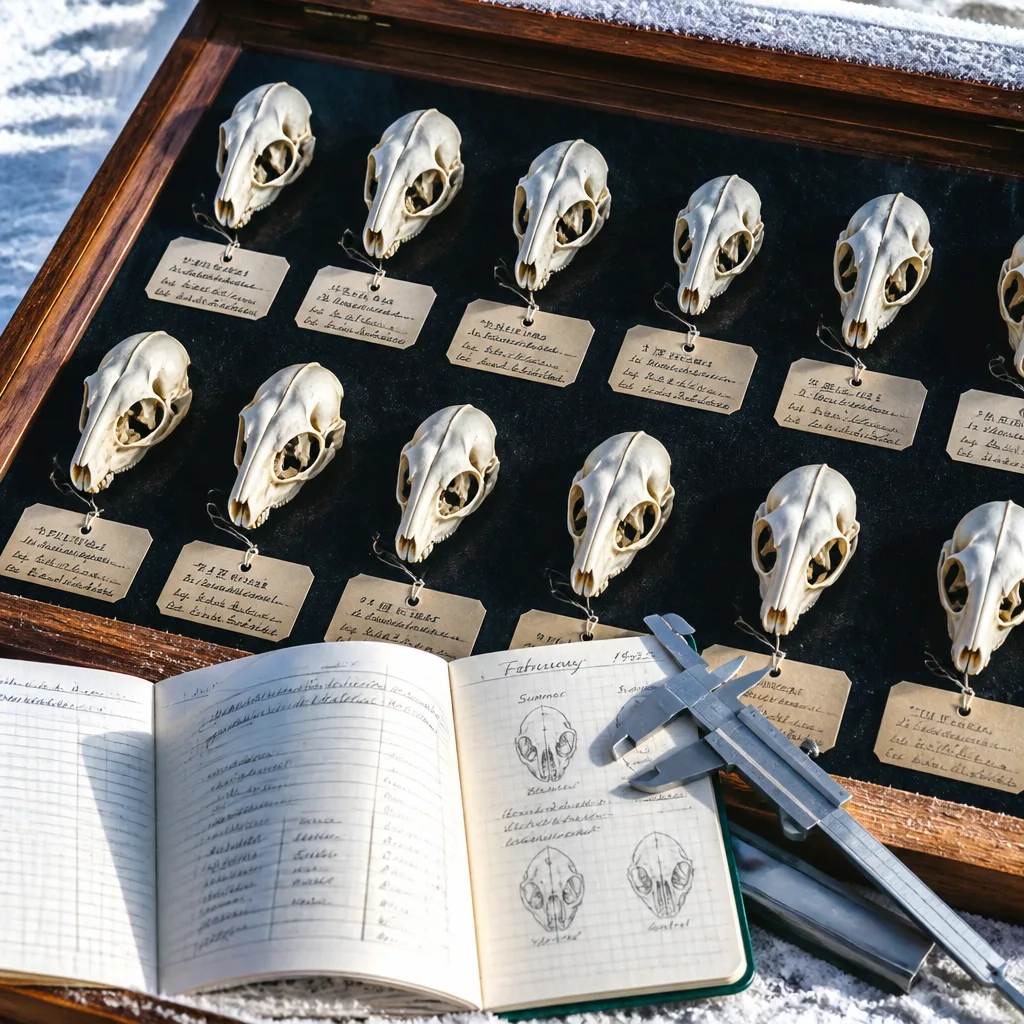
Long‑clawed shrews appear to remodel their skulls with the seasons, increasing the size of their snouts through winter while other parts of the skull shrink, according to a new study published in Proceedings of the Royal Society B. The finding — described by the authors as a “reverse Dehnel’s phenomenon” — comes from measurements of museum specimens collected in Hokkaido between 1948 and 1988.
What the researchers did
The team, led by Dr Yugo Ikeda of Toyo University in Japan, examined 136 skulls of the long‑clawed shrew, a small mammal that is born between spring and autumn and typically does not survive beyond its second winter. The specimens are housed at the Botanical Garden of Hokkaido University.
Because repeatedly measuring live, wild shrews without harm is effectively impossible, the researchers used the preserved skulls to obtain repeated cross‑sectional data through the animals’ short lifespans. They recorded 16 separate skull measurements and analysed how those measures varied by month and by indicators of sexual maturity.
Key findings
The measurements revealed that several skull traits changed with season, but not all in the same direction. Two results stand out:
- The braincase height (a vertical measurement of the skull) was on average 12% smaller in animals collected in winter (January–April) than in younger shrews gathered in August–September of their first year.
- By contrast, the rostrum (snout) height was 7% larger, and its width was 6% greater in shrews collected during winter.
“This is precisely why we termed it the ‘reverse Dehnel’s phenomenon’,” said Dr Yugo Ikeda.
The authors emphasise that the rostral enlargement reflects a change in bone structure itself — not merely soft‑tissue swelling — and that the suite of changes is reversible across seasons.
How to interpret the pattern
Dehnel’s phenomenon is a known seasonal shrinkage and regrowth of body and cranial structures in some small mammals (classically the common shrew and European mole). The pattern reported here differs because, while many cranial regions shrink in winter, the snout expands. The research team therefore labels the pattern a reverse of the classic phenomenon.
The study does not directly demonstrate the functional reason for the snout enlargement. The researchers note the changes are measurable and reversible and occur within the brief life cycle of the species. They suggest the morphology may be an adaptive response to winter conditions — for example, to cope with colder air — but the preserved‑specimen approach cannot on its own establish causation or precise physiological mechanisms.
Methodological strengths and limits
Using long‑term museum collections allowed the investigators to assemble a sample spanning months across many years without handling live animals. That approach provides valuable anatomical detail but has inherent limits: the study is observational and cross‑sectional rather than following individual animals over time, and it relies on the availability and representativeness of archived specimens.
| Data point | Value |
|---|---|
| Number of skulls analysed | 136 |
| Collection range | 1948–1988 (Hokkaido) |
| Braincase height change (winter vs Aug–Sep juveniles) | −12% |
| Rostrum (snout) height change (winter) | +7% |
| Rostrum width change (winter) | +6% |
The authors explicitly note practical challenges in measuring live shrews: capturing and repeatedly measuring such small, short‑lived animals without harm is “practically impossible”. The museum approach therefore offers a pragmatic alternative for detecting seasonal morphological trends.
Broader significance
Seasonal, reversible remodelling of bone is relatively rare among mammals and may illuminate how small endotherms manage energetic and sensory demands across a harsh annual cycle. While the present study quantifies changes and names a novel pattern, it leaves open several questions for follow‑up work — notably whether snout enlargement confers sensory, respiratory or thermal advantages, and by what cellular or developmental mechanisms bone size is altered and then restored.
For now, the finding stands as a neat reminder that museum collections are not simply historical curiosities: preserved specimens can reveal dynamic biological processes that unfold within the brief life of a small mammal and that might otherwise escape detection.