
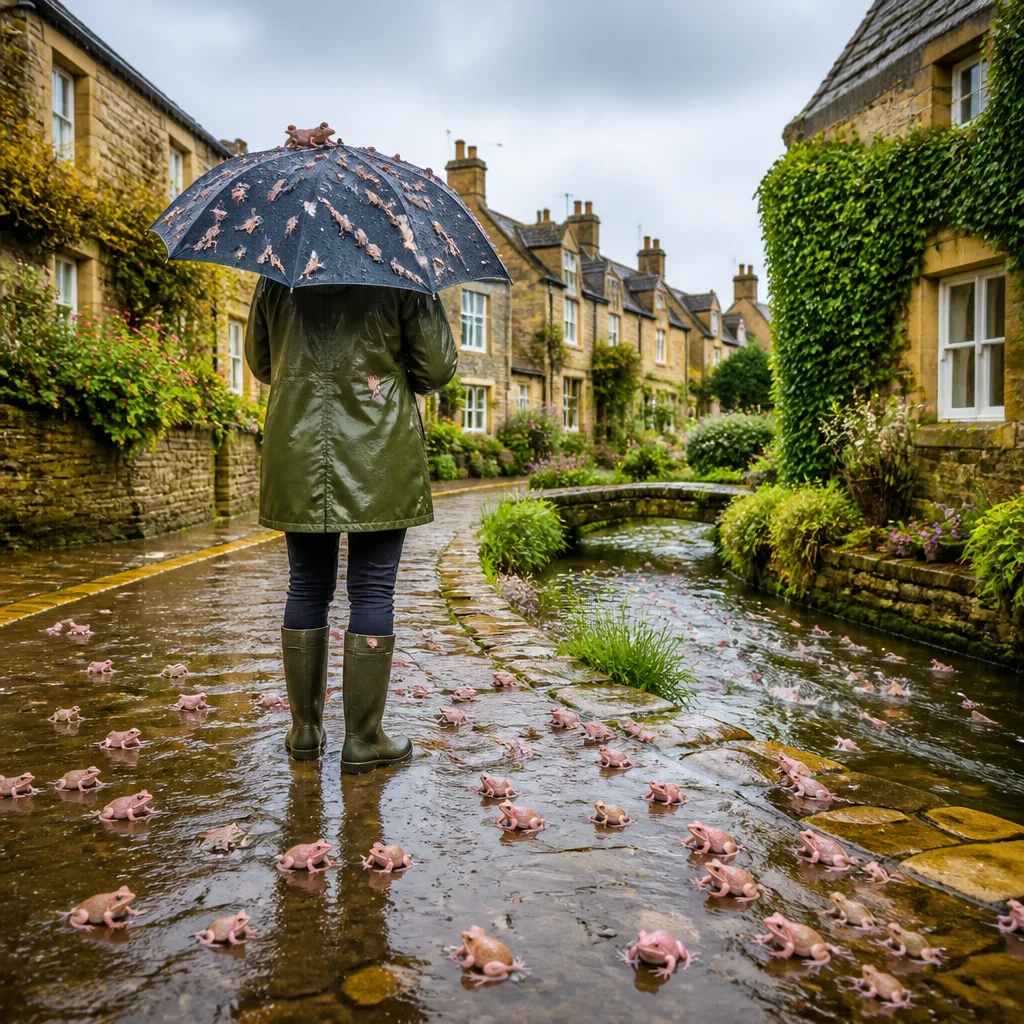
In October 1987 a striking episode of so‑called "animal rain" was reported in the Cotswolds, with witnesses saying hundreds of small, pink amphibians came down during a bout of torrential rain. A representative from the local Wildlife Trust subsequently examined specimens and identified them as albino common frogs (Rana temporaria). Despite the identification, scientists and local naturalists still lack a definitive explanation for how the animals ended up falling from the sky.
What was reported
Contemporary accounts, reported by the Stroud News & Journal and later retold by national outlets, described a scene in which a lady from Stroud saw a "legion of ‘tiny rose‑coloured frogs'" apparently hitting umbrellas and pavements before hopping off to nearby streams and gardens. Similar observations were made in Cirencester. The pinkish hue was explained by the Wildlife Trust's identification of albino common frogs, which lack the typical pigmentation of their species.
“bouncing off umbrellas and pavements and hopped off in their hundreds to nearby streams and gardens.”
Possible explanations and limits to the evidence
The event sits in a long catalogue of animal‑rain anecdotes from around the world that have included fish, spiders and amphibians. Several hypotheses have been proposed for such episodes, but none can be confirmed for the Cotswolds incident because contemporaneous meteorological and forensic data are limited.
- Post‑rain emergence: One hypothesis is simple misattribution — frogs already present in the landscape may have emerged en masse after heavy rain and been mistaken for falling animals.
- Waterspout transport: Another suggestion points to a waterspout or tornado‑like column of wind and water mist capable of lifting small animals from a freshwater source and carrying them to a different location before they fall out as the wind subsides.
- Observer error or amplification: Eyewitness accounts can conflate timing and origin; the apparent descent may have been a rapid but terrestrial movement from nearby hiding places.
Each explanation has precedent in meteorology and natural‑history reports, but the Cotswolds case lacks the corroborating measurements — such as an identified source waterbody, radar or storm records showing a waterspout, or systematic sampling — that would allow scientists to favour one mechanism with confidence.
Why the identification matters
Pinning down the animals as albino common frogs (Rana temporaria) changes the likely scenarios. These frogs are freshwater amphibians that typically inhabit ponds, streams and damp terrestrial habitats. That ecology makes a waterspout‑based transfer from a water body plausible in principle, since waterspouts can lift small, lightweight organisms. Conversely, an explanation based on local frogs emerging after rain is also compatible with the identification — albino individuals could simply have been present in nearby gardens and ditches and been more visible because of their pale colouring.
Broader context and scientific caution
Reports of animal rain are rare but not unique. Historical and modern records have documented instances involving fish, frogs, and even spiders carried aloft on wind currents. Scientists treat such anecdotes cautiously: without independent meteorological data and careful collection of specimens, causal claims remain speculative. The Cotswolds episode illustrates that well‑identified specimens do not automatically yield a mechanism.
| Fact | What we know |
|---|---|
| When | October 1987 |
| Where | Stroud and Cirencester, Cotswolds |
| Animals | Albino common frogs (Rana temporaria) as identified by a Wildlife Trust representative |
| Confirmed cause | Unknown — multiple plausible explanations, no definitive evidence |
For now, the Cotswolds episode remains a vivid example of how compelling eyewitness reports and species identification can still leave open the scientific question of mechanism. Resolving such mysteries would require contemporaneous storm observations, precise location of potential source habitats, and ideally, modern meteorological records linking a waterspout or other strong, localised wind event to the time and place of the observations.
Whether the best explanation is a dramatic lift by a waterspout or a perfectly ordinary rush of amphibians after rain, the story highlights the interplay between ecology, weather and human perception — and reminds us that even in well‑studied landscapes like the Cotswolds, nature can still produce events that challenge easy explanation.









