
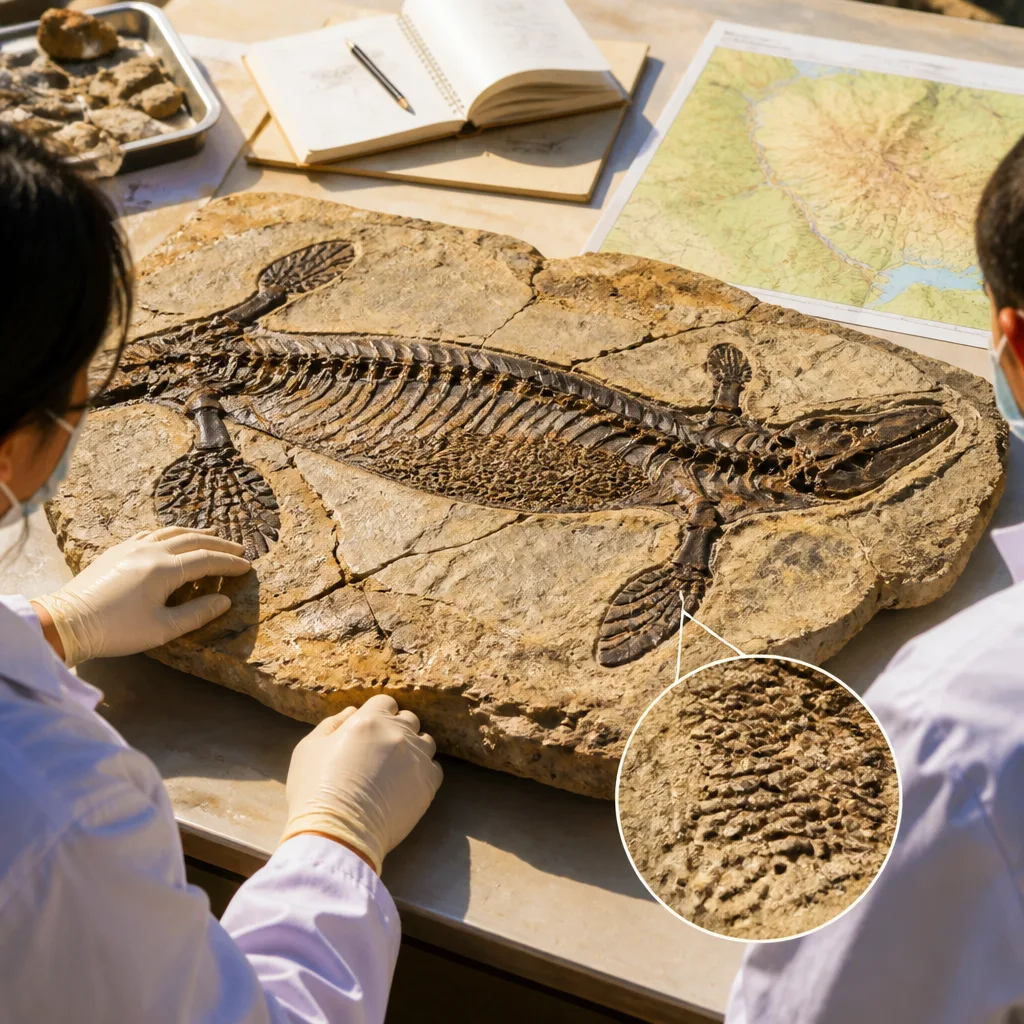
Chinese palaeontologists have identified a new reptile species that lived about 244 million years ago and shows anatomical specialisations for an aquatic life, according to a study of exceptionally preserved fossils from the Luoping biota in Yunnan Province.
An early aquatic archosauromorph
The newly named Austronaga, described by a team led by Li Chun of the Institute of Vertebrate Palaeontology and Paleoanthropology at the Chinese Academy of Sciences, belongs to the broader group Archosauromorpha — the lineage that later produced crocodiles, dinosaurs, pterosaurs and birds. The fossil material, unusually complete, preserves skeletal details and traces of soft tissues that together point to an animal that had largely abandoned terrestrial locomotion.
Key anatomical features include markedly longer forelimbs than hindlimbs, reduced hindlimbs, and enlarged autopodial elements (hands and feet) containing extra finger and toe bones. The outermost elements lack claws and instead form flipper-like structures comparable with other specialised aquatic reptiles.
"The findings indicate that the reptile had largely abandoned life on land and was well adapted to swimming,"
Wang Wei, the first author of the study, summarised the interpretation of these traits and the animal's ecological role.
Direct evidence of diet and lifestyle
Austronaga's fossil is notable not only for skeletal detail but for preserved internal remains. The specimen includes traces identified as stomach, liver and intestines, and researchers report partially digested fish scales in the large intestine. That gut content provides direct evidence that this animal fed on fish and was an active aquatic predator rather than an occasional swimmer.
- Age: ~244 million years (Middle Triassic)
- Location: Luoping biota, Yunnan Province, China
- Group: Archosauromorpha; member of Tanysauria
- Notable anatomy: longer forelimbs, reduced hindlimbs, enlarged hands/feet with extra phalanges, outermost elements forming flippers without claws
- Dietary evidence: fish scales in gut
What this pushes back in the evolutionary record
The authors place Austronaga within Tanysauria, a clade that already contained a range of ecologies from terrestrial to semi-aquatic forms. The new specimen expands the known ecological diversity of the group by adding a strongly aquatic representative and, crucially, pushes the earliest clear evidence for near-obligate aquatic adaptation in archosauromorphs to around 244 million years ago.
Comparative analysis with living and extinct aquatic animals showed that Austronaga's limb proportions fall within the range of species that depend almost entirely on aquatic habitats. Taken together, limb morphology, the modification of the autopodial bones and gut contents form a consistent picture of a specialised swimmer and fish-eating predator.
| Feature | Implication |
|---|---|
| Forelimbs longer than hindlimbs | Propulsive surface concentrated anteriorly; swimming specialisation |
| Reduced hindlimbs | Limited terrestrial mobility |
| Extra phalanges; flipper-like outer elements | Enhanced paddle surface for propulsion and manoeuvre |
| Fish scales in intestine | Direct evidence of piscivory |
Context and consequences
This discovery provides a rare snapshot of functional anatomy and ecology in the Triassic, a period of intense evolutionary experimentation after the end-Permian mass extinction. The preservation of internal organs alongside skeletal detail gives palaeontologists unusually strong evidence to infer lifestyle rather than relying on bone morphology alone.
By extending the record of aquatic specialisation among archosauromorphs, Austronaga offers insight into the tempo and pathways of ecological diversification that ultimately prefaced the later success of archosaurs. It adds to a growing picture in which lineages that would later dominate terrestrial ecosystems also explored and exploited aquatic niches early in their history.
Future work will test how widespread such aquatic adaptations were among contemporaneous relatives and whether similar anatomical solutions evolved repeatedly. For now, Austronaga stands as a compelling example of how the fossil record can preserve both form and function across nearly a quarter of a billion years.









