
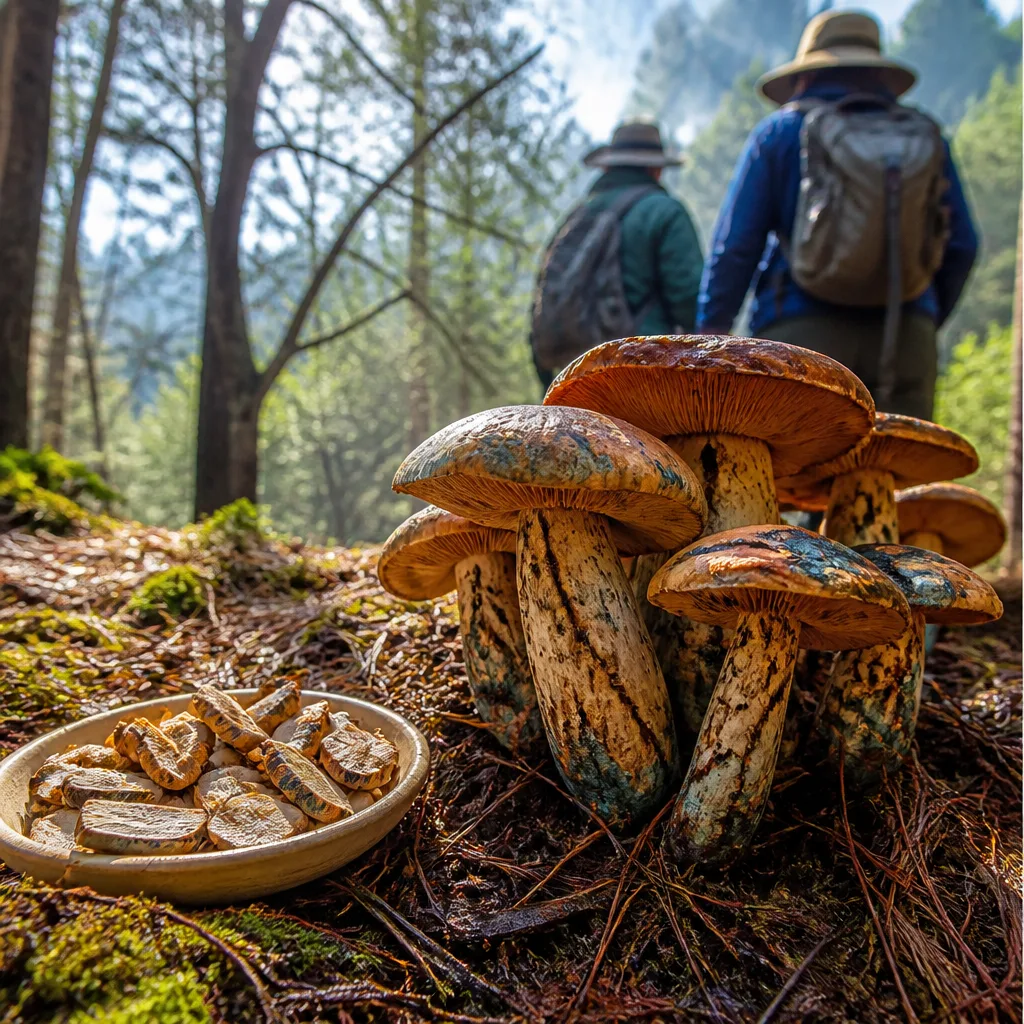
Every summer in China’s Yunnan province, doctors at a regional hospital treat hundreds of patients who describe the same extraordinary symptom: vivid hallucinations of tiny, human-like figures. The episodes cluster between June and August and are linked to consumption of a blue-staining mushroom now formally named Lanmaoa asiatica, commonly referred to locally as the ‘little people’ mushroom.
Pattern, timing and presentation
Clinicians report that affected people are often dizzy and disoriented yet show little abnormality in routine blood tests for liver and kidney function. The striking commonality is the content of the visions: sufferers consistently describe seeing miniature humanoid or fantastical creatures moving around them.
- Seasonality: cases occur in mushroom season, principally June to August.
- Geography: the mushroom grows in Yunnan, southwest China, and the Cordillera Region of the Philippines.
- Clinical picture: dizziness and disorientation with vivid lilliputian hallucinations despite largely normal standard blood tests.
How the mushroom was identified
Although accounts of these collective hallucinations go back decades, it was not until 2015 that researchers formally described the responsible fungus. Scientists purchased a specimen at a street market in Yunnan and used DNA sequencing to determine that it was a species previously unknown to science, which they named Lanmaoa asiatica. Genetic analysis indicated it is more closely related to the porcini family (Boletus edulis) than to recognised so-called ‘magic’ mushroom species.
What is known — and what remains unknown
Medical literature reviewed by investigators includes a study conducted over 30 years ago in which around 300 cases were analysed and the term lilliputian hallucination used to describe the phenomenon, referencing the tiny people of Gulliver’s Travels. The older paper emphasised the uniformity of patients’ reports.
“They saw them on their clothes when they were dressing and saw them on their dishes when eating,”
Despite the consistency of symptoms across many patients and the formal taxonomic identification of the fungus, subsequent chemical and pharmacological studies have so far been unable to isolate the psychoactive compound responsible for the hallucinations. Researchers have emphasised that the mushroom appears to produce its effects when eaten raw or undercooked — a common practice during mushroom season — but the precise mechanism remains unclear.
| Feature | Details |
|---|---|
| Species | Lanmaoa asiatica (described 2015) |
| Regions | Yunnan (China); Cordillera Region (Philippines) |
| Typical months | June–August |
| Reported cases | Hundreds annually; ~300 examined in a study over 30 years ago |
Context and consequences
The case of L. asiatica illustrates the limits of current knowledge in natural-product neuropharmacology: a fungus can provoke a highly reproducible hallucinatory syndrome while eluding identification of the active molecule. That has implications for public health advice in affected regions and for laboratory science. Until the causative agent is isolated and its pharmacology characterised, clinicians must rely on clinical history and regional epidemiology to link presentations to mushroom exposure.
For now, the practical message for foragers and consumers is cautious: traditional preparation methods matter, and undercooking or eating raw specimens has been associated with the syndrome. From a research perspective, L. asiatica presents an intriguing target for chemists and neuroscientists — a natural compound that produces a remarkably consistent change in perception, without clear markers on routine blood tests.
Further work will need to reconcile long-standing clinical observations with modern chemical analysis. Identifying the responsible compound would both explain the unusual symptom pattern and allow evidence-based guidance to protect communities who collect, sell and eat wild mushrooms.









