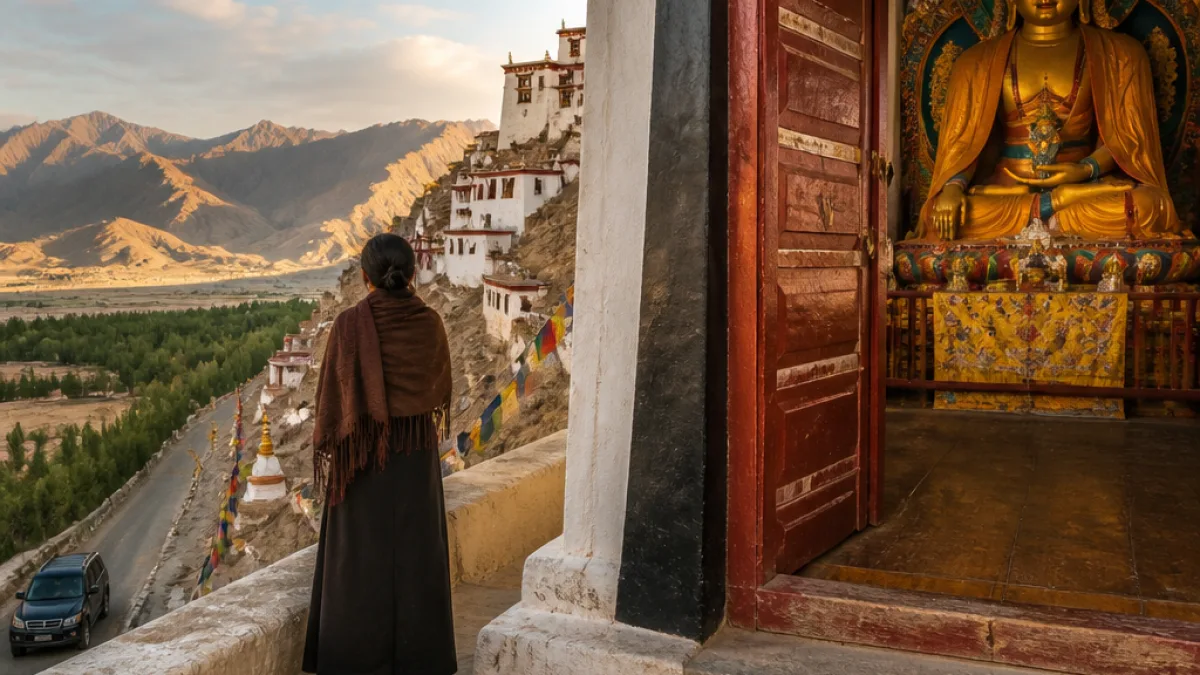
Leh, August 21: United States Ambassador to India Sergio Gor visited Thiksey Monastery on Friday, a prominent Buddhist centre about 19 kilometres from Leh, the Union Territory's main town. The visit formed part of a wider set of engagements in Jammu and Kashmir prior to his arrival in Ladakh.
Visit to a landmark monastery
Thiksey Monastery, perched on a hill above the Indus valley, is regarded as the largest monastery in central Ladakh and is often noted for its resemblance to the Potala Palace in Tibet. Founded in 1433, the complex houses ancient images, stupas, scroll paintings and wall murals. A prominent attraction at the site is the 15-metre-high statue of Maitreya Buddha, installed in the 1980s, and the monastery is known for its daily morning prayers and panoramic views of surrounding villages and the Indus River.
| Feature | Detail |
|---|---|
| Distance from Leh | 19 kilometres |
| Year founded | 1433 |
| Notable statue | 15-metre Maitreya Buddha (installed in 1980s) |
Diplomatic context and recent engagements
Ambassador Gor arrived in Leh on Thursday after a series of high-level meetings across the Kashmir Valley. The visit to Thiksey came against the backdrop of heightened strategic attention to the frontier region following the 2020 Galwan clashes and the subsequent prolonged border standoff with China.
Before travelling to Ladakh, Gor held talks in Srinagar and met regional stakeholders. On landing in Srinagar, he reiterated New Delhi’s claim over Jammu and Kashmir, describing the Union Territory as "an important part of India". Following a meeting with Chief Minister Omar Abdullah, Gor said their discussions were warm and optimistic about developing bilateral ties further.
"Kashmir is an important part of India. I am visiting the place for the first time. It is an incredibly beautiful place,"
"We had a very warm meeting and we look forward to building on our relationship,"
Those comments came alongside reporting that the encounter between the serving US ambassador and a sitting Jammu and Kashmir Chief Minister was the first such interaction in over 15 years, signalling a notable resumption of certain diplomatic contacts in the region.
Local reactions and significance
The ambassador’s presence in Leh, and specifically at a major religious and cultural site such as Thiksey, carries both symbolic and practical significance. Ladakh lies on a sensitive strategic frontier; visits by senior foreign diplomats are closely watched for signals about international attention to the region's security and development priorities.
While the visit itself was primarily cultural and observational in nature, it follows a pattern of increased diplomatic engagement in the greater Jammu and Kashmir–Ladakh theatre. The visit is likely to be interpreted locally as a reaffirmation of continued international interest in the area, alongside India's own administrative and infrastructural initiatives in the Union Territory.
What the visit does and does not indicate
- The trip was part of a broader set of engagements in Jammu and Kashmir rather than an isolated diplomatic mission focused solely on Ladakh.
- It included public remarks endorsing India's position on the Union Territory and conveyed a tone of optimism about bilateral ties.
- The visit does not, by itself, signify any immediate policy changes or new security arrangements; it is a diplomatic signal among many in a complex regional context.
Ambassador Gor's visit to Thiksey Monastery adds to a recent series of high-level movements by foreign envoys in the region and will be noted by local officials, religious institutions and security analysts as part of evolving diplomatic interactions with India in a strategically sensitive area.