Tech Mahindra has entered into a partnership with the I‑HUB Quantum Technology Foundation (I‑HUB QTF), hosted by the Indian Institute of Science Education and Research (IISER) Pune, to accelerate development of an indigenous trapped‑ion quantum computing platform, the company said.
Project scope and deliverables
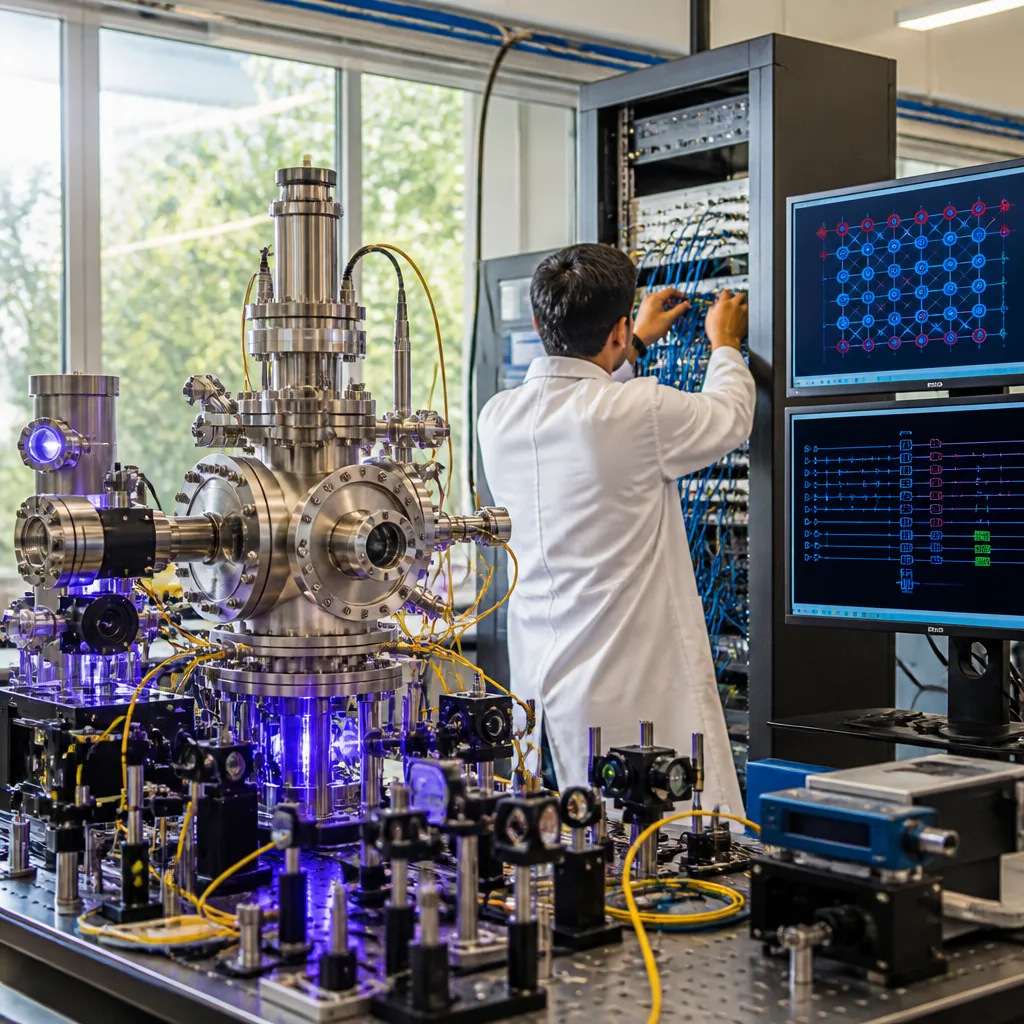
According to the announcement, I‑HUB QTF is developing a full‑stack 20‑qubit quantum computer based on the trapped‑ion architecture. Tech Mahindra will collaborate on the creation of the middleware layer — the software that links the quantum hardware and its control electronics — to enable efficient execution of quantum workloads and operational control of the system.
The partnership sets a target for technical completion by December 2026, with commercialisation activities expected to begin after that date, the companies said. The middleware will form a scalable software foundation for the trapped‑ion platform and is intended to make the facility usable by researchers, startups, students, enterprises and strategic sector innovators in India.
Why trapped‑ion and why middleware matters
Trapped‑ion quantum computers use charged atoms (ions) held in electromagnetic fields as quantum bits, or qubits. Middleware in this context is the control and orchestration software that translates high‑level quantum programmes into device‑level instructions and synchronises the control electronics with the qubits. Effective middleware is crucial to run quantum algorithms reliably and to bridge experimental hardware and user‑facing tools.
By supporting middleware development, Tech Mahindra said it will leverage its engineering and advanced technologies expertise to help build a scalable stack. The platform is intended to support research on algorithms, quantum machine learning (QML) and work related to post‑quantum cryptography (PQC), while also serving as a training environment for students and practitioners.
Potential applications and national context
The partners said the platform will help Indian users explore applications in areas such as drug discovery, logistics, cryptography and defence. The announcement frames the work as part of broader efforts to strengthen sovereign artificial intelligence capabilities by giving Indian researchers access to indigenous quantum infrastructure.
- 20 qubits — target capability of the trapped‑ion system.
- December 2026 — anticipated completion of the project.
- Post‑completion — commercialisation activities to make the platform available to users in research, industry and strategic sectors.
| Item | Detail |
|---|---|
| Hardware platform | Trapped‑ion quantum computer |
| Qubit count | 20 qubits |
| Software focus | Middleware between hardware and control electronics |
| Timeline | Completion by Dec 2026; commercialisation thereafter |
Implications and caveats
The collaboration signals an industry‑academia push to establish native quantum capability in India rather than relying solely on overseas providers. Local development can shorten feedback loops for researchers, improve data sovereignty and create a training ground for quantum engineers.
At the same time, a 20‑qubit machine sits at the small‑to‑medium end of current experimental quantum devices. Practical, large‑scale quantum advantage for most industrial problems remains an open technical challenge and typically requires many more qubits combined with error correction. The middleware and software choices made now will influence how easily the platform can scale or integrate with other quantum and classical computing resources.
Tech Mahindra said the partnership aims to accelerate access to the indigenous infrastructure for diverse Indian users and to catalyse application development. The companies positioned the work as complementary to efforts to use quantum computing to enhance AI and to support next‑generation enterprise applications.
The announcement did not provide detailed technical specifications of the trapped‑ion hardware or disclose funding amounts. Further milestones, access models for external users, and commercial pricing will likely be clarified as the project progresses toward its 2026 target.
For India’s technology ecosystem, the initiative is a step toward building local expertise in a field where hardware, control software and application stacks must be developed together to reach practical outcomes.