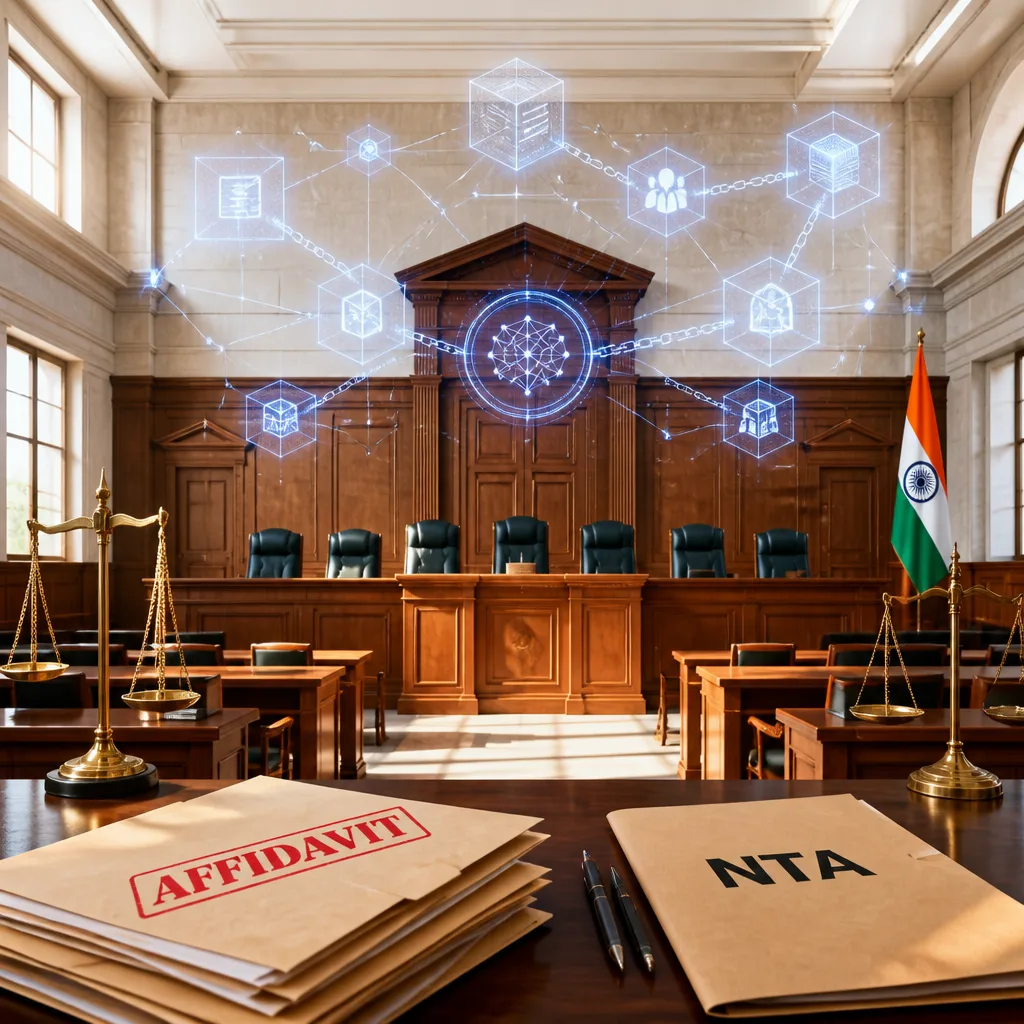
The Supreme Court on Wednesday asked the Centre to take concrete steps to "institutionalise" the National Testing Agency (NTA) and adopt technological measures to prevent future question-paper leaks in national entrance examinations.
Bench flags need for continuity, technology upgrades
A bench comprising Justices P.S. Narasimha and Alok Aradhe said the court was duty-bound to ensure the NTA functions as a "vibrant institution" and warned that without institutionalisation accumulated experience could be lost when senior officials are transferred. The observations were made during the resumed hearing of several petitions, including one by the Federation of All India Medical Association (FAIMA) seeking restructuring of the NTA.
"Our duty is to ensure that there is a vibrant institution that the country can be proud of. If you don't institutionalise, experienced people get transferred and the entire experience is lost. There are a lot of technological changes that have to be brought about," the bench said.
The court directed the Centre to file an affidavit indicating the progress made and the steps taken to implement the recommendations of two high‑level panels: the Radhakrishnan committee, set up after the 2024 NEET‑UG question paper leak, and the Nandan Nilekani committee, convened this year to suggest reforms for competitive examinations.
What the committees recommended
The bench noted that the Nandan Nilekani committee had suggested reforms involving AI and blockchain. For clarity, artificial intelligence (AI) refers to computer systems that perform tasks that normally require human intelligence, such as pattern detection; blockchain is a distributed ledger technology that creates tamper-evident records across multiple nodes.
| Committee | Context | Focus reported |
|---|---|---|
| Radhakrishnan committee | Set up after NEET‑UG 2024 paper leak | Strengthening exam conduct mechanisms |
| Nandan Nilekani committee | Constituted in 2024 to review competitive exam reforms | Recommended use of AI, blockchain and other reforms |
Implications for students and the testing ecosystem
If implemented, the measures could change how examinations are designed, delivered and monitored. The court's emphasis on institutionalisation is aimed at creating permanent capacity within the NTA for policy, operations and technology, rather than relying on ad hoc arrangements tied to personnel.
- Continuity: Institutionalisation would retain technical and administrative expertise despite routine transfers of officers.
- Technology adoption: Adoption of AI could assist in anomaly detection and automated monitoring; blockchain might provide tamper-evident records of question distribution and candidate data.
- Accountability: An affidavit from the Centre is expected to lay out concrete steps and timelines for implementing committee recommendations.
The bench specifically asked the Centre to file an affidavit setting out progress and steps taken to implement recommendations of the Radhakrishnan committee "as nuanced by" the Nilekani committee. The order underscores judicial concern about both governance and technical safeguards for high‑stakes examinations taken by millions of students.
Practical challenges and considerations
Introducing advanced technologies in the examination ecosystem carries both promise and challenges. AI systems need careful calibration and transparency to avoid false positives when flagging irregularities. Blockchain can create immutable logs but does not by itself prevent leaks if human actors collude before information is recorded on the ledger. Both technologies require investment in infrastructure, secure processes and skilled personnel within the NTA to operate and audit systems.
The court's demand for an affidavit will put pressure on the Centre to convert committee recommendations into detailed action plans, including resource allocation, timelines and governance measures. For candidates and educational institutions, clarity on how examinations will be made more secure and resilient will be crucial before the next cycle of national tests.
The hearing remains part of a broader judicial scrutiny following the 2024 NEET‑UG leak, and signals that courts expect not only technical fixes but structural reforms to ensure the integrity of national examinations.