
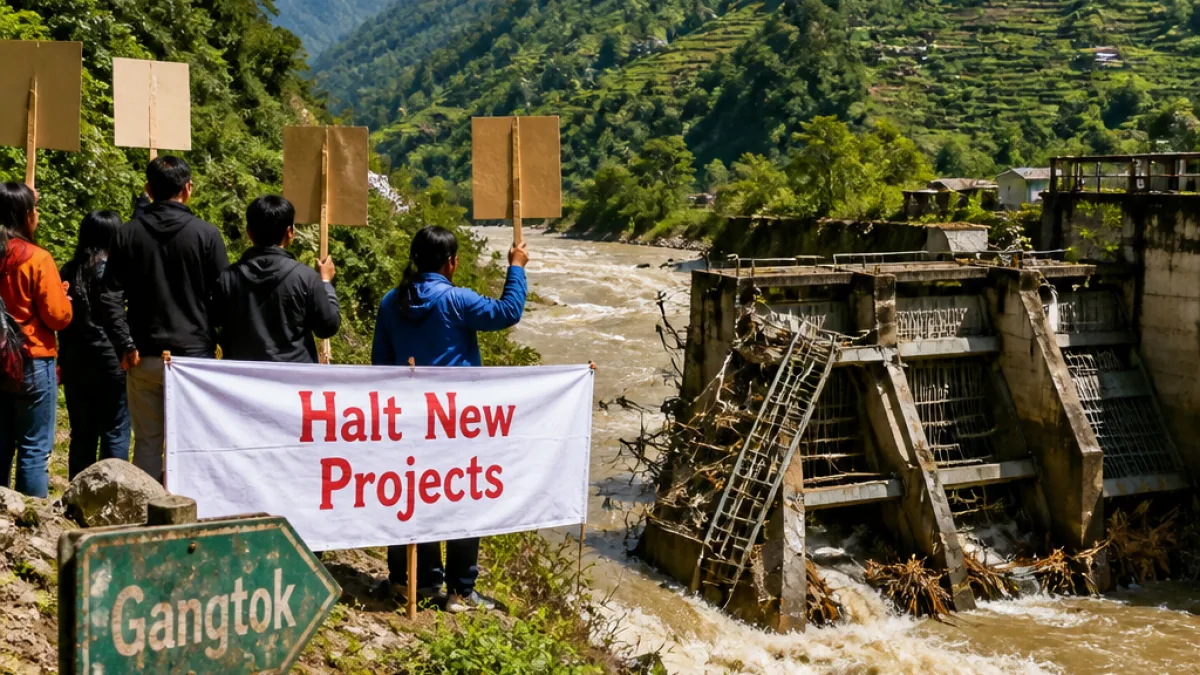
Gangtok: A Sikkim-based body representing the Bhutia and Lepcha communities has urged Prime Minister Narendra Modi to halt all new hydropower projects in the State and to order an independent, time-bound inquiry into existing and proposed schemes in the wake of devastating flash floods that hit neighbouring Nepal.
Call follows cross-border disaster that damaged power projects
The Sikkim Bhutia Lepcha Apex Committee (SIBLAC) said the Nepal disaster underlined the Himalayan region’s vulnerability and demanded a comprehensive reassessment of development activities on the State’s rivers. The appeal came after the Nepal Electricity Authority reported that at least 13 hydropower projects along the Bhotekoshi and Trishuli corridors suffered extensive damage when an earthquake-triggered avalanche of ice and rock in Tibet generated high-speed flash floods across the border.
The mudslide struck Tibet’s Gyirong port and surged into Nepal, washing away roads, inundating villages and damaging energy infrastructure. Among the plants affected was the 111-megawatt Rasuwagadhi hydropower plant in Nepal’s Rasuwa district, according to reports.
SIBLAC’s demands and rationale
SIBLAC convenor Tseten Taski Bhutia, who is also identified as chief advisor to the Sikkim unit of a national political party, expressed solidarity with those hit by the floods and urged the Centre to reassess hydropower policy in the Himalayan frontier.
“The disaster in Nepal highlights the vulnerability of the Himalayan region, requiring a fresh assessment of development activities,”
The committee asked the Union government to:
- Immediately stop approval of new hydropower projects in Sikkim;
- Order an independent, time-bound probe into the environmental, geological, seismic, social and national security implications of all existing and proposed projects in the State;
- Publish a white paper containing the findings of the assessment.
Mr Bhutia emphasised that SIBLAC was not opposed to development but warned that projects must not be pursued at the cost of the ecological and social security of India’s Himalayan frontier.
Local experience of hydropower-linked disasters
The committee’s plea drew on recent local experience. Sikkim has previously faced natural disasters linked, directly or indirectly, to hydropower works. Media reports cited the October 2023 glacial lake outburst flood in the State that destroyed the 1,200MW Teesta-III hydropower installation. SIBLAC and other local stakeholders argue such incidents demonstrate the need for a revised risk assessment framework that explicitly accounts for cascading hazards in high Himalayan environments.
Environmental experts and disaster managers note the Himalaya’s susceptibility to rapid-onset events — including avalanches, landslides, glacial lake outbursts and extreme rainfall — which can be amplified by infrastructure in fragile catchments. Proponents of hydropower counter that projects are essential for energy security and regional development, while insistence on stricter safeguards and monitoring has increased across the country.
What SIBLAC wants from the Centre
In its representation, SIBLAC recommended a multi-disciplinary probe covering:
- Environmental impact and cumulative ecological stress;
- Geological and seismic vulnerability assessments specific to Himalayan river corridors;
- Social impacts on local and indigenous communities; and
- National security implications of infrastructure in border districts.
| Item | Reported figure / detail |
|---|---|
| Hydropower projects damaged in Nepal | At least 13 |
| Noted affected plant | Rasuwagadhi — 111 MW |
| Reference Sikkim event | October 2023 glacial lake outburst affecting Teesta-III (1,200 MW) |
Implications and the way forward
Experts in mountain hydrology and disaster risk reduction say a formal, transparent reassessment — with published methodology and stakeholder consultations — would help balance developmental needs and safety. Such a process could identify measures to reduce exposure, including revised siting criteria, strengthened early-warning systems, and mandatory cascading-hazard analyses for projects in vulnerable catchments.
SIBLAC’s appeal places pressure on both the State and Union authorities to demonstrate that project approvals incorporate the latest scientific understanding of Himalayan hazards. Whether the Centre responds with a moratorium, an audit or new guidelines remains to be seen. For now, the committee has asked that any future decisions be deferred until the requested independent probe and white paper are completed and disclosed.
Officials at the Union Ministry of Power and the State government were not cited in the representation reported by the committee; no immediate comment from the ministries was available in the material reviewed.












