
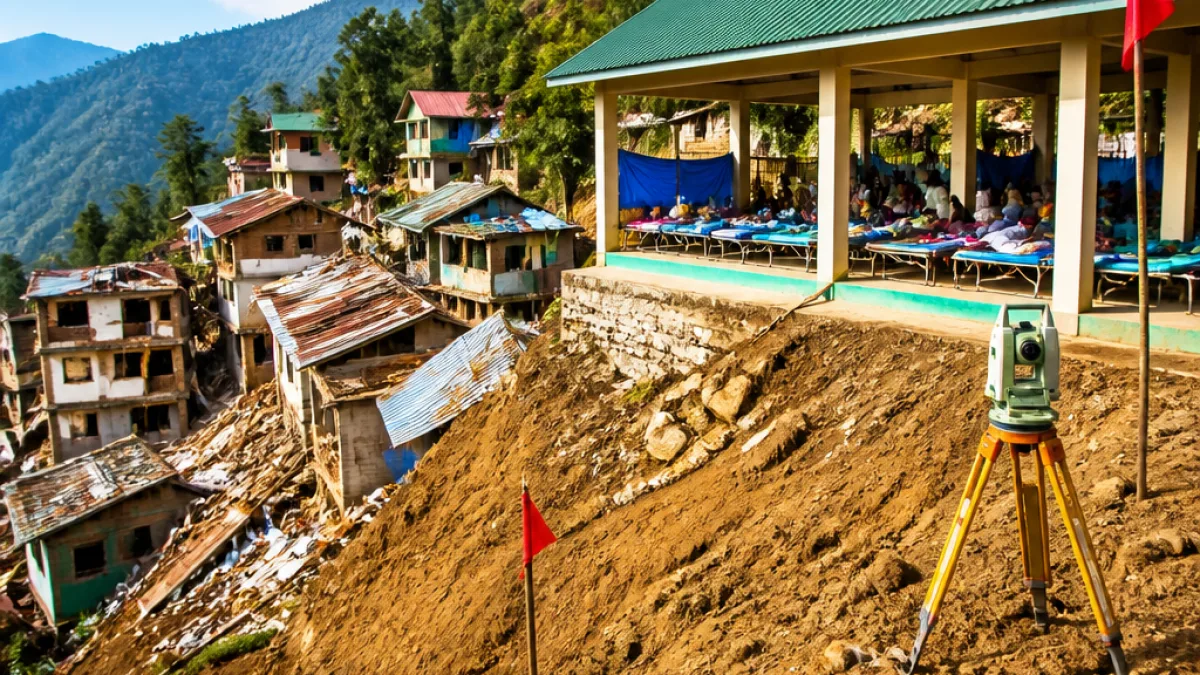
GANGTOK: The Sikkim government is weighing a formal declaration to label Rimbi village in West Sikkim as uninhabitable after a series of landslides and flash floods during the monsoon season damaged homes and infrastructure, officials said.
Extent of damage and displacement
State disaster authorities reported that at least 32 private houses and 4 government quarters suffered damage in the incidents, which began on August 13 and escalated with a heavy spell of rain the following day. Several small wooden and semi-pucca dwellings were destroyed and household effects were lost, according to the official assessment.
Sikkim Disaster Relief Commissioner Rinzing Chewang, who inspected Rimbi on September 25, said affected families have been moved to temporary accommodation. 107 people are currently housed at the Gram Prasasan Kendra relief camp, while residents of nine houses in the nearby Singlitam locality have been evacuated to another camp.
"Rimbi may be uninhabitable after the recurring landslide from Singlitam. We have shifted affected residents to the Gram Prasasan Kendra, with 107 people currently accommodated at the relief camp," said Chewang.
Survey and technical response planned
Officials said a multidisciplinary geological survey will be carried out after the monsoon season to determine the causes, extent of slope destabilisation and remedial options. The survey is intended to assess whether the settlement can be made safe or whether permanent relocation is required.
Authorities noted that the crisis has been building since mid-August, as steep slopes above the hamlet continued to move downhill. Even areas previously considered less vulnerable, including homes close to Mit Khola, have been affected by floodwaters carrying large quantities of mud and debris.
Relief, compensation and housing support
The state government has outlined immediate financial and housing support for affected families. Those whose houses have been completely destroyed will receive ₹1.3 lakh in relief. Additional compensation for other damage will be provided in accordance with existing norms.
Under the Sikkim Housing Scheme, policy provisions include land allocation and construction of a house for families who have lost land. Households who retain their land will be provided assistance for rebuilding homes.
Government stance and next steps
Chief Minister Prem Singh Tamang described the situation as serious and said the safety and welfare of residents remain the government’s top priority. He directed concerned departments to take necessary measures, officials said.
With the monsoon not yet fully withdrawn from the region and slope movements continuing in Singlitam, residents expressed fear that another heavy rainfall episode could trigger further damage. Authorities have kept evacuation and relief arrangements in place until the geological assessment is completed.
Local impact and precautionary guidance
Experts involved in landslide response typically advise avoiding reoccupation of visibly unstable slopes, maintaining clear drainage to reduce saturation, and restricting construction on steep gradients until stabilisation measures are implemented. Officials said these standard precautions will inform post-survey rehabilitation planning.
- Immediate relief: 107 people at Gram Prasasan Kendra relief camp; additional evacuees in Singlitam camp.
- Compensation: ₹1.3 lakh for fully destroyed houses; other aid as per norms.
- Technical action: Multidisciplinary geological survey planned after monsoon.
| Item | Count |
|---|---|
| Private houses damaged | 32 |
| Government quarters damaged | 4 |
| People in relief camp | 107 |
| Evacuated houses in Singlitam | 9 |
Officials said further decisions on declaring the area uninhabitable and on relocation sites will follow the geological survey and inter-departmental consultations. Until then, relief arrangements and monitoring of slope movement remain in force.
Residents and local institutions have been urged to cooperate with authorities during the assessment and to follow directives aimed at minimising loss of life and property as the monsoon recedes and technical teams prepare to evaluate long-term options for Rimbi and neighbouring settlements.












