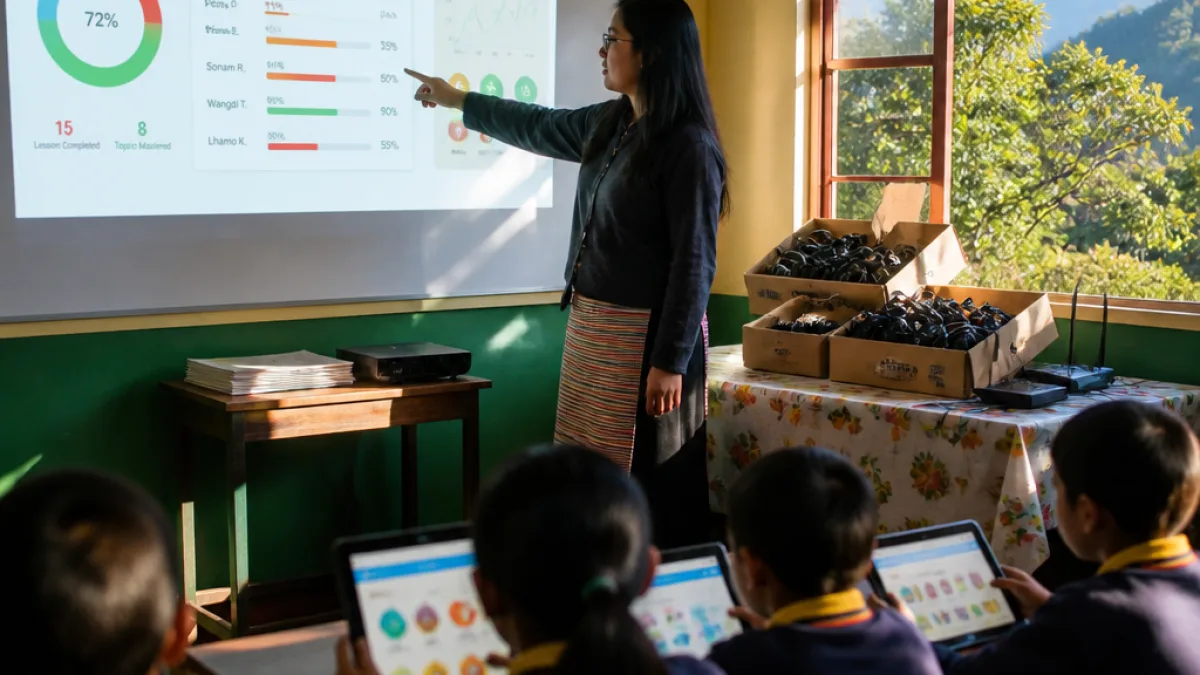
The Sikkim Education Department, in partnership with the EkStep Foundation, has begun a pilot programme that uses artificial intelligence to deliver daily, personalised learning practice to primary pupils in Gangtok district. Launched after a memorandum of understanding in April 2026, the initiative — called AI-FunZone — is currently being implemented in 71 government schools across the Khamdong, Nandok and Martam blocks and covers approximately 2,100 students of Classes III, IV and V.
What the pilot does
AI-FunZone delivers short, adaptive practice sessions in literacy and numeracy during the regular school day. Rather than a one-size-fits-all worksheet, the AI system analyses a learner’s responses and immediately adjusts subsequent activities to address specific gaps. For reading, the software can listen to a pupil and identify difficulties in decoding particular sounds; for mathematics, it flags particular error patterns and tailors follow-up exercises.
The practice is integrated as a part of the normal timetable in a dedicated 60-minute AI-FunZone class, not as an extra session. Students can record their answers, listen back and re-record as often as needed, which the Education Department says helps reduce the fear of making mistakes and supports repeated practice.
Role of teachers and monitoring
Officials emphasise that teachers remain central to the classroom. The technology is described as a facilitation tool: teachers guide activities, interpret dashboard data and provide in-person support where the AI indicates a learner needs help. A real-time dashboard gives teachers visibility into each pupil’s progress and highlights areas requiring additional classroom attention.
So far, the department reports a positive response from classroom teachers to the use of multimedia elements — graphics, audio and interactive formats — while pupils have reacted favourably to the play-way approach embedded in the programme.
Training and scale
Approximately 300 Resource Persons from the three pilot blocks have been trained to support classroom delivery and teacher facilitation, the Education Department said. The pilot will allow authorities to assess operational issues and learning outcomes before considering a scale-up to additional schools or grades.
| Parameter | Figure |
|---|---|
| Schools in pilot | 71 |
| Students covered | ~2,100 |
| Blocks | Khamdong, Nandok, Martam |
| Resource Persons trained | ~300 |
Challenges identified
While teachers and pupils have embraced the content, the pilot faces infrastructure constraints. The programme requires computers or tablets, headsets and high-speed internet; some standalone primary and junior high schools have reported shortages of these essentials. The Education Department and partner foundation will need to address hardware and connectivity shortfalls if further expansion is planned.
- Device needs: tablets or computers at the classroom level.
- Audio equipment: headsets to support listening and oral practice.
- Connectivity: reliable high-speed internet for real-time dashboards and adaptive content.
Intent and safeguards
The scheme has been designed to support foundational literacy and numeracy rather than to create competitive ranking among children: the programme does not produce class rankings or comparisons. Instead, it prioritises abundant practice and remedial support for learners who have fallen behind on basic skills.
Officials framed the pilot as an attempt to combine teacher expertise with adaptive technology to improve practice time for young learners. The immediate aim is to evaluate whether daily, short, personalised practice can accelerate acquisition of reading and arithmetic skills in the early grades.
Next steps and evaluation
The pilot’s outcomes — in terms of learning gains, teacher workload, infrastructure costs and operational challenges — will inform any decision on wider deployment. The training of Resource Persons and early classroom feedback will feed into an evaluation that the Education Department says will guide future policy on the use of AI tools in government schools.
If the pilot demonstrates measurable improvement in foundational skills and can be made cost-effective by addressing device and connectivity gaps, Sikkim may consider a phased expansion. For now, the project remains a controlled experiment focused on three blocks of Gangtok district.