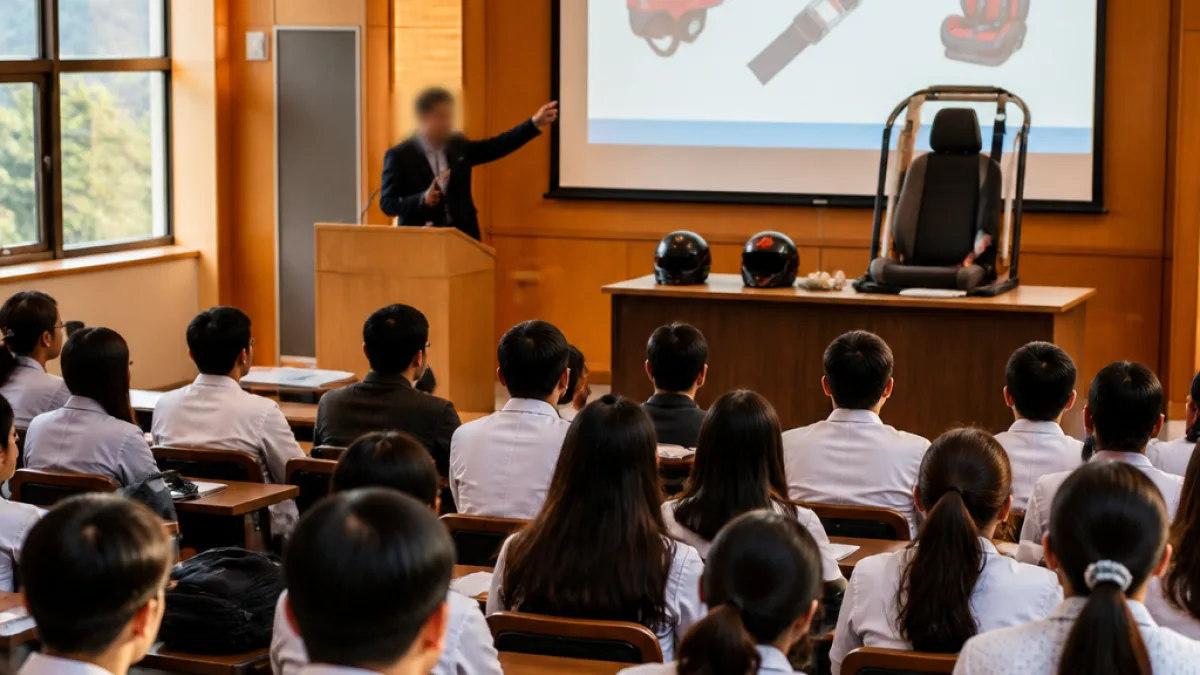
Gangtok: Padma Shri awardee and AIIMS Guwahati president Prof. Dr B K S Sanjay made a focused appeal for enhanced road‑safety education and enforcement during a visit to Sikkim, addressing students and faculty at the Sikkim Manipal Institute of Medical Sciences and the National Institute of Technology Sikkim.
Road safety framed as a public‑health and national responsibility
Describing road traffic accidents as a major public‑health concern and a matter of national responsibility, Dr Sanjay stressed adherence to traffic rules and practical preventive measures. According to the report, he emphasised the use of helmets and seat belts, and urged avoidance of speeding, distracted driving and driving under the influence of alcohol.
- Helmet and seat‑belt use: highlighted as primary life‑saving measures.
- Behavioural risks: warned against speeding, distracted driving and drunk driving.
- Education and enforcement: urged for stronger emphasis in curricula and stricter implementation of traffic laws.
During his interactions at both institutions, Dr Sanjay combined advocacy with academic outreach, engaging with medical and engineering students on the health, engineering and policy aspects of road safety. The visit linked clinical concerns around trauma care with preventive strategies aimed at reducing the burden of road injuries.
Engagements with state leadership and strategic visit
The delegation also met Sikkim Governor Om Prakash Mathur, where Dr Sanjay presented his book Bharat Mein Sadak Durghatnayen, co‑authored with Dr Gaurav Sanjay. The visit further included a stop at Nathu La Pass, where Army personnel briefed him on the pass's strategic significance, its Silk Route history and its role in the Kailash Mansarovar Yatra.
| Venue | Purpose |
|---|---|
| Sikkim Manipal Institute of Medical Sciences | Lecture and engagement on road‑safety as a public‑health issue |
| NIT Sikkim | Talk on road safety, engineering and prevention |
| Raj Bhavan (meeting) | Presentation of book to Governor Om Prakash Mathur |
| Nathu La Pass | Briefing by Army on strategic and historical aspects |
Officials at the institutions received the delegation, which tied together clinical perspectives from orthopaedics and spine surgery with preventive education. The visit was reported to have included discussions on how to reduce road trauma through both behavioural change and systemic measures.
Local implications and practical steps
The visit underscores a broader public‑health challenge for Sikkim and the region: reducing morbidity and mortality from road crashes requires coordinated action across health, transport, law enforcement and education sectors. Measures suggested by Dr Sanjay map onto internationally recognised best practices for road‑traffic injury prevention, including:
- Mandatory and enforced helmet and seat‑belt laws;
- Targeted road‑safety education in schools, colleges and driver training programmes;
- Improved post‑crash trauma care and referral linkages between primary, secondary and tertiary facilities;
- Strict enforcement of speed limits and laws against driving under the influence.
For students and residents, the practical guidance delivered during the campus events was straightforward: adopt protective gear, avoid risky driving behaviour, and support community and institutional efforts to promote safer roads.
The presentation of Bharat Mein Sadak Durghatnayen during the Raj Bhavan meeting placed the clinical and policy discussion in a wider national context, linking scholarly work on road accidents with on‑ground advocacy. The briefing at Nathu La added a strategic and historical dimension to the visit, situating the medical outreach within broader national service and awareness activities.
There was no immediate announcement of new state initiatives or funding commitments during the visit. However, the engagement with academic institutions and the Governor may prompt local planners and educators to consider integrating road‑safety modules into curricula and campus transport policies.
Dr Sanjay’s visit to Sikkim combined clinical credibility, public‑health messaging and interface with state leadership and defence personnel, reinforcing road safety as an interdisciplinary priority for the state.