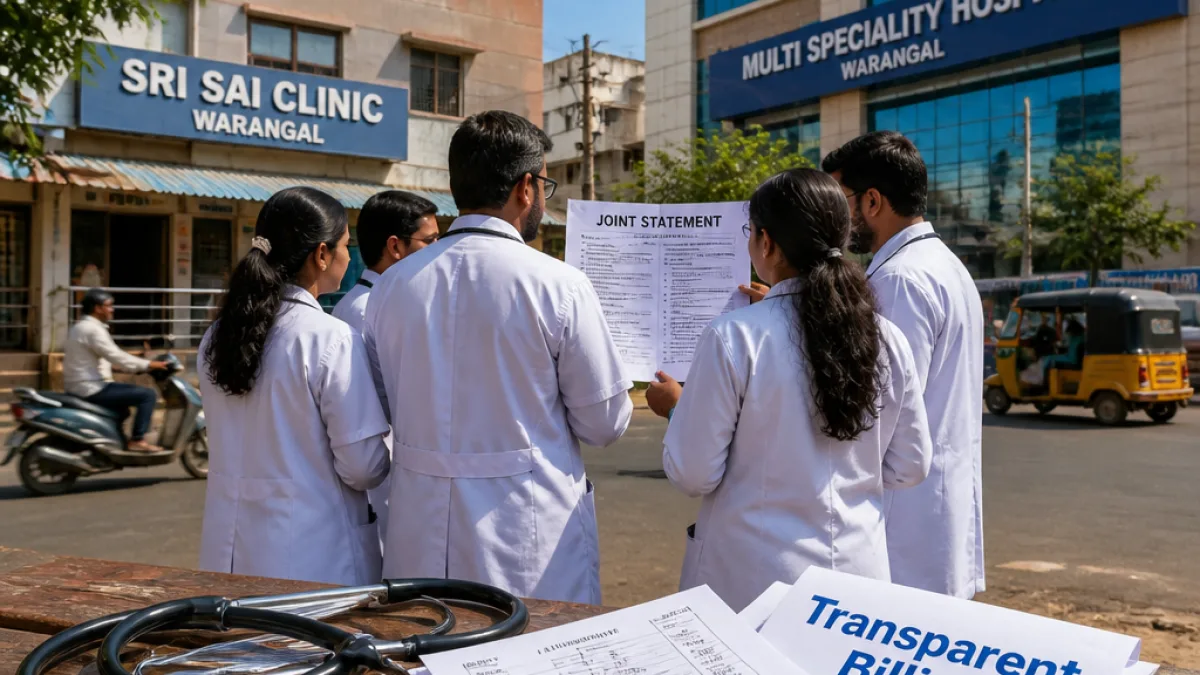
The Indian Medical Association (IMA), Warangal, and the Healthcare Reforms Doctors Association (HRDA), Telangana, have criticised recent public remarks that they said unfairly portrayed doctors and private hospitals as routinely overcharging patients for consultations and investigations. The associations urged balanced discussion, transparent billing and action only where evidence of malpractice exists.
Associations stress diversity of practice and costs
In a joint response, the IMA, Warangal, and HRDA said that practices of a few individuals or corporate hospitals should not be generalised to the entire medical fraternity. The groups acknowledged the need to safeguard patients from unnecessary tests and excessive billing, but cautioned that blanket statements could harm the reputation of doctors and undermine public trust.
HRDA president Dr Karthik Nagula emphasised that consultation fees varied considerably depending on several factors, including qualification, specialty, experience, location and the type of healthcare facility. He said not every practitioner charged the widely circulated consultation fee range and that investigations ordered depended on clinical necessity.
"Not every doctor charged ₹1,000–₹1,500 as consultation fee and not every patient presenting with fever was subjected to investigations costing ₹15,000–₹30,000," the HRDA president said, according to the associations' statement.
Operational costs and facility differences cited
The associations outlined that small and medium-sized hospitals operate with different cost structures compared with large corporate hospitals. They listed recurring expenditures that private facilities shoulder, including salaries for doctors and nursing staff, building rent, medical equipment maintenance, EMIs, electricity, biomedical waste management, fire safety, municipal and professional taxes and statutory compliances.
- IMA and HRDA stance: Support measures to prevent unnecessary investigations and irrational treatment where established.
- Concern raised: Generalising from a few cases could damage the medical profession's reputation.
- Call to action: Transparent billing, rational investigation protocols and informed consent.
When billing issues arise
Both bodies said any doctor or hospital found indulging in unethical or irrational practices should be subject to action based on evidence against the concerned individual or institution. They recommended strengthening primary and urban healthcare facilities to reduce unnecessary referrals and investigations.
The following table summarises the fee and investigation ranges cited in the associations' rebuttal and their stated considerations:
| Item | Range cited | Associations' comment |
|---|---|---|
| Consultation fee | ₹1,000–₹1,500 | Varies by qualification, specialty, experience and facility type |
| Investigation costs (for some reported cases) | ₹15,000–₹30,000 | Depends on clinical condition, comorbidities and severity |
Local patients and civic groups in Warangal have voiced concern in recent years about out-of-pocket healthcare expenditure, making this exchange particularly significant for the district. Experts and associations frequently call for patient education about informed consent and the clinical rationale for tests, along with stronger primary care to reduce unnecessary secondary referrals.
The IMA and HRDA reiterated that where unethical practices are established, regulatory and legal remedies should be applied. They urged policymakers and media commentators to distinguish between isolated malpractice and routine clinical practice when framing public debate on healthcare costs in Telangana.
The associations' statement did not propose specific price caps or statutory limits; instead, it focused on transparency, protocol-driven investigations and protection of patient interests without unfairly penalising medical professionals for legitimate clinical care.
Warangal residents who face billing disputes are advised to seek itemised bills, request clinical justification for investigations and use statutory consumer and health grievance mechanisms where necessary.