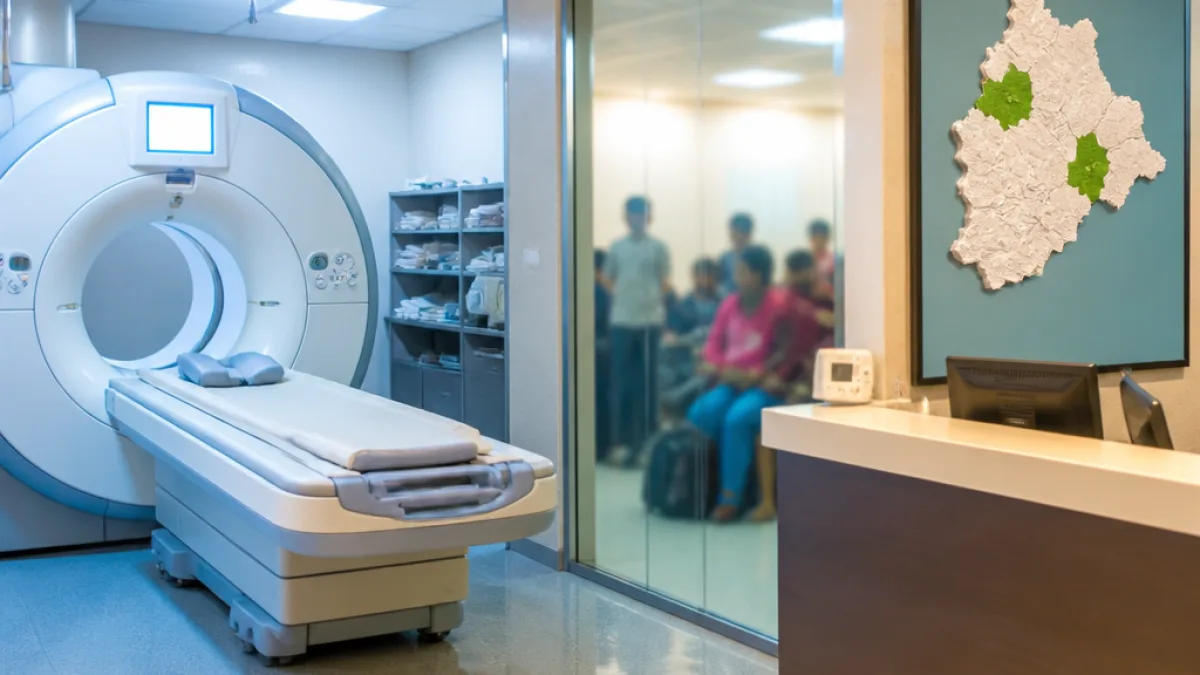
Hyderabad: Government hospitals in Telangana operate just nine MRI machines, the state health department told the Assembly, revealing a stark gap in diagnostic capacity across the state. With an estimated population of around 3.8 crore, the figure works out to roughly one government magnetic resonance imaging scanner for every 42 lakh people.
Concentration in four districts
The data presented in the Assembly showed the nine machines are spread across eight government institutions located in only four districts. Hyderabad accounts for the bulk of the capacity, with six MRI machines sited at Gandhi Hospital, Osmania General Hospital, NIMS, TIMS Sanathnagar and MNJ Institute of Oncology and Regional Cancer Centre. NIMS was recorded as having two machines. The other three machines are at MGM Hospital in Warangal, RIMS in Adilabad and the Government General Hospital in Jayashankar Bhupalpally.
The departmental figures also highlight that 29 of Telangana’s 33 districts do not have a single government MRI facility, leaving most districts dependent on private centres or referral to urban hospitals.
Planned additions offer limited immediate relief
Responding to the shortfall, the state has announced plans to add nine more MRI machines for government hospitals. The proposed placements include Nizamabad, Siddipet, Suryapet, Nalgonda and Mahabubnagar, while additional units were also proposed for Niloufer Hospital in Hyderabad, Gandhi Hospital and Osmania General Hospital.
Healthcare experts and doctors who reviewed the expansion welcomed the intent but cautioned that procurement of machines alone will not solve access problems.
- Nearly 50 per cent of sanctioned posts across the state health system are vacant, the Assembly data noted.
- Shortage of trained radiologists and MRI technicians could delay or limit the utilisation of new scanners.
- Logistics such as power supply, maintenance contracts and consumables also determine operational readiness.
Local impact and patient journeys
For patients in districts without a government MRI, diagnostic imaging can become a costly and time-consuming aspect of care. Many residents must travel to Hyderabad or other urban centres for an MRI, pay out of pocket at private imaging centres or face delays in diagnosis when scanners are overbooked. In conditions such as stroke, spinal injuries and oncology cases, timely MRI imaging is frequently critical to clinical decisions.
Public hospitals typically offer imaging at subsidised rates or free in some programmes, so the absence of government scanners increases out-of-pocket expenditure and may delay treatment for lower-income patients.
Operational challenges beyond machines
The health department’s disclosure in the Assembly underlined staff shortages as a major constraint. Even where machines are present, the lack of trained radiologists and MRI technologists can limit the number of scans performed daily. Maintenance and calibration of MRI units require technical contracts and uninterrupted power supply—factors that influence uptime.
Experts caution that without a parallel investment in human resources, training and infrastructure, new scanners risk being underused. They recommend a phased approach combining procurement with recruitment drives, in-service training for technicians, tele-radiology links for remote reporting and service-level agreements for maintenance.
| District / Institution | Number of MRI machines |
|---|---|
| Hyderabad (Gandhi, Osmania, NIMS, TIMS Sanathnagar, MNJ) | 6 (NIMS has 2) |
| Warangal (MGM Hospital) | 1 |
| Adilabad (RIMS) | 1 |
| Jayashankar Bhupalpally (Government General Hospital) | 1 |
State plans to install nine additional scanners were also outlined in the Assembly. The proposed allocations include:
- Nizamabad, Siddipet, Suryapet, Nalgonda and Mahabubnagar (one each).
- Additional units for Niloufer Hospital, Gandhi Hospital and Osmania General Hospital in Hyderabad.
What to watch next
Key metrics to monitor in coming months will be contract awards for the new MRI units, timelines for installation, recruitment of technical staff and the roll-out of tele-reporting where local radiologists are unavailable. Transparency on budget allocations, procurement timelines and projected operational dates will determine whether the announced expansion translates into improved access for patients across Telangana.
The figures were supplied by the state health department in the Legislative Assembly, according to the official data presented there.
Note: The disclosure underscores systemic gaps in public diagnostic services in a state where most MRI capacity remains concentrated in Hyderabad. Addressing both equipment and workforce deficits will be essential to broaden access to timely imaging care.