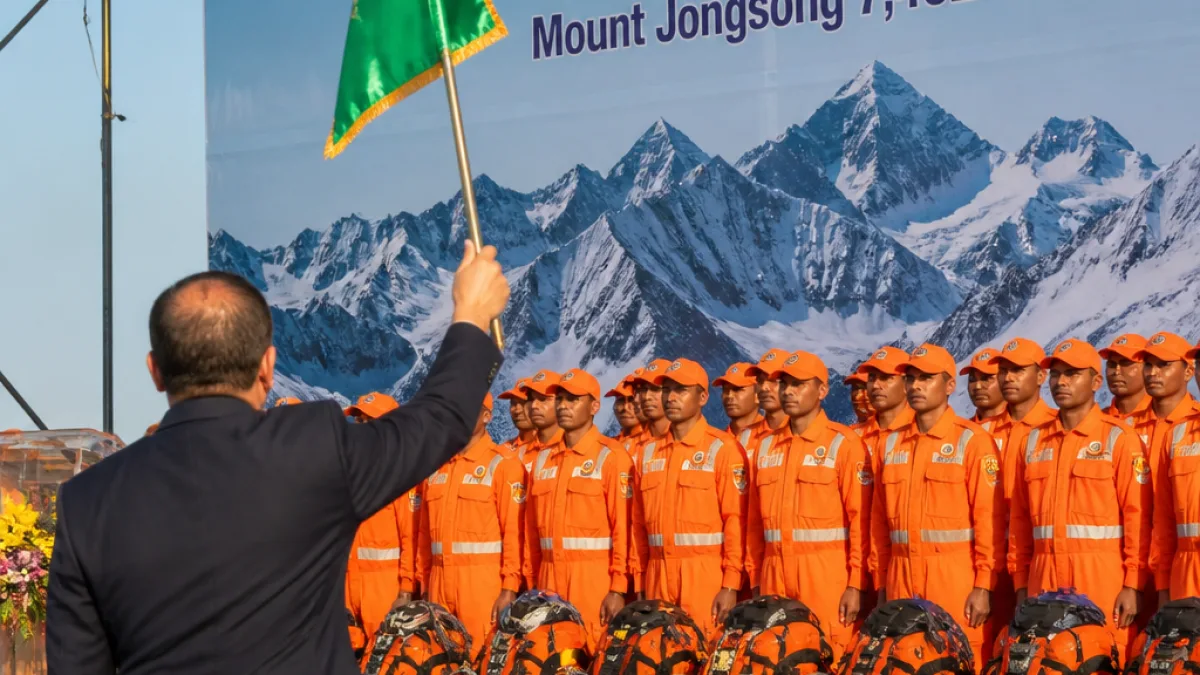
Kolkata: Sikkim Chief Minister Prem Singh Tamang on Friday flagged off the National Disaster Response Force's (NDRF) fourth mountaineering expedition, named "Shikhar", to Mount Jongsong, a 7,462-metre peak on the tri-junction of India, China and Nepal. The team of 41 members will conduct the operation from 4 September to 11 October, the NDRF said.
High-altitude exercise framed as operational preparedness
An NDRF official described the expedition as both a mountaineering challenge and a means to validate the force's readiness for rescue operations in extreme terrain.
"The expedition will be a challenging test of the team's mountaineering skills, operational preparedness, physical and mental endurance, courage, discipline, determination and team spirit," the official said.Chief Minister Tamang conveyed his best wishes to the team and underlined the importance of such high-altitude training in a state that has experienced multiple natural disasters.
During the flag-off, Tamang recalled the 2011 earthquake that struck Sikkim and the glacial lake outburst flood (GLOF) of 2023, citing the NDRF's role in rescue and relief operations in both crises. He also referenced a recent tunnel rescue operation to commend the professionalism and courage of NDRF personnel, and expressed confidence in continued coordination between the state government and the central rescue force.
Operational context and local implications
The expedition to Mount Jongsong combines technical mountaineering with rehearsals of search-and-rescue procedures in an area characterised by steep slopes, crevasses and unpredictable weather. For Sikkim, which has difficult topography and vulnerable settlements downstream of high-altitude glaciers and lakes, such exercises serve dual purposes: honing the NDRF's capabilities and strengthening state-centre coordination in disaster response.
Officials said the deployment will involve acclimatisation, route fixing, high-altitude medical preparedness and simulated rescue scenarios at progressively higher camps. The training is expected to yield operational lessons on logistics, communications and medical evacuation in remote mountain environments.
Expedition details
| Parameter | Detail |
|---|---|
| Expedition name | Shikhar (NDRF 4th mountaineering expedition) |
| Peak | Mount Jongsong (7,462 metres) |
| Team strength | 41 members |
| Duration | 4 September–11 October |
Why this matters for Sikkim residents
- Enhanced rescue capability: High-altitude training improves response time and techniques for mountain rescues.
- Community reassurance: Visible exercises aim to build public confidence after past disasters such as the 2011 earthquake and the 2023 GLOF.
- Inter-agency coordination: Joint planning with state authorities can sharpen evacuation and relief strategies for remote communities.
Tamang emphasised the history of cooperation between the Sikkim government and the NDRF and said this partnership would continue to minimise loss of lives and property during emergencies. He praised the dedication of NDRF personnel in reaching remote, high-altitude locations to render assistance during past incidents.
The NDRF has previously conducted mountaineering and high-altitude exercises as part of its preparedness cycle; officials view such expeditions as necessary to adapt standard operating procedures to the steep and glaciated terrain of the Himalaya, where avalanches, landslides and glacial lake breaches pose recurring threats.
No operational or security incidents were reported at the flag-off. The NDRF will provide further updates as the expedition progresses and as teams complete key stages such as summit attempts, medical drills and simulated evacuations.
Authorities have asked local communities and trekkers to follow advisories and avoid restricted high-altitude zones while the exercise is underway to ensure safety and clear access for rescue teams if required.