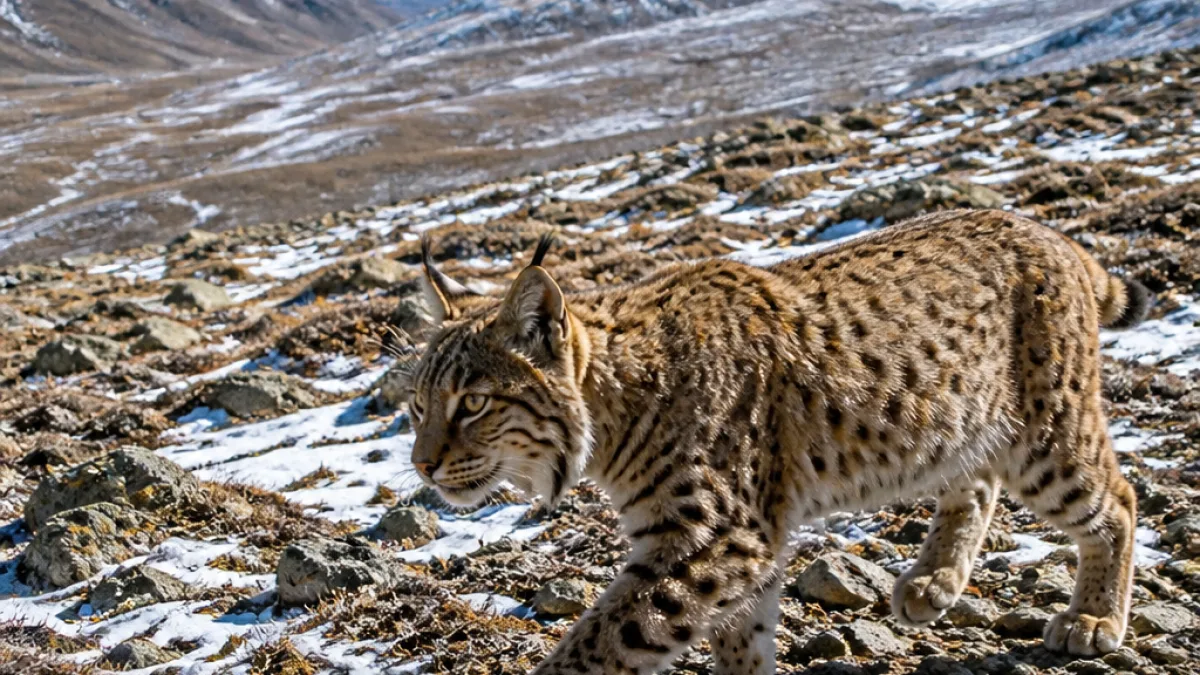
A camera trap has photographed a Eurasian lynx (Lynx lynx) on the Tso Lhamo plateau in Sikkim at an altitude of over 17,400 feet, providing the first confirmed photographic evidence of the species in the state, official records show.
Part of long-term monitoring effort
The image was captured in January 2026 in Mangan district during a long-term snow leopard and trans-Himalayan rangeland monitoring programme led by the Sikkim Forest Department in partnership with WWF-India. The programme deploys camera traps and other survey methods to track snow leopards and associated wildlife while assessing the ecological condition of high-altitude rangelands.
According to the Forest & Environment Department, the camera-trap photograph shows the lynx moving across a rocky, sparsely vegetated high-altitude slope on the plateau. The record follows a 2025 photographic documentation of a Eurasian lynx in Arunachal Pradesh and is the second such record from the Eastern Himalayas.
“It highlights the ecological significance of our high-altitude rangelands and reinforces our commitment to protecting these fragile ecosystems. The cooperation of the Lachen Dzumsa in facilitating access to these remote areas has been important to this work,” said Udai Gurung, Chief Conservator of Forests (Wildlife), Sikkim.
High-altitude rangelands as functioning ecosystems
Experts involved with the monitoring initiative say the Tso Lhamo plateau supports a range of cold-adapted carnivores and prey species, indicating a functioning predator–prey system rather than an ecological void. The area is also frequented by snow leopard, Pallas’s cat, Tibetan wolf, sand fox, argali, Tibetan gazelle and kiang, according to the programme documentation.
Conservationists argue that such records challenge perceptions of trans-Himalayan rangelands as barren cold deserts and instead point to their conservation value for both large carnivores and their prey.
Implications for conservation and management
The photographic record bolsters arguments for strengthened monitoring and protection of high-altitude habitats. Camera-trap evidence can inform policy decisions on grazing, local community access, tourism and anti-poaching measures in fragile rangeland ecosystems.
Officials credited the cooperation of local governance institutions in facilitating access to remote survey locations. The statement from the Forest & Environment Department highlighted the role of the Lachen Dzumsa, a traditional local self-governance body, in enabling the field teams to operate in these areas.
What the image shows
- Species: Eurasian lynx (Lynx lynx)
- Date of capture: January 2026
- Location: Tso Lhamo plateau, Mangan district, Sikkim
- Altitude: Over 17,400 feet
- Programme: Snow leopard and trans-Himalayan rangeland monitoring (Sikkim Forest Department & WWF-India)
| Aspect | Detail |
|---|---|
| Survey partners | Sikkim Forest Department and WWF-India |
| Notable associated species | Snow leopard, Pallas’s cat, Tibetan wolf, sand fox, argali, gazelle, kiang |
| Conservation significance | First confirmed photographic record of Eurasian lynx in Sikkim; second in Eastern Himalayas |
Context in the region
The new record comes a year after a photographic documentation of a Eurasian lynx in Arunachal Pradesh in 2025, also detected during joint surveys involving WWF-India and a state forest department. Together, these observations expand the known contemporary distribution of the species in the Eastern Himalayas and provide baseline data for future studies on range, population status and habitat connectivity.
Field biologists say sustained camera-trap monitoring across trans-Himalayan rangelands will be necessary to determine whether these are transient individuals dispersing from core ranges, or signs of resident populations. Such distinction has implications for targeted conservation actions.
Local stewardship and forward steps
Officials emphasised that continued collaboration with local communities and traditional governance bodies will be central to future monitoring and protection efforts. The Forest & Environment Department and WWF-India are expected to continue the monitoring programme and to analyse further camera-trap data to better understand species presence, movement patterns and habitat use on the plateau.
The Sikkim finding underlines the importance of evidence-based management of high-altitude rangelands and may inform state-level planning on biodiversity conservation, livestock grazing regimes and human-wildlife coexistence in fragile alpine ecosystems.