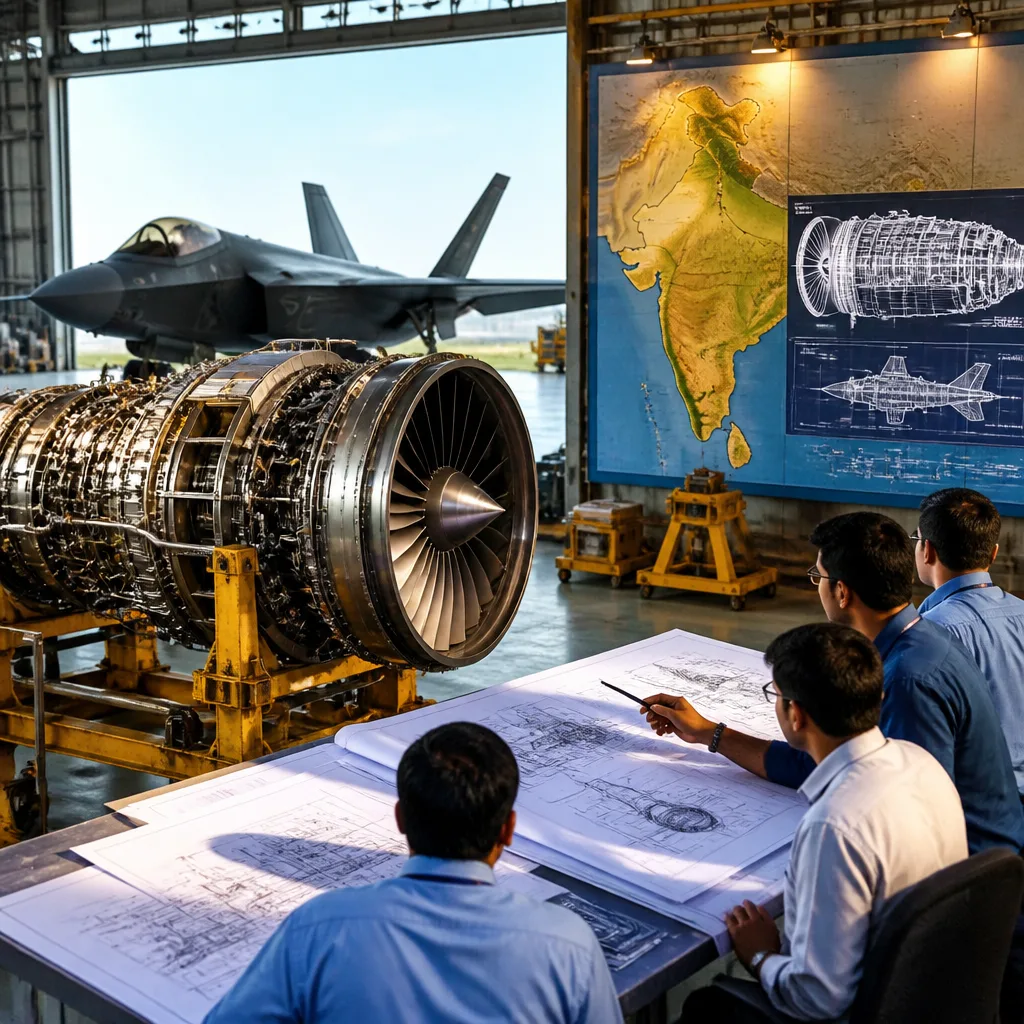
New Delhi: Reliance Industries Limited and British engine maker Rolls‑Royce have announced a strategic intent to partner on the design, development, manufacture and delivery of a sovereign combat engine for India’s Advanced Medium Combat Aircraft (AMCA) programme, according to media reports on Friday.
Partnership aims and national context
The two companies said the collaboration will focus on building indigenous capabilities in aircraft propulsion — an area India has prioritised as part of efforts to reduce dependence on foreign suppliers for critical defence systems. The proposed work includes exploration of a dedicated Aero Gas Turbine Complex in India that would act as a centre of excellence for power and propulsion technology.
Reliance and Rolls‑Royce described the move as aligning with the government’s push for self‑reliance in defence technology and the development of domestic engines to support the AMCA, a home‑grown fifth‑generation fighter project that requires a high‑thrust combat engine.
What each partner brings
Reports said the partnership intends to combine Rolls‑Royce’s expertise in advanced propulsion with Reliance’s manufacturing, technology and scale capabilities. Specifically, the partnership will explore design, development and manufacturing capacity in India, and the setting up of the proposed Aero Gas Turbine Complex to consolidate power and propulsion work.
“Our intent with Rolls‑Royce is to combine their world‑leading expertise in advanced propulsion with Relian…”
Media coverage also quoted Anant Ambani, Executive Director of Reliance Industries Limited, describing the firm’s strategic focus on building sovereign capability in critical technologies.
Potential implications and challenges
If realised, the collaboration could shorten the pathway for high‑performance aero‑engine development by combining foreign design expertise with local scale manufacturing — a model India has pursued across sectors to speed technology absorption. An in‑country aero gas turbine complex could also serve as a training and testing hub for engineers and suppliers who must meet stringent defence quality and reliability standards.
Yet building a combat‑rated engine remains one of the most technologically demanding tasks in defence manufacturing. It requires long‑term investment, specialised materials, precision manufacturing, rigorous testing facilities and an extensive supplier ecosystem. Previous Indian efforts to indigenise gas turbine and fighter‑class engines have faced technical and timeline challenges; collaboration with an established engine maker aims to mitigate some of those hurdles but does not remove them.
- Strategic intent: Joint development of an indigenous combat engine for AMCA.
- Infrastructure: Proposal to explore an Aero Gas Turbine Complex in India as a centre of excellence.
- Complementary strengths: Rolls‑Royce brings propulsion expertise; Reliance contributes manufacturing scale and execution capabilities.
What this means for Indian defence manufacturing
The announcement fits broader policy aims to nurture a domestic defence industrial base capable of designing and producing complex systems. A successful technology transfer and co‑development model would create opportunities for Indian suppliers, reduce import dependence and potentially support future export efforts. However, success will depend on detailed programme agreements, transfer of technical know‑how, a steady supply chain and long‑term commitments to testing and certification.
| Area | Role indicated |
|---|---|
| Design & development | Joint work leveraging Rolls‑Royce expertise |
| Manufacturing & scale | Reliance to provide manufacturing capability and execution |
| Testing & centre | Proposed Aero Gas Turbine Complex in India |
The reports emphasise that the announcement sets out a strategic intent rather than a finished contract or timeline. Detailed project plans, schedules, funding arrangements and technical roadmaps were not published in the immediate reports.
For India’s technology and defence ecosystem, the partnership marks a high‑profile attempt to combine international engineering know‑how with large domestic industrial capacity — a hybrid approach that policymakers and industry have favoured to accelerate complex capability development.