
Gadchiroli, Aug 28: A 26-year-old pregnant woman in labour was carried on a foldable stretcher by villagers across a water body in Maharashtra’s Gadchiroli district after floodwaters and the absence of a bridge prevented an ambulance from reaching the hamlet, the district health department said on Friday.
Health officials say response was timely
According to a press release issued by the district health administration and reported by PTI, the woman, identified as a resident of Koindul village in Etapalli taluka, went into labour on Friday morning. The department said the local ASHA was informed at 7:40 am, who immediately notified the auxiliary nurse midwife. An ambulance was dispatched at 8:00 am, but could not proceed further as heavy inundation had blocked the route.
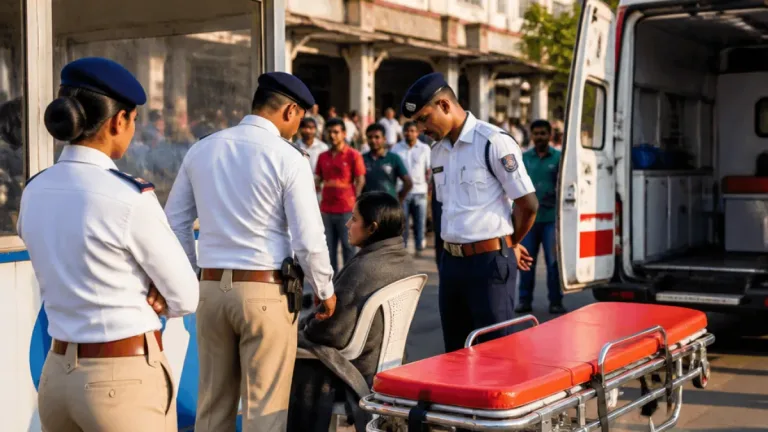
The health department said the ambulance halted near the flooded area at 8:30 am. With assistance from villagers and health staff, the patient was carried on a foldable stretcher and loaded into the vehicle at 9:00 am. She was admitted to the Kasansur Primary Health Centre at 9:30 am, where a doctor found her haemoglobin to be critically low. Given the high‑risk condition, she was referred at 11:30 am and admitted to LKAM Hospital in Hedri for advanced care.
| Time | Event |
|---|---|
| 7:40 am | ASHA notified of labour pains |
| 8:00 am | Ambulance dispatched |
| 8:30 am | Ambulance stopped due to inundation |
| 9:00 am | Patient carried on stretcher and loaded into ambulance |
| 9:30 am | Admitted to Kasansur PHC |
| 11:30 am | Referred to and admitted at LKAM Hospital, Hedri |
Context: geography, infrastructure and maternal health risk
Gadchiroli is a district with challenging terrain and many remote habitations that lack all‑weather road connectivity. The incident underlines perennial infrastructural bottlenecks that complicate emergency medical transport during the monsoon season, when rivers and drains swell and bridges or causeways may be impassable.
- Key risk: delayed access to definitive obstetric care can increase maternal and neonatal morbidity and mortality.
- Local mitigation: ASHA workers and auxiliary nurse midwives are often first responders in remote communities.
- System pressures: ambulances and referral facilities may be available but rendered ineffective by poor last‑mile connectivity.
The health department emphasised that despite the severe infrastructural bottlenecks and geographical isolation, the coordination between community health workers, ambulance staff and local residents ensured the patient reached care and was referred for higher management when needed.
Policy implications and health system response
Health experts and policy documents — including guidance from the Union Ministry of Health and Family Welfare and the National Health Mission — advocate for strengthened emergency transport systems, contingency plans for monsoon disruptions and shore‑up of community‑level obstetric services in tribal and remote areas. This episode reiterates the need for:
- improved all‑season road and bridge connectivity to reach isolated habitations;
- prepositioning of emergency transport alternatives such as boat ambulances where waterways are common;
- regular training, supplies and support for ASHAs and auxiliary nurse midwives to manage high‑risk pregnancies until referral.
Such measures are part of ongoing national and state health programmes, but implementation varies across districts, especially in difficult terrain and forested tracts.
The district health office provided the timeline and clinical details in its press release to counter widely circulated videos and reports showing villagers carrying the woman across the water. The administration said the patient was stabilised at the PHC and promptly referred for advanced care.
Readers are reminded that while community action can save lives in emergencies, structural and systemic solutions remain essential to ensure safe, timely care. For individual medical concerns, consult a qualified doctor or your nearest health facility.